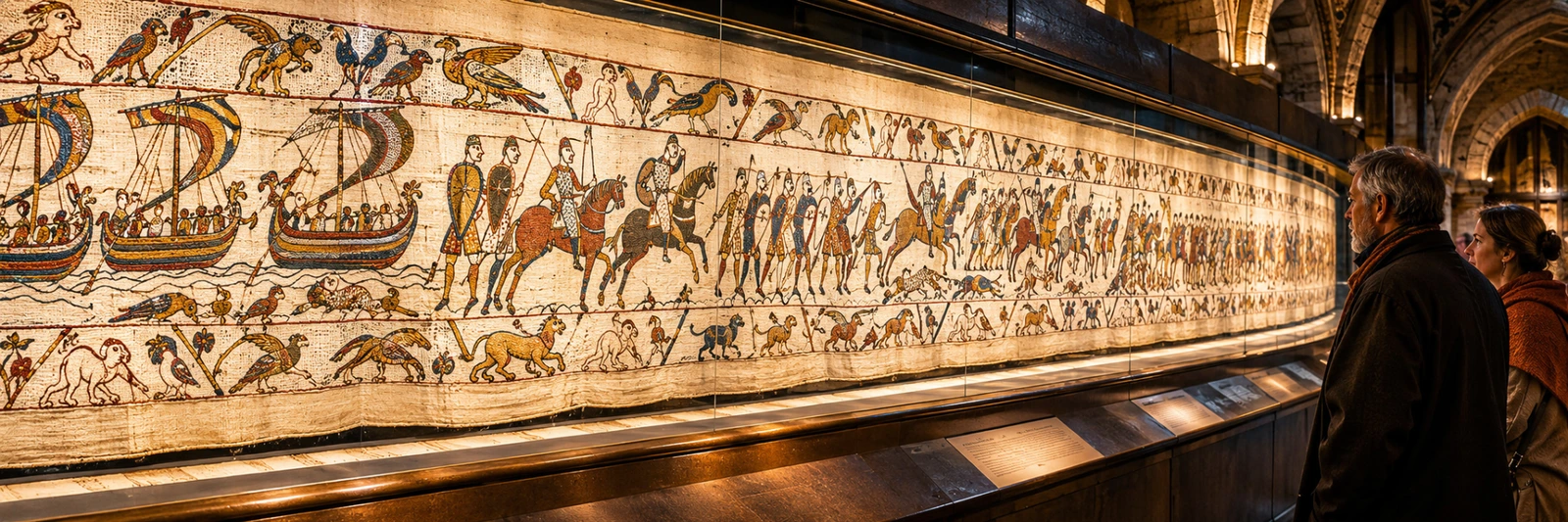
Look beyond the kings, knights and battles of the Bayeux Tapestry and you will discover naked figures, mythical beasts, mischievous animals and ancient fables. What were medieval embroiderers trying to tell us?
A Very Strange World Hiding in Plain Sight
Most people know the Bayeux Tapestry for one thing: the Norman Conquest of England in 1066.
It is the famous medieval embroidery showing William the Conqueror, King Harold, armies marching, ships sailing across the Channel and the bloody Battle of Hastings.
But look a little closer.
Above and below this great historical drama, something rather peculiar is happening.
Naked men strike improbable poses. Birds confront other birds. Foxes appear alongside their unsuspecting victims. Lions, griffins and strange hybrid creatures inhabit a world of their own.
Some figures seem comical. Others are unsettling. A few appear to have absolutely nothing to do with the invasion of England.
It is as though someone decided that the most important political event of the eleventh century needed a generous helping of medieval absurdity.
Yet these strange additions were not necessarily random decoration.
They may have provided a second story running alongside the first: a commentary on ambition, dishonesty, power, morality and the foolishness of human beings.
And in some cases, the animals may have had more to say about the Norman Conquest than the soldiers themselves.
First, It Isn't Actually a Tapestry
Before examining its peculiar inhabitants, there is a small historical misunderstanding to clear up.
The Bayeux Tapestry is not technically a tapestry at all.
A true tapestry is woven, with its design formed as the fabric is made. The Bayeux Tapestry is an embroidery: coloured woollen threads stitched onto a linen background.
It was probably produced in England during the late eleventh century, perhaps within a few decades of the events it depicts.
The surviving work measures approximately 68.5 metres long but only about half a metre high.
That makes it an extraordinarily long, narrow picture story.
Its main narrative occupies the central strip. Above and below are two decorative borders, each roughly seven centimetres deep.
And it is within these narrow margins that much of the strangeness begins.
According to the Bayeux Museum, the embroidery contains approximately 1,500 designs, including hundreds of human figures and animals.
The creatures are not merely scattered across the fabric. They occupy carefully arranged spaces, sometimes interacting with one another and sometimes appearing to respond to the human drama unfolding beside them.
The borders are almost a parallel universe.
Why Are There Naked People in the Borders?
Perhaps the most surprising figures are the naked humans.
Among the animals and decorative motifs appear unclothed men, sometimes with conspicuous anatomical details.
To modern eyes, their presence seems almost absurd.
Why would a work associated with the conquest of a Christian kingdom include such figures?
The first thing to understand is that medieval attitudes towards nudity were not identical to our own.
Nakedness could represent innocence, vulnerability, shame, sexuality, punishment, spiritual exposure or simply the human body itself.
Medieval artists regularly depicted unclothed people in religious manuscripts, church sculpture and other visual settings.
Adam and Eve, the damned at the Last Judgement, sinners, monsters and comic figures might all appear without clothing.
Nudity was not automatically treated as something that had to be hidden from every public image.
But that does not tell us precisely why particular figures appear in the Bayeux Tapestry.
Some scholars have suggested that certain marginal figures might be connected with the moral character of people depicted nearby. Others have explored possible references to sexuality, scandal or transgression.
These suggestions are interesting, but they are not established facts.
There is no surviving eleventh-century explanation telling us exactly what the embroiderers intended.
It is therefore misleading to claim that every naked figure represents a particular sin, person or political accusation.
What we can say is that the figures belong to a wider medieval visual culture in which humour, bodily exaggeration and moral commentary could coexist with serious historical or religious subjects.
The medieval imagination was often considerably less solemn than we might expect.
The Fox, the Crow and the Politics of Deception
One of the most revealing discoveries in the borders is the presence of scenes associated with Aesop's fables.
These ancient animal stories were widely known in medieval Europe.
They were entertaining, but they also carried lessons about human behaviour.
One of the fables represented in the Bayeux Tapestry is The Fox and the Crow.
In the familiar story, a crow possesses a piece of cheese.
A cunning fox flatters the bird, praising its appearance and encouraging it to sing.
The crow opens its beak, drops the cheese and loses its prize to the fox.
The lesson concerns vanity, flattery and deception.
Now consider the main subject of the embroidery.
Harold and William are competing over the English crown. Promises, political obligations, competing claims and accusations of betrayal dominate the narrative.
Could the fox and crow be commenting on those events?
Possibly.
A viewer familiar with the fable might recognise parallels between the foolish crow, the calculating fox and the powerful men attempting to secure England's throne.
But which historical figure is supposed to be the fox?
And who is the crow?
That is where the interpretation becomes complicated.
The animals may support the political message of the main embroidery. Alternatively, they may invite a more ironic reading in which both sides appear ambitious, calculating or morally compromised.
Historian Stephen D. White has explored how the fables might provide satirical commentary on the world of kings, lords and warriors.
This is a particularly intriguing possibility.
While the main story presents great men struggling for power, the little animals beneath them may be reminding viewers that great men are not necessarily wise men.
A Medieval World Full of Monsters
Not every animal in the Bayeux Tapestry is familiar.
Alongside recognisable birds, dogs, deer and lions are creatures belonging to the world of medieval imagination.
The Bayeux Museum identifies fantastic animals including griffins and centaurs.
A griffin combines features traditionally associated with an eagle and a lion.
A centaur has the upper body of a human and the body of a horse.
Such creatures were well established in medieval art long before the embroidery was produced.
They appeared in manuscripts, carvings and other decorative traditions.
Their presence does not mean that eleventh-century embroiderers necessarily believed they had personally encountered such animals.
Medieval artists inherited an enormous collection of stories, symbols and visual conventions from classical antiquity, Christian teaching and earlier artistic traditions.
The boundary between natural history and imaginative literature was not always drawn where we would draw it today.
Animals could represent virtues and vices, convey religious ideas, or simply provide striking imagery.
A lion might suggest strength or authority in one context, while appearing as an ordinary decorative animal in another.
A fantastic beast might carry a symbolic meaning, but it could also have been copied from an existing artistic model.
Research by W. Brunsdon Yapp has explored the animals in the Bayeux Tapestry and their possible connections with earlier visual traditions, including bestiaries.
The important point is that there is no reliable universal dictionary that allows us to translate every embroidered creature into a single fixed meaning.
Sometimes a monster is symbolic.
Sometimes it is decorative.
And sometimes we simply do not know.
Were the Animals Secretly Mocking the Conquerors?
This is where the borders become especially interesting.
The central narrative is often understood as broadly favourable to William's claim to the English throne.
Harold's conduct, particularly his relationship with William and the question of an oath, plays an important role in that presentation.
Yet the border images do not always appear to offer straightforward praise of anyone.
Animals trick one another. Predators pursue prey. Some scenes suggest folly or conflict.
Historian Daniel Terkla has argued that the marginal imagery can interact with the main narrative, contributing to its political message.
Other interpretations place greater emphasis on irony and satire.
In this reading, the animals are not simply cheering for the victorious Normans.
They are offering a wider commentary on the dangerous behaviour of powerful people.
A fox deceiving a crow is not necessarily a portrait of one particular nobleman.
It might instead be a warning about the kind of conduct that produces conflict in the first place.
The distinction matters.
It would be tempting to declare that the embroidery contains a secret anti-Norman message hidden by rebellious English needleworkers.
That would make an excellent story.
Unfortunately, there is insufficient evidence to present it as historical fact.
The identities of the individual makers remain unknown, and we cannot demonstrate that the borders were deliberately designed to undermine the central narrative.
Nevertheless, the possibility of a complex relationship between the borders and the conquest story is a serious subject of scholarly investigation.
The images may be doing considerably more than filling empty space.
Even the Birds Might Be Watching
One particularly fascinating line of research concerns the birds.
They appear throughout the borders in different shapes, colours and positions.
Some stand in pairs. Others turn towards neighbouring figures or appear to direct their attention towards the central action.
Medieval textile specialist Gale R. Owen-Crocker has examined the birds in detail, including their possible identities and their relationship with the narrative.
Her research raises the possibility that some birds function almost like an audience.
They may appear to observe, respond to or comment upon events involving the human characters.
Imagine the effect.
In the centre, kings make decisions that will change England forever.
Above them, a bird seems to look on.
Below them, an animal fable warns about deception.
The result is a visual composition in which the viewer is encouraged to move repeatedly between the main story and its margins.
The embroidery becomes something more complex than a simple illustrated chronicle.
It becomes a work in which different layers of imagery may speak to one another.
Of course, not every bird needs to be interpreted as a political commentator.
Some may have been included for balance, rhythm or visual variety.
But the possibility that the margins participate in the storytelling is difficult to ignore.
When the Borders Become a Battlefield
There is another extraordinary detail.
As the embroidery reaches the Battle of Hastings, the lower border begins to change.
Earlier sections contain animals, decorative forms and small independent scenes.
But during the fighting, the lower margin increasingly becomes occupied by the consequences of war.
Fallen soldiers and dead horses appear beneath the main battle.
The violence has effectively spilled out of the central narrative.
The boundary between the great historical event and its decorative surroundings begins to break down.
This is one of the clearest examples of the borders performing a storytelling function.
They are no longer merely framing the action.
They are extending it.
A viewer following the battle encounters not only armed men in combat but also the bodies left behind.
It is a powerful visual device, and one that feels remarkably sophisticated for an embroidery made nearly a thousand years ago.
The border that previously accommodated strange beasts and animal stories has become a place for human death.
Whatever the original meaning of every fox, bird or naked figure, this transformation demonstrates that the margins were capable of carrying narrative significance.
Who Actually Designed All This?
Another mystery concerns the people responsible.
The Bayeux Tapestry is generally thought to have been made in England, with Canterbury frequently proposed as a possible centre of production.
Its patronage is often associated with Bishop Odo of Bayeux, William the Conqueror's half-brother, although the details of its commission remain debated.
The individual designer or designers are unknown.
So are the names of the embroiderers.
That uncertainty leaves us with an intriguing possibility.
The people responsible for stitching a celebration of the Norman Conquest may themselves have belonged to the society that had been conquered.
But we should be careful not to imagine a known group of English women secretly inserting political jokes into their work.
The evidence does not identify the makers in that way.
What survives is the extraordinary achievement of skilled medieval craftspeople working with linen, wool, colour and an ambitious visual design.
They created hundreds of figures, carefully arranged scenes and an extended narrative whose smaller details still generate debate.
The strange animals and human figures were part of that achievement.
They deserve to be examined as seriously as the kings and soldiers.
So Why Are There Naked People and Strange Creatures?
The most convincing answer is also the least sensational.
There was probably no single reason.
Some creatures belonged to familiar decorative traditions.
Some scenes illustrated moral fables.
Some figures may have carried symbolic or humorous meanings.
Others appear to interact with the central historical narrative, while a few remain almost impossible to interpret with confidence.
The borders may combine entertainment, ornament, moral instruction, political commentary and visual storytelling.
That mixture is not necessarily contradictory.
Medieval audiences were accustomed to images operating on several levels at once.
A fox could be an amusing animal, a character in a well-known story and a reminder of the dangers of deceit.
A naked figure could be comic, shameful, symbolic or simply part of an inherited artistic convention.
A fantastic beast could evoke an imaginative world without requiring a precise political interpretation.
And an apparently decorative border could suddenly become an extension of a battlefield.
Perhaps the greatest mistake is to assume that medieval people divided serious history and playful imagery as neatly as we often do today.
For them, the strange and the solemn could inhabit the same piece of cloth.
The Real Mystery Is What We Have Forgotten How to Read
Nearly a thousand years after its creation, the Bayeux Tapestry remains one of the most remarkable visual records of medieval Europe.
We can identify its ships, weapons, buildings and many of its historical characters.
We can follow its account of the Norman Conquest and recognise familiar moments from 1066.
But the smaller images remind us how much of the medieval world remains difficult to recover.
The original viewers may have recognised jokes, stories, allusions or visual conventions that are now obscure.
Some figures may have been immediately understandable to people familiar with contemporary customs or popular tales.
Others may have been ambiguous even then.
We cannot know for certain.
And that is what makes the borders so fascinating.
The embroidery tells us a famous story about the conquest of England.
But around its edges, another world survives: one populated by cunning foxes, foolish birds, impossible creatures and naked human beings.
The kings and warriors occupy the centre.
Yet the margins may have something equally important to say about them.
Sometimes the strangest part of history is not what people chose to remember, but what they left hiding around the edges.
Evidence and Historical Notes
Well supported
- The Bayeux Tapestry is an eleventh-century embroidery rather than a woven tapestry.
- Its upper and lower borders contain real and imaginary animals, human figures and scenes associated with Aesop's fables.
- The Fox and the Crow is among the identifiable fables.
- The lower border incorporates fallen soldiers and horses during the battle sequence.
- Scholars have studied the borders as potentially meaningful elements of the overall narrative.
Interpretations still debated
- Whether particular naked figures represent sexuality, scandal, shame or political criticism.
- Whether specific animals correspond to Harold, William or other historical individuals.
- Whether the fables reinforce the conquest narrative, satirise its protagonists or serve several purposes simultaneously.
- How much of the marginal imagery is symbolic rather than ornamental.
Not established
- That the borders contain a deliberately concealed anti-Norman protest.
- That every fantastic animal possesses a fixed symbolic meaning.
- That we can identify the individual embroiderers or recover their personal intentions.
Sources and Further Reading
1. Bayeux Museum — The Story of the Tapestry. Official museum account of the embroidery, its borders and fantastic animals.
2. English Heritage — The Bayeux Tapestry and St Augustine's Abbey. Background on the embroidery's construction, English origins and narrative structure.
3. Stephen D. White — “The Fables in the Borders.” In The Bayeux Tapestry and Its Contexts: A Reassessment, Boydell & Brewer, 2014, pp. 154–182; published online on Cambridge Core in 2023. A detailed examination of the fables and their conflicting interpretations.
https://doi.org/10.1017/9781782043898.010
4. W. Brunsdon Yapp — “Animals in Medieval Art: The Bayeux Tapestry as an Example.” Journal of Medieval History, 13 (1987), pp. 15–73.
https://doi.org/10.1016/0304-4181(87)90042-X
5. Gale R. Owen-Crocker — “Squawk Talk: Commentary by Birds in the Bayeux Tapestry?” Anglo-Saxon England, 34 (2005), pp. 237–254.
https://doi.org/10.1017/S0263675105000116
6. Daniel Terkla — “Cut on the Norman Bias: Fabulous Borders and Visual Glosses on the Bayeux Tapestry.” Word & Image, 11 (1995), pp. 264–290.
https://doi.org/10.1080/02666286.1995.10435919
RELATED CURIOSITIES
Why Were People Afraid to Step Inside a Fairy Ring?
Why Did People Believe the Moon Could Predict the Weather?
Why Was the Seventh Son of a Seventh Son Supposed to Have Magical Powers?