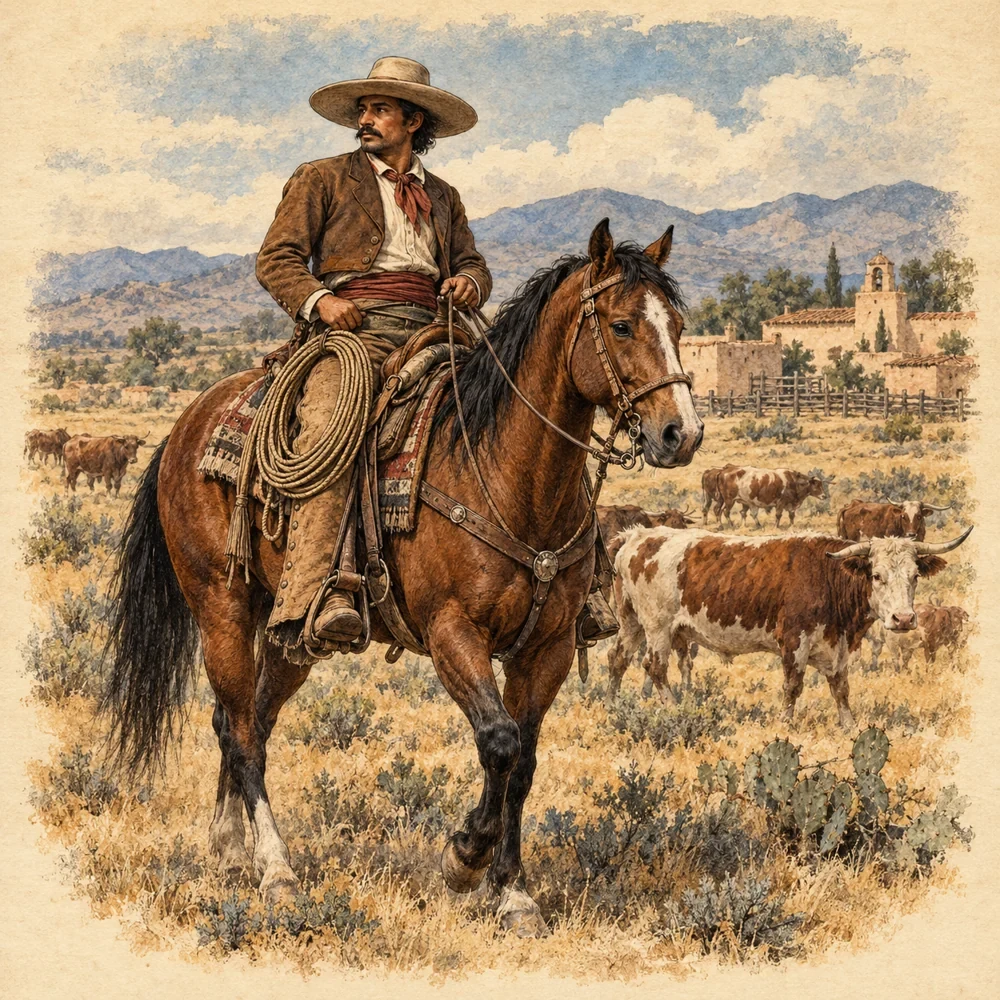
The cowboy seems inseparable from America: a horse, a broad-brimmed hat and an enormous amount of horizon. Yet much of his working equipment and expertise came through people speaking Spanish.
Follow the cattle rather than the cinema, and the trail leads through Mexico towards an older Spanish inheritance.
THE SHORT ANSWER
The American cowboy has important Spanish roots, but saying he simply “originated in Spain” leaves out much of the story.
Spanish colonisation brought cattle, horses and ranching traditions to the Americas in the sixteenth century. In Mexico and the borderlands, generations of vaqueros developed the mounted cattle work that strongly influenced later American cowboys. Indigenous people were participants in that development, not merely spectators.
Spain supplied a foundational inheritance. Mexican and other local communities adapted it. The American cattle industry gave it further forms. No single birthplace explains the whole tradition.
WHAT WE KNOW
A vaquero is a cattle worker: the word comes from vaca, Spanish for cow. Long before Hollywood made the cowboy a national emblem, Spanish America had mounted herdsmen tending livestock.
The chronology matters. The Spanish arrival of horses and cattle in Mexico belongs to the 1500s. The celebrated American trail-driving era belongs largely to the decades after the Civil War ended in 1865. These were connected stages separated by centuries.
There are also named people behind the broad outline. The National Park Service identifies a Ziaguan Indigenous man named Carlos as the first person listed as a vaquero at Mission San Antonio de Valero, later known as the Alamo. He died in 1728. That is a local documentary example, not a claim that Carlos was the first cowboy anywhere.
The surviving record makes it difficult to treat the cowboy as an occupation invented suddenly by English-speaking settlers.
HOW IT BECAME A HABIT
Ranching knowledge travelled with workers, animals and settlements. It also developed wherever people faced new terrain and working conditions.
In Texas, incoming Anglo-American stock raisers encountered existing Spanish and Mexican cattle traditions. Historian Jack Jackson describes how stock-handling methods passed between communities, particularly from 1821 into the trail-driving era.
Vaqueros continued working on ranches and cattle drives as those industries expanded. They helped make the later American system possible.
The equipment offers a particularly visible trail. Ropes, saddles, spurs, protective leather clothing and broad-brimmed hats belonged to a working inheritance that was adapted over time. They were useful tools before they became costume.
The language kept some of that history. “Lariat” comes through Spanish la reata, a rope; “buckaroo” is an English adaptation of vaquero. “Chaps” derives from chaparreras, leather protection for the legs.
A cowboy could use Spanish-derived vocabulary all day without thinking he was speaking another culture’s history.
THE STORY EVERYONE TELLS
The familiar version begins with an American rider in a largely empty landscape. He is independent, usually white, and apparently born knowing everything about horses.
A corrective story reverses the direction: the cowboy was really Spanish, perhaps born specifically in the marshes of Andalusia, and America borrowed the finished article.
The correction contains a substantial truth. Spanish cattle traditions belong in the ancestry. But a precise Andalusian birthplace is a stronger claim than the evidence presented here establishes.
Resemblance between working horsemen on opposite sides of the Atlantic is suggestive. It does not, by itself, identify one village, marsh or moment as the origin of every later cowboy practice.
WHAT THE EVIDENCE ACTUALLY SAYS
WELL SUPPORTED — Spanish and Mexican influence documented; a single birthplace unproven.
The evidence supports a historical sequence: Spanish ranching traditions entered the Americas; vaquero practices developed in Mexico and neighbouring regions; later American cattle workers adopted substantial parts of that knowledge.
It does not support treating Mexico as a corridor through which an unchanged Spanish invention merely passed.
Nor does Spanish colonial ownership tell us the ancestry of everyone doing the work. The documented Indigenous vaquero at San Antonio is a useful reminder that institutions, techniques and workers had different histories.
The American cowboy also emerged from a varied workforce. Mexican, Black, Indigenous and European-descended cowhands all belonged to the cattle industry. The familiar solitary white hero is a selective image of that world.
Finally, the lasso should not be assigned a single inventor on the basis of cowboy history alone. Its place in the vaquero inheritance is well established; that does not prove that people in Spain invented every form of rope-catching.
The strongest answer is therefore a shared and developing tradition, with Spain and Mexico central to its history.
WHY IT STUCK
A working cowboy needed skill, endurance and colleagues. Popular entertainment found it easier to sell a single memorable hero.
Buffalo Bill’s Wild West, launched in 1883, helped turn frontier life into spectacle. Novels, films and television carried the image further, often making the cowboy whiter and more solitary than the historical workforce.
The practical kit survived because it worked. The legend survived because it travelled beautifully.
Hollywood made the cowboy recognisable around the world. His working ancestors had already travelled a very long way.
SOURCES & FURTHER READING
Texas State Historical Association — Jack Jackson, “Vaquero”. Historical synthesis of vaquero work and its transmission into Anglo-American ranching.
https://www.tshaonline.org/handbook/entries/vaquero
Smithsonian American Art Museum — “Public Sculpture: Vaquero”. Educational resource addressing Mexican contributions to cowboy heritage and the difference between real and mythical cowboys.
https://americanart.si.edu/education/learning/public-sculpture-vaquero
National Park Service — “Mission San Antonio de Valero, The Alamo”. Includes the documented Indigenous vaquero Carlos.
https://www.nps.gov/subjects/travelspanishmissions/mission-san-antonio-de-valero-the-alamo.htm
National Park Service — “Cowboys”, Grant-Kohrs Ranch National Historic Site. Working conditions, vaquero vocabulary and the varied cattle workforce.
https://www.nps.gov/grko/learn/historyculture/cowboys.htm
Library of Congress — “Black Cowboys at ‘Home on the Range’”. Spanish antecedents, Black cowhands and the selective popular image of cowboy history.
https://blogs.loc.gov/loc/2022/03/black-cowboys-at-home-on-the-range/
Library of Congress — “Buffalo Bill: Topics in Chronicling America”. The Wild West spectacle launched in 1883.