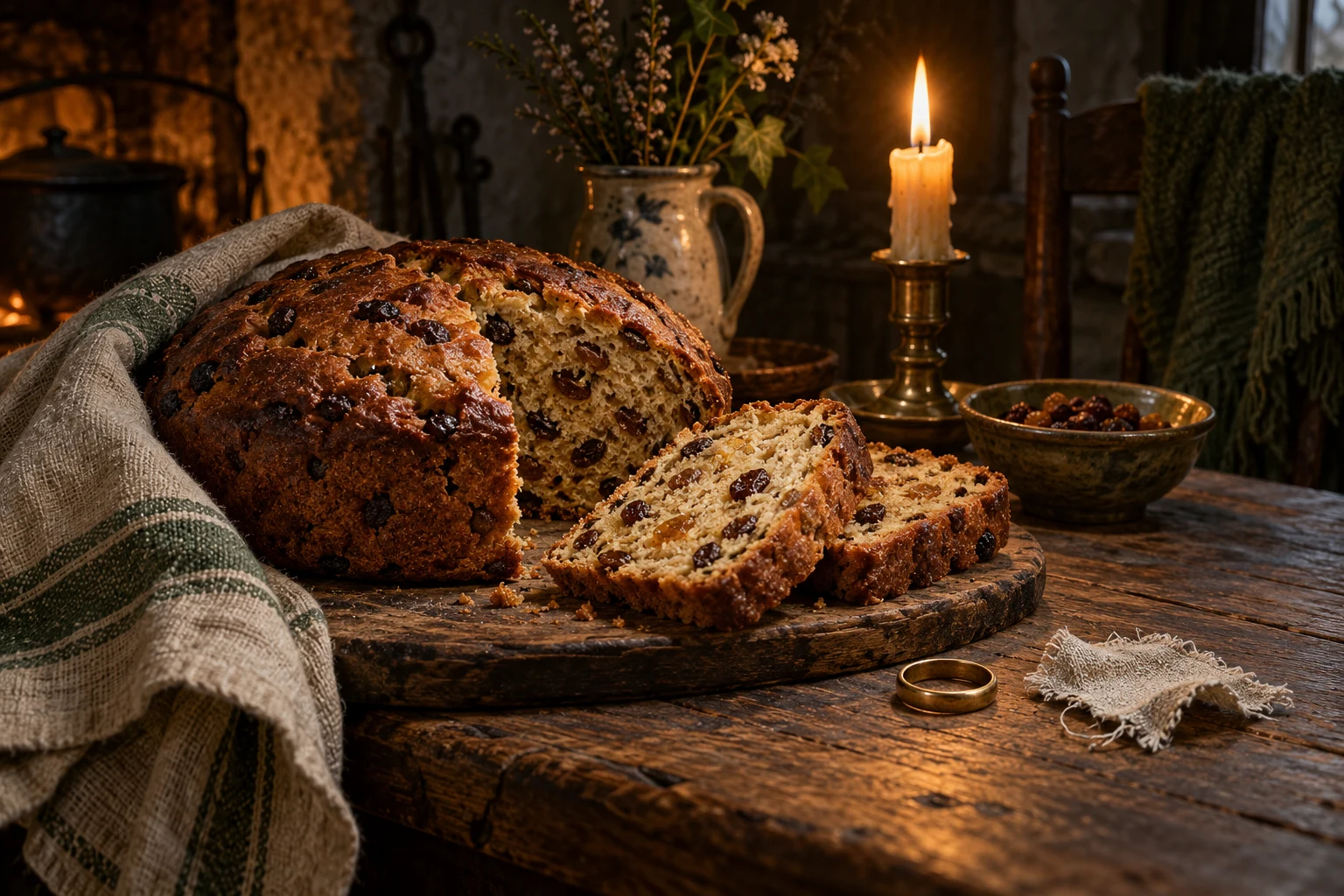
One slice might promise a wedding. Another could leave you facing a year in rags.
At an Irish Halloween table, the surprise inside the cake was sometimes more interesting than the cake itself. But there was no single recipe for what the future would bring.
THE SHORT ANSWER
Rings and scraps of cloth were hidden in barmbrack as fortune-telling tokens. Finding the ring commonly predicted marriage; receiving the rag could warn of poverty or ragged clothing.
Other objects supplied other possible futures. The loaf turned a shared Halloween meal into a game in which chance decided whose prospects looked brightest.
The custom is securely documented. Its exact beginnings are uncertain, and surviving accounts do not give every charm the same meaning.
WHAT WE KNOW
Barmbrack is an Irish fruit loaf associated with Halloween. Although often described as a cake, traditional Halloween brack is a sweet, yeast-raised bread. Tea brack is a related bake; the names should not make us assume that every household followed the same recipe.
Particularly useful evidence survives in Ireland’s Schools’ Collection. From 1937 to 1939, pupils gathered folklore and local knowledge from parents, grandparents and neighbours.
These records take us into the household rather than presenting a single official set of rules.
One account from Béal an Átha Móir describes a brack containing a ring, a bean and a rag. The ring identified the person who would marry first, the bean promised wealth, and the rag foretold poverty.
The collection records the custom by the late 1930s. Memories supplied by older informants may reach further back, but the date of a recollection does not tell us when the practice began.
HOW IT BECAME A HABIT
The cake belonged to a wider Halloween repertoire of attempts to discover the future.
Marriage was a recurring subject. Who would marry? Who would remain single? Would a future household be prosperous or poor?
A hidden object gave these large questions a small, visible answer.
The symbolism is easy to recognise: a ring suggests marriage, while a rag suggests material hardship. That is a reasonable reading of the objects, rather than a documented explanation from whoever first devised the custom.
Sharing the loaf also made the prediction public. Everyone could see who had received which token, supplying the gathering with an immediate subject for congratulations, teasing or disappointment.
THE STORY EVERYONE TELLS
A familiar modern account presents a fixed list: a ring for marriage, a coin for wealth, a rag for poverty, and several less welcome objects for other outcomes.
Such lists describe recognisable versions of the tradition. They become misleading when treated as rules obeyed everywhere in Ireland.
The other tempting explanation takes the whole practice directly back to ancient Samhain.
Halloween’s Gaelic seasonal background matters. It does not, by itself, establish that ancient celebrants baked the same fruit loaf, hid the same objects or assigned them today’s familiar meanings.
A general association with an old festival cannot supply a missing history of a particular cake.
WHAT THE EVIDENCE ACTUALLY SAYS
WELL SUPPORTED applies to the use of hidden objects for Halloween fortune-telling.
The Schools’ Collection also preserves striking variations. One account associates the ring with being the first to die and a small stick with marriage. Another describes the rag as an omen of a coffin.
Those are individual recorded versions, not evidence that the better-known marriage and poverty meanings are wrong. They show why folklore should not be flattened into one national instruction sheet.
Nor does a recorded prediction prove that everyone believed it literally. A gathering could accommodate apprehension, amusement and scepticism around the same table.
We can establish that people described these practices and their supposed meanings. We cannot establish that the charms predicted events, identify a single inventor, or demonstrate an uninterrupted survival from ancient Samhain.
WHY IT STUCK
The attraction is easy to understand. A shared loaf concealed an answer, and every slice offered another chance to find it.
The ring also made an especially memorable prize: small enough to hide and instantly recognisable when discovered.
Modern accounts still describe rings in shop-bought Halloween bracks. The full assortment of ominous scraps and objects is less familiar, but the central pleasure survives: choosing a slice and wondering what might be inside.
Halloween did not always need a ghost to make the future feel uncertain. Sometimes a piece of cake was enough.
RELATED CURIOSITIES
Why Did Halloween Fortune-Telling Involve Three Bowls of Water?
Why Did People Look into Mirrors at Midnight on Halloween?
Why Do We Bob for Apples at Halloween—and What Did It Have to Do With Marriage?
SOURCES & FURTHER READING
National Folklore Collection, Dúchas — “Halloween”, Béal an Átha Móir (B.), Schools’ Collection. Local account of the ring, bean and rag.
https://www.duchas.ie/en/cbes/4658449/4656940/4662667
National Folklore Collection, Dúchas — Schools’ Collection transcripts for Halloween, including CBÉS 0581 p. 201, CBÉS 0621 p. 418 and CBÉS 0639 p. 25. Contrasting charm meanings.
https://www.duchas.ie/en/cbes/transcripts?Page=12&SearchLanguage=ga&SearchText=halloween
Dúchas — “The NFC Collections”. Background and dates of the Schools’ Collection.
https://www.duchas.ie/en/info/cbe-collections
RTÉ Radio 1 — “Ring, Pea, Stick, Rag: The history of barmbracks and their charms”. Discussion with UCC food historian Regina Sexton and bakery specialist Tony Kane.
Tourism Ireland — “Ireland: the home of Halloween traditions”. Contemporary account of barmbrack and its tokens.
https://www.ireland.com/en-gb/magazine/culture/halloween-traditions/