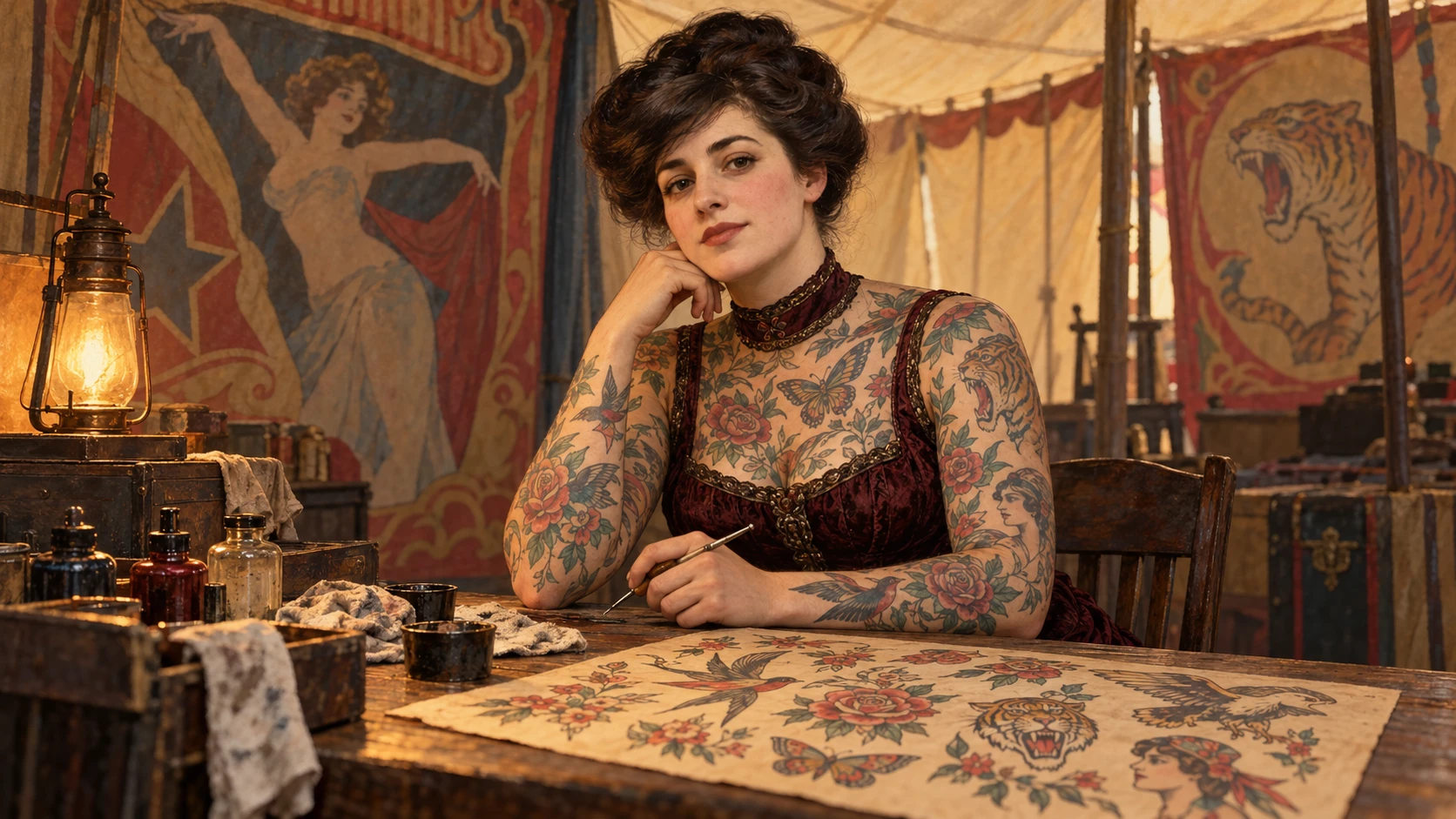
A heavily tattooed woman could earn money simply by letting an audience look. Maud Wagner also learned to hold the needle.
Her story belongs to a world of travelling shows, painted attractions and publicity tales that could be almost as elaborate as the tattoos themselves.
THE SHORT ANSWER
Maud Wagner’s tattoos became part of her livelihood as a performer, while tattooing became a trade she practised herself. Displaying decorated skin and decorating other people’s skin were connected ways of earning a living.
That explains their professional usefulness. It does not establish every personal reason she chose them. Nor should her story be confined to Victorian times: born in 1877, she developed her tattoo career in the early twentieth century.
WHAT WE KNOW
Wagner was already a travelling performer before becoming famous for her tattoos.
Contemporary evidence establishes that she worked as a tattooist. Reporting published by HPPR in 2026 reproduces Gus Wagner’s acknowledgement to a St Louis newspaper in 1904 that his wife also practised the craft.
Their business combined performing with tattooing. Local historical accounts describe appearances at fairs, vaudeville venues and amusement arcades, where the Wagners could be both the attraction and the people offering a service.
Maud learned hand tattooing: applying the design through manually worked needles rather than an electric machine.
HOW IT BECAME A HABIT
The tattooed woman was an established attraction before Maud entered the business.
Nora Hildebrandt appeared at Bunnell’s Dime Museum in New York in 1882. Audiences paid to see something presented as extraordinary.
The commercial logic is straightforward: tattoos supplied a permanent attraction that travelled with the performer. That is an interpretation of the business model, rather than proof that every woman entered it for the same reason.
Tattooing itself also travelled. Gus had been a merchant seaman, and the Seaport Museum traces his movement from international voyages into a career touring the United States.
THE STORY EVERYONE TELLS
The familiar account gives Maud’s career a romantic beginning.
At the 1904 St Louis World’s Fair, she supposedly agreed to a date with Gus in exchange for tattooing lessons.
It is an exceptionally tidy story: a bargain, a romance and a new profession in a single encounter.
Unfortunately, the chronology does not hold up comfortably.
WHAT THE EVIDENCE ACTUALLY SAYS
WELL SUPPORTED applies to Maud’s working career, rather than every detail of her legend.
The South Street Seaport Museum identifies a photograph of the pair as dating from 1903, when they were performing in Terre Haute, Indiana. Its account places the beginning of Gus tattooing Maud there, before the fair.
The first-meeting story therefore conflicts with the museum’s chronology. The precise lesson-for-a-date bargain remains unverified.
“America’s first female tattoo artist” also deserves caution. Historian Alan Govenar has questioned how that priority can be demonstrated. “Pioneering American woman tattooist” is a firmer description.
The surrounding entertainment culture needs similar scrutiny. Nora Hildebrandt’s publicity used an invented Indigenous captivity story. That was racist showmanship, not reliable biography. It should not be transferred to Maud.
Surviving Wagner materials include photographs, equipment, designs and a substantial scrapbook. These can establish a working life more securely than they can reconstruct private feelings.
WHY IT STUCK
Maud’s appeal is easy to understand. Her appearance makes an arresting photograph; her occupation gives that photograph another meaning.
An audience might see a decorated body. A customer could encounter a skilled worker.
Remembering both roles gives her a fuller history than either a romantic anecdote or an uncertain claim to being first.
RELATED CURIOSITIES
Why Did Women’s Short Hair Cause Such a Scandal?
Why Did Sailors Tattoo Swallows on Their Bodies?
Why Do Actors Say “Break a Leg”?
SOURCES & FURTHER READING
South Street Seaport Museum — Martina Caruso, “Deepening the Story” (8 January 2026). Museum-held photographs, the 1903 chronology and Nora Hildebrandt’s publicity.
https://southstreetseaportmuseum.org/deepening-the-story/
HPPR — “This Kansas farm girl ran off to join the circus and changed the tattoo world forever” (17 July 2026). Historical reporting, the 1904 newspaper evidence and questions about priority.
https://www.hppr.org/2026-07-17/maud-wagner-tattoo-artist-kansas
South Street Seaport Museum — “The Original Gus Wagner: The Maritime Roots of Modern Tattoo”. Maritime background and travelling tattoo work.
https://southstreetseaportmuseum.org/gus-wagner/
South Street Seaport Museum — “Explore the Collections”, Tattoo Collection. Description of the surviving Wagner archive.
https://southstreetseaportmuseum.org/explore-the-collections/
Visit Emporia — “Maud Wagner”. Local account of her performing career and hand tattooing; its World’s Fair meeting story requires correction against the museum evidence.
https://visitemporia.com/people/maud-wagner/
The New Yorker — Maria Lokke, “A Secret History of Women and Tattoo” (15 January 2013). The photographic feature that prompted this investigation, drawing on Margot Mifflin’s Bodies of Subversion.
https://www.newyorker.com/culture/photo-booth/a-secret-history-of-women-and-tattoo