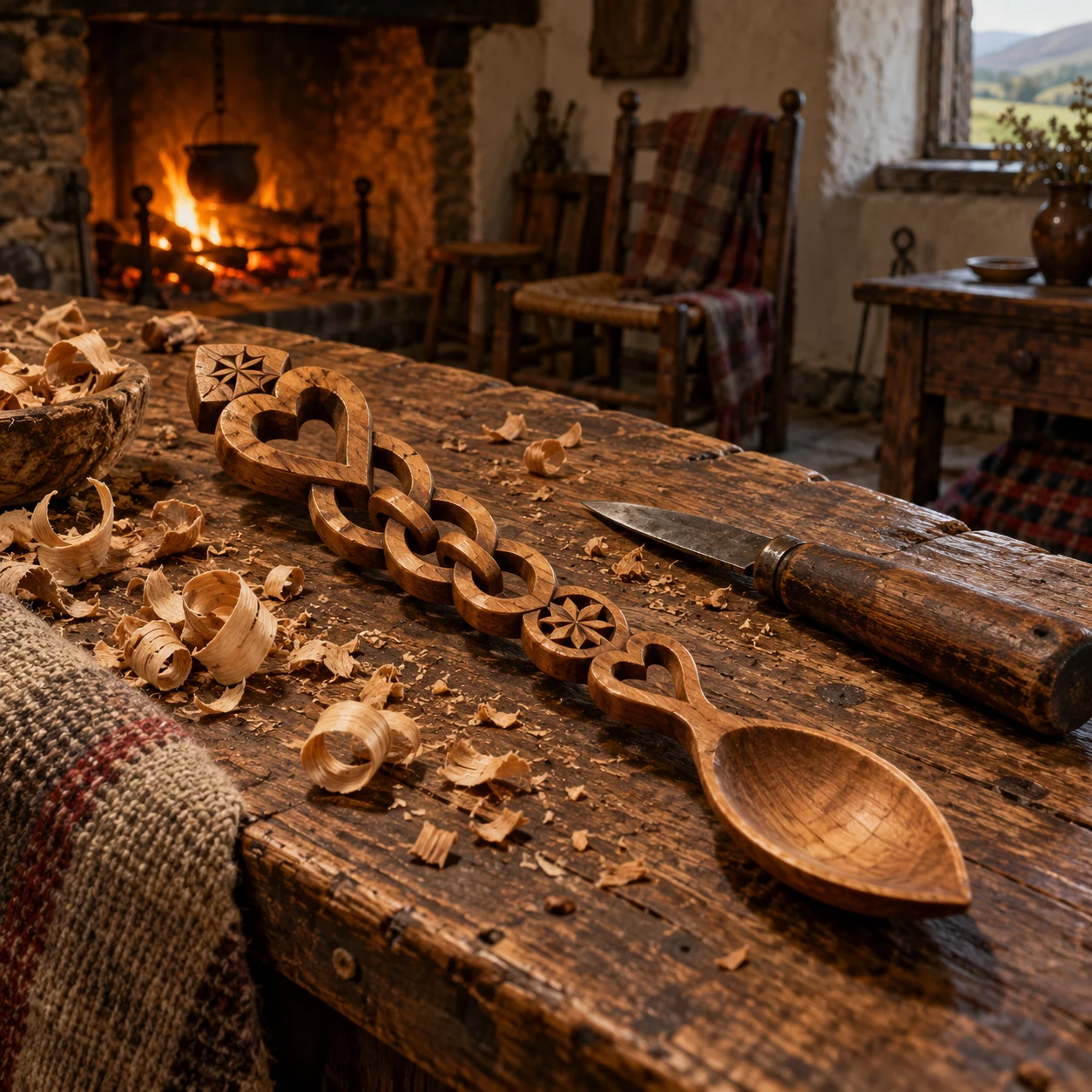
A spoon may not be the first object that comes to mind when choosing a romantic gift.
But in Wales, a carefully carved wooden spoon could carry a message of affection, demonstrate a suitor’s skill and become a treasured reminder of a relationship. Some were so elaborate that using them to eat soup would have seemed a terrible waste.
THE SHORT ANSWER
Welsh lovespoons were carved wooden spoons given as tokens of affection, particularly during courtship. Surviving examples show that the tradition was established by at least the seventeenth century.
Their decorated handles could display remarkable craftsmanship, with hearts, chains and other patterns cut into the wood. The objects and their use as love tokens are well documented, but their precise beginnings are uncertain. The meanings now attached to individual motifs should also be treated with care.
WHAT WE KNOW
At first glance, a lovespoon resembles an everyday household utensil that has received rather more attention than strictly necessary.
Look closer, however, and the handle may contain interlocking links, pierced hearts, wheels, flowers or twisting shapes. Some carvers created moving features from the same piece of wood, turning a familiar object into a display of patience and dexterity.
People’s Collection Wales describes lovespoons as the best-known Welsh love tokens and says they have been given by suitors to sweethearts since at least the mid-to-late seventeenth century. The oldest example in the collection at St Fagans National History Museum is dated 1667.
That surviving date gives us a useful landmark. It does not necessarily tell us when the first lovespoon was made.
Wooden objects can be used, damaged, discarded or lost. The oldest object preserved in a museum is not automatically the first object of its kind.
HOW IT BECAME A HABIT
Spoons were familiar, practical things. Wood was a material that could be worked with relatively simple tools, although the most elaborate surviving examples required considerable skill.
In Wales, the carved spoon became associated with courtship. Swansea Museum describes the custom of men carving spoons for women they were courting between the seventeenth and nineteenth centuries.
A finely worked spoon could offer more than an attractive present. It showed that its maker had spent time on the gift and could handle tools skilfully. The object carried both the affection behind it and evidence of the work involved.
Not every decorated spoon served precisely the same purpose, however. Similar carved gifts were made outside Wales, and spoons were also given to mark anniversaries and other occasions.
Over time, the lovespoon became especially associated with Welsh identity and folk art. Contemporary carvers still make them as gifts for weddings, engagements, anniversaries and other celebrations.
THE STORY EVERYONE TELLS
A popular explanation gives every feature of a lovespoon a clear romantic meaning.
A heart means love. A chain means a lasting bond. A particular number of links or a carved wheel may be said to reveal another precise wish.
These interpretations make an appealing guide to the object. They also turn a complicated tradition into a neat visual dictionary.
Some designs undoubtedly invite symbolic readings. A heart is a familiar sign of affection, and a chain can easily suggest a connection between two people.
But it is a larger claim to say that every carver, in every place and period, meant exactly the same thing by each detail.
WHAT THE EVIDENCE ACTUALLY SAYS
The strongest evidence is for the objects themselves and their association with affection and courtship.
Aberystwyth University’s School of Art notes that carved spoons were given as love tokens and to commemorate anniversaries. It also observes that dating and classifying many examples is difficult because patterns were copied across generations and surviving objects are not always well documented.
The same collection cautions that the meanings of geometrical motifs can remain obscure.
A design may have held a personal meaning for its maker or recipient. It may have been chosen because it was attractive, technically impressive or familiar from another spoon. Without a record explaining the maker’s intentions, we cannot always tell.
The lovespoon tradition is therefore well supported. A universal code that translates every historic carving is not.
The popular claim that the romantic verb “spooning” must have originated with Welsh lovespoons also needs independent linguistic evidence. The existence of the carved gifts alone does not establish that connection.
WHY IT STUCK
The lovespoon survives because it makes affection visible.
It is a useful shape transformed into something deliberately less ordinary: an everyday object made special by care, skill and time.
That combination has travelled well beyond its original setting. A carved spoon can still say something simple and personal, even when nobody expects to eat with it.
RELATED CURIOSITIES
Why Did Scots Make Newlywed Men Run Through Town Carrying Stones?
Why Is the Wedding Ring Worn on the Fourth Finger?
SOURCES & FURTHER READING
People’s Collection Wales — Welsh lovespoons, including examples from Amgueddfa Cymru.
https://www.peoplescollection.wales/collections/434821
Aberystwyth University School of Art Museums and Galleries — Welsh Folk Craft: Love Spoons.
https://museum.aber.ac.uk/collections-welshfolkcraft-lovespoons.php
Swansea Museum — Love Spoons.
https://www.swanseamuseum.co.uk/our-collection/finds-from-swansea-and-neath/love-spoons/