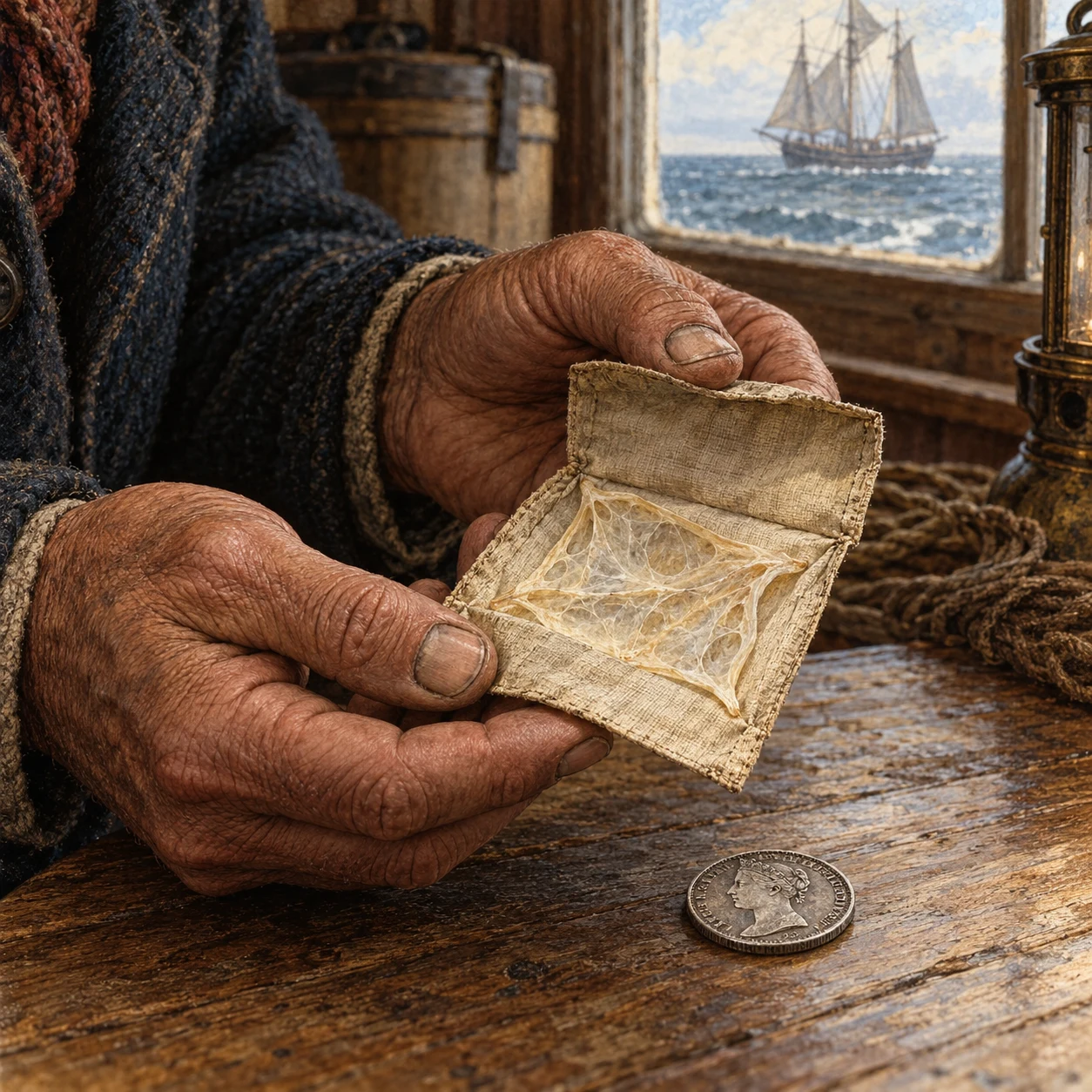
Among the objects a sailor might treasure was something that had begun its journey in a birthing room: a thin membrane preserved after a baby’s birth.
To its owner, this unlikely keepsake could represent a promise that the sea would never claim him. Surviving charms and accounts of their sale show how seriously that promise could be taken.
THE SHORT ANSWER
Some sailors carried a baby’s caul because it was believed to protect its possessor from drowning. A caul is a piece of the fetal membranes that sometimes remains over a newborn’s head or face at birth.
The belief extended beyond the child born with it: someone else could acquire the caul and supposedly acquire its protection. This helped turn an unusual birth accompaniment into a saleable talisman.
The practice is historically documented. Its exact beginnings are uncertain, and there is no evidence that a caul could prevent drowning.
WHAT WE KNOW
A charm associated with the fisherman Ronald Edward Dunn provides a particularly tangible example. A Royal Museums Greenwich resource, crediting Great Yarmouth Museums, describes it as combining a baby’s caul with a silver threepence. The object is dated 1862.
Dunn went to sea in the 1870s and spent more than fifty years fishing. The museum account records that he was never drowned and his boat never sank. That tells us about the life associated with the charm; it cannot establish that the charm kept him safe.
Written evidence reveals a market as well as a belief. In his 1879 Notes on the Folk-Lore of the Northern Counties of England and the Borders, William Henderson recorded that seamen purchased cauls against drowning.
He reported asking prices of twenty guineas in 1779, twelve pounds in 1813 and six guineas in 1848. These are historical reports of particular offers, rather than a standard price list or proof that every sale was completed.
Henderson also described a caul for which a seaman had reportedly paid fifteen pounds and which he had carried for thirty years. Such an object could remain a valued possession across much of a working life.
HOW IT BECAME A HABIT
The maritime charm belonged to a broader family of beliefs about unusual births. Henderson recorded traditions in which being born with a caul marked a child as fortunate, while losing or discarding it threatened that good fortune.
For sailors, the promise took a particularly useful form: immunity from drowning. If the protection could pass with the object, a family’s preserved birth membrane might become another person’s safeguard at sea.
That helps explain the trade, although it does not identify the first seller or the first sailor to believe the claim. The surviving evidence shows a custom already in circulation.
THE STORY EVERYONE TELLS
The best-known literary caul belongs to David Copperfield.
In the opening chapter of Charles Dickens’s novel, David explains that his caul was advertised for fifteen guineas. The only bidder offers a mixture of money and sherry, an arrangement the family declines.
Ten years later, it is raffled. The winner is an elderly woman who eventually dies in bed at ninety-two without ever having drowned.
Dickens then supplies the essential detail: she has avoided going on the water throughout her life, except when crossing a bridge.
The joke depends on readers recognising both the superstition and the difficulty of proving it. A person’s survival could be credited to the charm even when there was a much simpler explanation.
This is fiction, not the record of a particular transaction. Alongside museum objects and folklore collections, however, it shows how familiar the idea was to a nineteenth-century audience.
WHAT THE EVIDENCE ACTUALLY SAYS
WELL SUPPORTED describes the historical belief and the use of cauls as charms. It does not describe their supposed protective power.
We can establish that cauls were preserved, offered for sale and associated with protection from drowning. We cannot establish that every sailor accepted the belief, or that it had one meaning everywhere.
Why this particular protection? One plausible interpretation connects the membrane’s association with life before birth, surrounded by fluid, to survival in water. Its unusual appearance and association with a fortunate birth may also have mattered. These are interpretations of the symbolism, not a securely documented founding explanation.
The distinction between a caul over the face and a baby born entirely within an intact amniotic sac also matters: accounts of the charm should not assume that every preserved caul came from the latter kind of birth.
Nor should a museum object’s date be mistaken for the date the superstition began. Dunn’s charm demonstrates one instance; Henderson’s earlier reported prices show that the belief was already circulating before it.
WHY IT STUCK
The caul offered a portable promise against a danger that skill alone could not always overcome.
For its owner, it could turn an uncertain future into something that felt a little more manageable: a small, tangible connection between a fortunate beginning and the hope of returning home.
Its power was a matter of belief. The fear behind it was entirely real.
RELATED CURIOSITIES
Why Did Sailors Tattoo Swallows on Their Bodies?
Why Were Coins Placed Under a Ship’s Mast?
Why Is Killing an Albatross Supposed to Bring Bad Luck?
SOURCES & FURTHER READING
Royal Museums Greenwich / Great Yarmouth Museums — Shipwreck Objects: Sailor’s Charm. Ronald Edward Dunn’s caul and silver threepence; object references GRYEH 1981.52.1 and 1981.52.2.
https://www.rmg.co.uk/sites/default/files/import/pages/files/shipwreck_objects15_charm.pdf
William Henderson — Notes on the Folk-Lore of the Northern Counties of England and the Borders (1879), Chapter I, especially pp. 22–23. Historical reports of cauls, prices and protective beliefs.
Pitt Rivers Museum, University of Oxford — Imogen Crawford-Mowday, Caul: A Sailor’s Charm. Museum objects and interpretation of the belief’s symbolism.
https://england.prm.ox.ac.uk/englishness-sailors-charm.html
Charles Dickens — David Copperfield, Chapter I: I Am Born. A fictional treatment of the caul trade and protection against drowning.