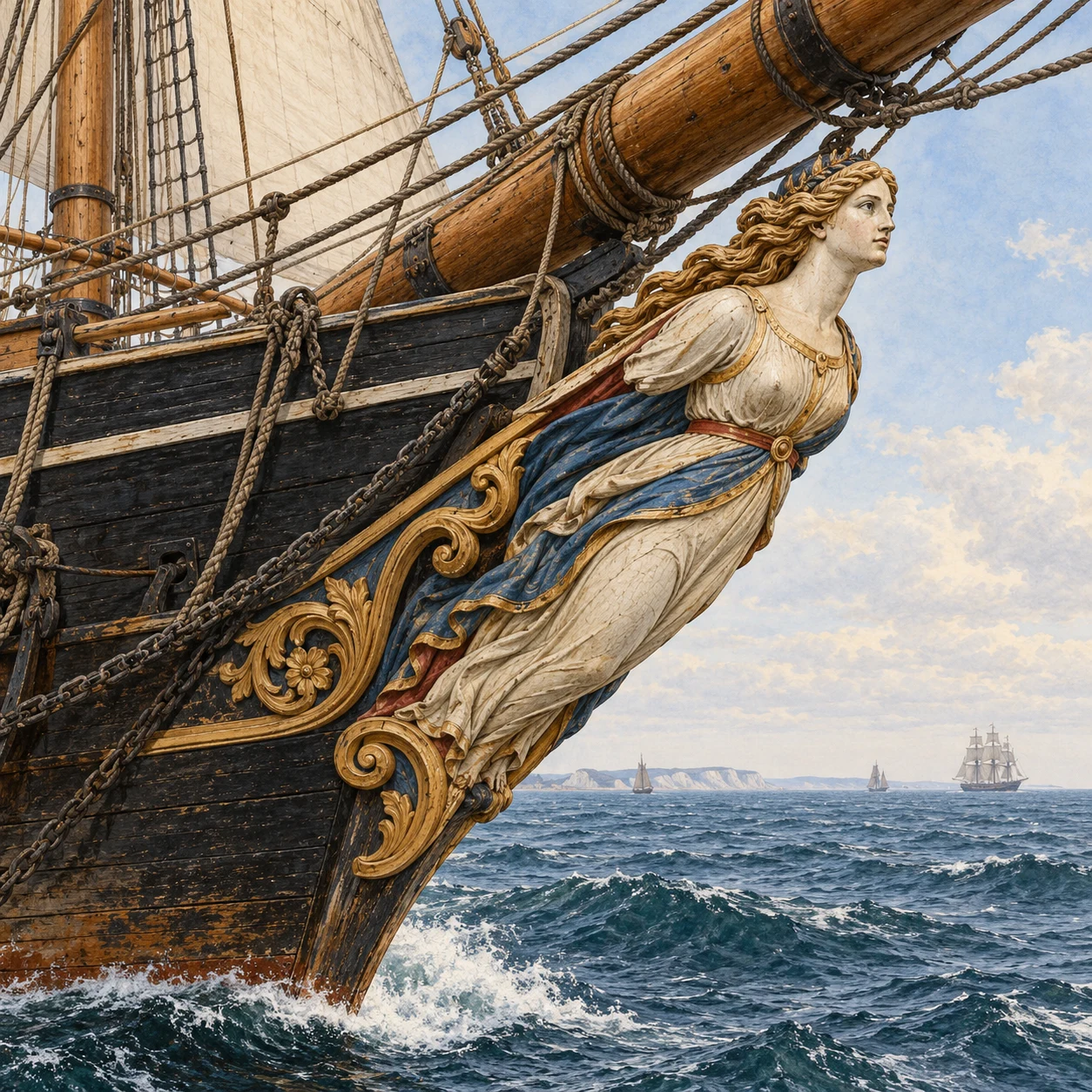
A woman leans towards the waves. A lion bares its teeth. A classical hero stares beyond the harbour.
Carved figures once travelled at the bows of ships, meeting the sea before the people aboard them. They could announce a vessel’s name, proclaim its owner’s power or offer the reassurance of a watchful guardian.
THE SHORT ANSWER
Ships carried figureheads for several overlapping reasons: decoration, identification, prestige and protection.
A carving could turn a ship’s name into a recognisable character or display the ambitions of a navy or merchant owner. Figureheads also acquired protective meanings, with some seafarers treating them as lucky presences associated with the ship’s spirit.
There was no single explanation for every carving. A royal emblem, a mythological hero and a merchant vessel’s portrait might share a position at the bow while communicating rather different things.
WHAT WE KNOW
The decoration of ships’ bows has a long history, but the familiar carved figures of European sailing ships should not be treated as one unchanged custom handed down from antiquity.
Surviving art gives us firm points along the way. Historic England notes that the Bayeux Tapestry depicts the Norman invasion fleet with animal-headed ships. Centuries later, elaborate warship carving made political statements as well as visual ones.
Sovereign of the Seas, built for Charles I in 1637, carried a gilded figure of a king on a rearing horse. This was royal authority made conspicuous at sea.
The Swedish Naval Museum supplies another revealing example. Its figurehead from Prudence depicts Perseus holding Medusa’s head. The museum interprets the composition politically: Perseus represents Gustav III, the rescued Andromeda represents Finland, and Medusa stands for Russia.
Such imagery carried a message about how a state wished to see itself—and its enemies.
HOW IT BECAME A HABIT
For merchant owners, a memorable carving could help make a vessel memorable too.
Mystic Seaport Museum explains that ship carvings expressed pride and attracted public attention. A figurehead reinforcing the ship’s name could help customers remember it. Art and commercial recognition worked together.
Producing these objects also supported a specialised trade. In nineteenth-century Mystic, ship carving was generally a separate business from shipbuilding. One local carving enterprise served most of the river’s six shipyards during part of the century, while also undertaking work for buildings and other customers.
The figure at the bow was therefore more than a sailor’s improvised charm. It could be a commissioned artwork, made by a craftsman whose skills also belonged to the world ashore.
THE STORY EVERYONE TELLS
The most appealing explanation is that the figurehead contained the ship’s soul and guarded everyone aboard.
That interpretation has a genuine place in maritime tradition. Royal Museums Greenwich describes figureheads as lucky charms representing the ship’s spirit and associated with protection and safe homecoming.
But a protective meaning does not explain every choice of subject.
Cutty Sark’s figurehead, Nannie, is a witch from Robert Burns’s Tam o’ Shanter. The ship’s name also comes from the poem: a “cutty sark” is a short nightdress.
Nannie’s outstretched hand holds a horse’s tail because, in Burns’s story, she tears the tail from Tam’s fleeing horse. The carving’s unusual detail has a specific literary explanation, rather than a universal maritime one.
WHAT THE EVIDENCE ACTUALLY SAYS
WELL SUPPORTED applies to the multiple documented functions of figureheads. Surviving carvings, historical images and museum research establish their use as decoration, representations of names, expressions of power and objects associated with protection.
They do not establish that every sailor believed a spirit literally inhabited every figure.
Nor were figureheads always women. Lions, heroes and male portraits belong to the record. At Gustav III’s Swedish navy, the museum describes male figures on ships-of-the-line named for qualities such as audacity, and female figures on frigates with female names.
It is also misleading to assume that every surviving carving can be confidently matched to a vessel. In 2025, the Australian National Maritime Museum announced its acquisition of a nineteenth-century figurehead depicting a First Nations woman. Its ship and carver remained unconfirmed.
The museum also highlighted an uncomfortable contradiction: a colonial society could place a First Nations woman in a protective role aboard ship while dispossessing First Nations communities ashore. A figurehead could express admiration without implying equality.
Finally, their decline was connected with changing ship design. Mystic Seaport Museum links the late nineteenth-century retreat of figureheads to steam power and the loss of the sailing rig that had helped provide their natural setting at the bow.
They did not disappear simply because sailors collectively stopped believing in luck.
WHY IT STUCK
A ship could have a written name and still benefit from a face.
The carving offered something people could recognise, remember and become attached to. It might make royal power visible, give a business a distinctive image or suggest a companion looking ahead into uncertain water.
That helps explain their continuing appeal in museums. Separated from the ships they once accompanied, these wooden figures still seem to be watching for somewhere to arrive.
RELATED CURIOSITIES
Why Is Renaming a Ship Considered Bad Luck?
Why Were Coins Placed Under a Ship’s Mast?
Why Did Sailors Tattoo Swallows on Their Bodies?
SOURCES & FURTHER READING
Historic England — A Brief History of Ship Figureheads. Historical imagery, naval symbolism and Sovereign of the Seas.
https://heritagecalling.com/2019/01/31/a-brief-history-of-ships-figureheads/
Royal Museums Greenwich — Cutty Sark’s figurehead ‘Nannie’. Protective meanings, Burns’s poem and the horse’s tail.
https://www.rmg.co.uk/cutty-sark/attractions/cutty-sarks-figurehead-nannie
Swedish Naval Museum — The Figurehead Hall. Gustav III’s fleet, naming conventions and the political symbolism of Prudence.
https://www.marinmuseum.se/en/visit/exhibitions/the-figurehead-hall
Mystic Seaport Museum — Ship Carver. Commercial identity and the specialist carving trade.
https://mysticseaport.org/explore/village-old/ship-carver/
Mystic Seaport Museum — Figureheads and Shipcarvings. Public art, personality and the decline associated with steamship design.
https://mysticseaport.org/exhibit/figureheads-and-shipcarvings/
Australian National Maritime Museum — Rare 19th century ship figurehead joins the Australian National Maritime Collection, 11 June 2025. Uncertain provenance and colonial representation.