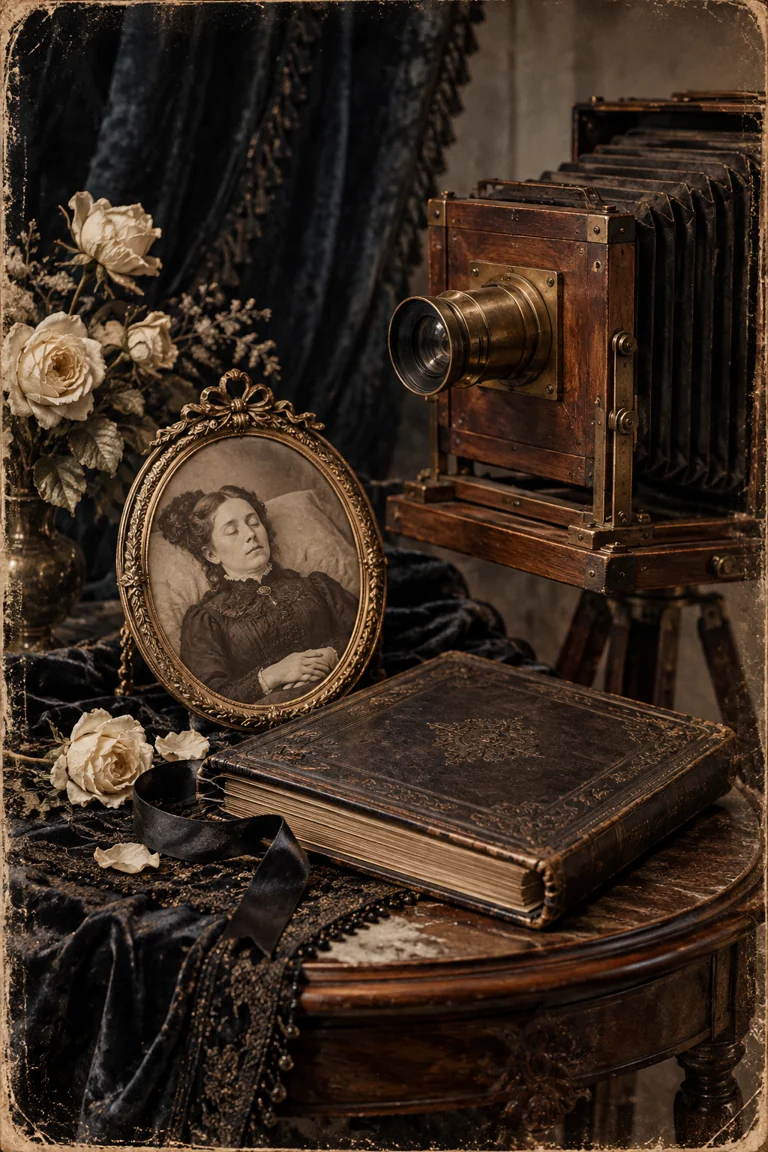
To modern eyes, the idea seems unsettling. A family gathers around a deceased loved one, a photographer arranges his camera, and a final portrait is taken. Yet in the nineteenth century, such photographs were not necessarily regarded as macabre. They could be treasured keepsakes, preserving a face that might otherwise be lost to memory.
Victorian post-mortem photography was a genuine practice, but the reasons behind it were generally more tender than the sensational stories circulating online today.
The Short Answer
Victorian families sometimes photographed deceased relatives to preserve their likeness and remember them. Photography was becoming more accessible during the nineteenth century, but many people, especially young children, died without having been photographed while alive.
A post-mortem portrait could therefore become the family's only surviving image of someone they loved.
The photographs were expressions of grief, affection and remembrance, rather than evidence of an unusual fascination with death.
When Did Photographing the Dead Begin?
The public introduction of the daguerreotype in 1839 transformed portrait-making. Previously, commissioning a painted likeness was generally beyond the means of many households.
Photography offered a new way of preserving someone's appearance. Early photographs could still be expensive, but photographic processes and commercial portrait services became progressively more accessible.
Post-mortem portraits emerged within this expanding photographic culture.
The practice was not confined to Britain. Surviving examples and historical research document memorial photography in several European countries and the United States.
Why Were Children So Often Photographed?
One of the most poignant aspects of nineteenth-century memorial photography is the number of surviving portraits of deceased infants and children.
Child mortality was much higher than it is today. Illnesses and infections that are now frequently treatable could prove fatal.
Some children died before their parents had commissioned an ordinary portrait.
For grieving families, a photograph taken after death might provide a precious visual record of a child's face.
The Metropolitan Museum of Art preserves a remarkable example from around 1850 by the French photographer Alphonse Le Blondel. It depicts a deceased child within a carefully composed memorial scene.
Such images reveal how photography could become part of the grieving process.
How Were the Photographs Arranged?
Some deceased subjects were photographed lying peacefully, occasionally surrounded by flowers, bedding or other familiar objects.
Children might be pictured as though sleeping. Other photographs showed the deceased in a coffin or included relatives within the composition.
The resulting images could be placed in family albums, kept in cases or shared with relatives.
Not every photograph was designed to conceal the reality of death. Some explicitly documented the deceased person's final resting appearance.
These different approaches reflected individual family preferences and changing photographic conventions.
Were Dead Victorians Really Propped Up to Look Alive?
One of the most persistent internet stories claims that Victorian photographers routinely strapped corpses into metal stands so that they could be photographed standing upright.
There is no convincing historical evidence that this was a normal photographic practice.
Photographic posing stands certainly existed, but they were designed to help living sitters remain still during an exposure.
Their presence in a nineteenth-century portrait does not demonstrate that the subject was dead.
Similarly, closed eyes, an unsmiling expression, an awkward posture or a blurred face are not reliable indicators of a post-mortem photograph.
Many images circulated online as photographs of the dead have been incorrectly identified.
Genuine memorial photographs exist in documented collections, but individual images should not be labelled post-mortem without reliable provenance or supporting evidence.
Was This a Particularly Victorian Obsession?
The Victorians developed elaborate mourning customs, but remembering the dead through portraits was not an entirely new idea.
Painted post-mortem portraits, death masks and other memorial representations existed before photography.
The camera provided a different and increasingly accessible means of preserving a person's appearance.
It is also misleading to assume that every Victorian family commissioned photographs of deceased relatives. The practice varied across places, periods, households and photographic traditions.
The surviving evidence establishes that it happened, not that it was universal.
Why Did the Custom Decline?
As photography became cheaper, faster and more widespread, families increasingly accumulated photographs of relatives during their lifetimes.
The growth of personal cameras and informal snapshots reduced the likelihood that a photograph taken after death would be someone's only surviving likeness.
Funeral customs and attitudes towards photographing the deceased also changed.
Nevertheless, memorial photography did not disappear entirely. Some families continue to find comfort in photographs taken after a death, including through contemporary bereavement photography.
The Strange Part
Perhaps the strangest thing about Victorian post-mortem photography is how differently we interpret it today.
A photograph originally commissioned as an act of love may now circulate online as a supposedly frightening curiosity.
The real history is less sensational, but more moving.
Behind many of these portraits was a simple human wish: to remember a face after the person was gone.
Evidence and Uncertainty
WELL SUPPORTED — the practice is documented; many modern photograph identifications are disputed.
Historical photographs, museum collections and contemporary accounts establish that nineteenth-century families sometimes commissioned portraits of deceased relatives.
The practice's purposes and presentation are well documented, although individual motivations varied.
Claims that ordinary photographic posing stands were routinely used to support standing corpses are not supported by convincing historical evidence.
Many photographs shared online as post-mortem portraits lack reliable provenance and should be treated cautiously.
Sources
1. The Metropolitan Museum of Art — Alphonse Le Blondel, [Postmortem], circa 1850. A documented memorial daguerreotype.
https://www.metmuseum.org/art/collection/search/283105
2. Australian Museum — Mourning: Victorian Era. Historical context for memorial photography and mourning customs.
https://australian.museum/about/history/exhibitions/death-the-last-taboo/mourning-victorian-era/
3. Smithsonian National Museum of American History — Portrait of a Seated Woman with a Baby on her Lap. Discussion of the difficulties of identifying purported post-mortem photographs.
https://americanhistory.si.edu/collections/object/nmah_554929
4. Museu Nacional d'Art de Catalunya — Post-mortem photographic portraits in the nineteenth century. Historical discussion of memorial portraiture and bereavement.
https://blog.museunacional.cat/en/post-mortem-photographic-portraits-in-the-nineteenth-century/
5. Atlas Obscura — Clearing Up Some Myths About Victorian 'Postmortem' Photographs. Examination of the standing-corpse and posing-stand myths.
https://www.atlasobscura.com/articles/victorian-post-mortem-photographs