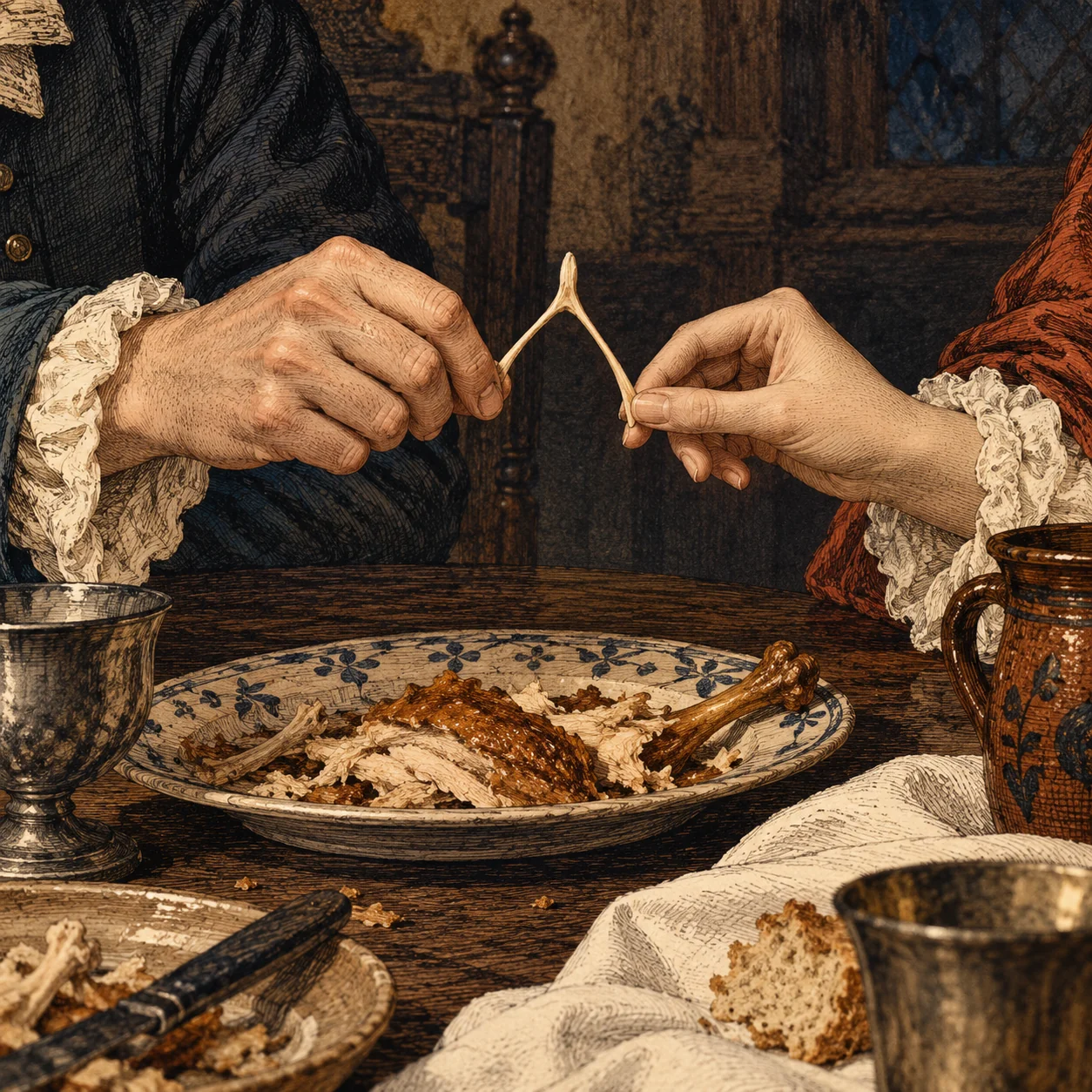
The turkey has been carved, the plates have been cleared, and someone has carefully saved a small forked bone.
Two people take an end, make a private wish and pull. A piece of dinner has become a competition for the future. But before the wishbone became a Thanksgiving tradition, it had another name — and sometimes a rather different prediction to make.
THE SHORT ANSWER
Breaking a wishbone belongs to an old family of customs in which poultry bones were used to make wishes, predict marriage or decide who would receive good fortune.
The practice is clearly documented in seventeenth-century England, where the bone was called the “merrythought”. Later North American folklore records preserve several versions, including ones concerned with future husbands rather than general wishes.
Its association with Thanksgiving fits a custom already suited to a poultry dinner. The familiar claim that it passed directly from the ancient Etruscans to the Romans and then to England is much harder to demonstrate.
WHAT WE KNOW
The wishbone is a real piece of anatomy: the furcula, formed from the joined collarbones of a bird. Turkeys have one, but so do chickens and many other birds.
That matters because the custom was never dependent on Thanksgiving turkey.
One particularly revealing account comes from the English antiquary John Aubrey. In his Remaines of Gentilisme and Judaisme, compiled in 1686–87 and published in full in 1881, he described two people breaking the merrythought of a chicken or woodcock.
Aubrey treated the practice as familiar rather than newly invented.
His instructions, however, involved rather more preparation than most families now require.
A participant first balanced the bone on their nose like spectacles, then shook their head until it fell off while concentrating on a thought. Two people subsequently pulled the bone apart, with the longer portion securing the thought. A further drawing of the fragments could determine the wish.
He also recorded reports of related customs in Germany, including a version in Anhalt that omitted the nose-balancing ceremony and involved obtaining something from the loser.
This was already a collection of variations, rather than one universal ritual.
HOW IT BECAME A HABIT
The bone offered a convenient object for a small domestic ceremony. It had two branches, two people could hold it, and its breaking produced an immediately visible result.
A meal supplied the equipment. Family members supplied the rules.
By the nineteenth century, the practice was recorded across the Atlantic. Fanny D. Bergen’s Current Superstitions, published in 1896, collected beliefs from English-speaking communities in North America.
One entry describes hanging a wishbone above a door so that the next person to enter would identify a future lover.
Another, recorded from Prince Edward Island, describes two girls breaking the bone to discover who would remain unmarried longer.
The terminology changed too. “Merrythought” was the older English name; “wishbone” emerged in nineteenth-century American English. Online Etymology Dictionary dates its example of “wishbone” to 1860.
The newer word makes the bone’s supposed purpose unusually clear.
THE STORY EVERYONE TELLS
The popular ancient-origin story begins with the Etruscans of ancient Italy.
They supposedly regarded chickens as prophetic birds, preserved their wishbones and touched or stroked them while making wishes.
The Romans then adopted the practice. In a frequently repeated addition, demand for lucky bones exceeded the supply, so people began breaking them to share the opportunity.
The custom subsequently travelled to England and eventually reached America.
It is an appealing explanation. It supplies an ancient civilisation, sacred birds and a neat reason for snapping the bone.
But each stage needs evidence. Repeating the whole journey does not establish the connections between its stops.
WHAT THE EVIDENCE ACTUALLY SAYS
Ancient bird divination is real.
Cicero’s On Divination discusses Roman auspices involving sacred chickens, including the interpretation of their feeding behaviour.
That establishes a historical connection between birds and attempts to discover divine intentions. It does not establish the modern wishbone game.
Watching a living chicken eat, preserving a dead bird’s bone and pulling that bone apart while wishing are different actions. Evidence for one cannot automatically prove the others.
The sources examined for this article do not demonstrate an uninterrupted Etruscan-to-Roman-to-English chain. Nor do they establish that Romans introduced bone-breaking because too many people wanted a wish.
The firmer documentary ground is the later merrythought custom.
Even its rules were flexible. In Bergen’s Prince Edward Island example, the longer piece meant a longer wait for marriage. The accompanying rhyme put it plainly:
“Shortest to marry,
Longest to tarry.”
So the piece now commonly treated as the winning fragment could once deliver an unwelcome romantic forecast.
Our evidence label is WELL SUPPORTED for the historical custom. Its first invention, precise route into Thanksgiving observance and claimed direct descent from ancient Italy remain uncertain.
WHY IT STUCK
The ritual turns an ordinary leftover into a shared moment of suspense.
It requires little explanation, gives two people something to compete over and allows everyone else to watch. A private hope becomes a public game without anyone having to reveal the hope itself.
It can also survive perfectly well without literal belief. You do not need to expect supernatural intervention to enjoy winning.
Thanksgiving provides a particularly suitable setting: a family meal, a turkey and people who already know what happens next.
The bone may no longer predict your marriage. It can still start an argument about who pulled first.
RELATED CURIOSITIES
Why Do We Throw Salt Over Our Shoulder?
Why Is the Number 13 Considered Unlucky?
SOURCES & FURTHER READING
John Aubrey, Remaines of Gentilisme and Judaisme, 1686–87, edited by James Britten and published in 1881 — especially the merrythought account on pages 92–93.
https://archive.org/details/remainesofgentil00aubruoft
Fanny D. Bergen, Current Superstitions (1896) — entries 223–224 record wishbones associated with future lovers and marriage predictions.
https://www.gutenberg.org/files/18992/18992-h/18992-h.htm
Cicero, On Divination, Book II, translated by W. A. Falconer — ancient evidence for divination involving the feeding of sacred chickens, rather than proof of wishbone-breaking.
https://penelope.uchicago.edu/Thayer/e/roman/texts/cicero/de_divinatione/2%2A.html
Online Etymology Dictionary, “wishbone” — nineteenth-century terminology and the older merrythought custom.
https://www.etymonline.com/word/wishbone
Michael Quinion, World Wide Words, “Merrythought” — the older name, American terminology and marriage associations.
https://www.worldwidewords.org/ww-mer1.html
Smithsonian Magazine, “This Thanksgiving, Make a Wish on a Dinosaur” — the anatomy and evolutionary history of the furcula.
https://www.smithsonianmag.com/science-nature/this-thanksgiving-make-a-wish-on-a-dinosaur-87598064/