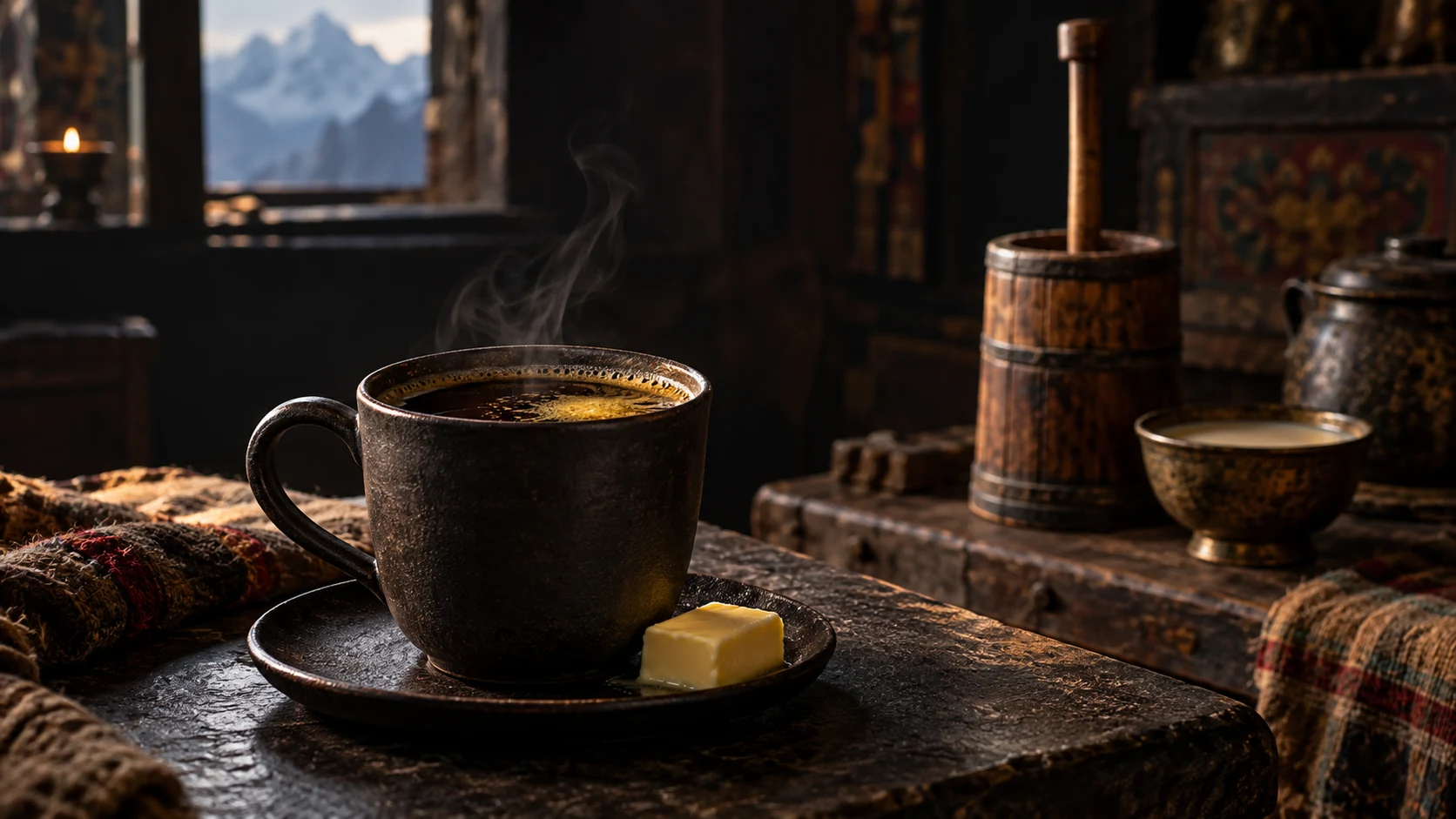
A lump of butter drops into a cup of hot coffee.
For some people, that looks like breakfast gone wrong. For others, it is part of a morning ritual said to provide energy, suppress hunger and sharpen concentration.
Butter coffee became an international wellness trend in the twenty-first century, particularly through the drink marketed as Bulletproof Coffee. Its modern story is often traced to the butter tea of Tibet.
But that can give the wrong impression.
Tibetans were not drinking some ancient version of buttery coffee. The older tradition involved tea, butter and salt — a drink with its own long history, preparation methods and social significance.
Coffee came much later.
The Short Answer
People put butter in coffee today largely because of a modern wellness trend inspired by traditional Himalayan butter tea.
In Tibetan regions, strong tea has long been combined with butter — traditionally often butter from yak or yak-cattle milk — and salt. The mixture is churned into an emulsion and consumed as an everyday drink and food.
In the early 2000s, American entrepreneur Dave Asprey encountered yak-butter tea while travelling in Tibet. He later developed a different drink using coffee, butter and eventually MCT oil, publishing his recipe in 2009 and developing it into the Bulletproof brand.
That helped turn butter coffee into an international trend.
The historical connection is therefore genuine.
The claim that butter coffee itself is an ancient Tibetan tradition is not.
What We Know
Tea reached the Tibetan Plateau surprisingly early
The history begins not with coffee, but with tea.
For many years, histories of Tibetan tea drinking commonly placed its arrival around the Tang dynasty, particularly the seventh and eighth centuries.
There is even a frequently repeated story linking tea's introduction to Tibet with the marriage of the Chinese princess Wencheng to the Tibetan king Songtsen Gampo in AD 641.
The problem is that archaeology has complicated that story considerably.
A study published in Scientific Reports in 2016 examined plant remains from the Gurgyam Cemetery in Ngari, western Tibet.
Researchers identified physical evidence of tea dating to approximately AD 200.
That is several centuries earlier than the traditional Tang-dynasty account.
The discovery does not prove that people were already making butter tea exactly as it is known today. It does demonstrate that tea was travelling across the Tibetan Plateau much earlier than historians once thought.
So there is no securely documented moment when someone first looked at a bowl of tea and decided to put butter in it.
The custom appears to have developed within a much longer history of tea, pastoralism, dairy production and trade.
Tea Became Something More Like Food
Traditional Tibetan butter tea is very different from the sweet tea familiar in Britain or the milk tea served in many other parts of the world.
Known by names including po cha or bo cha, depending on transliteration and region, it is generally made from strong tea combined with butter and salt.
Historically, compressed brick tea was particularly practical because it could survive long-distance transportation into the Tibetan Plateau.
The tea could be boiled until strong, then mixed with butter and salt and churned vigorously.
The result was not merely flavoured tea.
The churning dispersed the fat through the liquid, producing something closer to a warm emulsion.
In an environment where dairy products, barley and pastoral livestock formed important parts of everyday life, adding butter to tea made considerably more sense than it might to someone encountering the drink for the first time in a modern European coffee shop.
It added fat and energy to something people drank regularly.
Butter tea could also be combined with tsampa, roasted barley flour, making tea part of something that blurred the modern Western distinction between drink and food.
An Eyewitness Described It in 1909
By the beginning of the twentieth century, we have unusually vivid written descriptions of the custom.
Japanese Buddhist monk and traveller Ekai Kawaguchi, who travelled in Tibet around the turn of the century, described butter tea in his 1909 book Three Years in Tibet.
He wrote of tea being boiled until dark before being mixed with fresh butter and salt in a cylinder.
Elsewhere in the book he described butter, boiled tea and salt being placed together in a tall cylindrical vessel and mixed using a piston-like churn.
The motion emulsified the ingredients into the finished drink.
Kawaguchi admitted that he initially found the appearance difficult to accept because the drink looked oily.
But his account makes something else clear.
This was not an exotic novelty occasionally consumed by Tibetans.
Tea drinking was embedded in everyday life.
Kawaguchi described butter tea at breakfast, in monasteries and during social drinking. Later Western travellers recorded similarly frequent consumption.
Butter tea was therefore already an established cultural practice long before anyone thought of turning the idea into a Western coffee trend.
It Was Also About Hospitality
Butter tea was more than a source of calories.
It became part of hospitality.
A guest might be served tea and have the bowl repeatedly topped up by the host. Drinking, refilling and serving could therefore become part of the social exchange between visitor and household.
That matters because reducing Tibetan butter tea to an early version of a modern "biohack" removes much of its cultural context.
It was food.
It was drink.
It was hospitality.
And in some settings it also formed part of religious and ceremonial life.
The modern butter-coffee movement borrowed one conspicuous feature — putting fat into a hot caffeinated drink — from a tradition that meant considerably more than that.
How Butter Tea Became Butter Coffee
The modern story has a much clearer beginning.
American technology entrepreneur Dave Asprey says that during a journey in Tibet in 2004 he drank yak-butter tea after becoming exhausted at high altitude.
Asprey later experimented with recreating the experience at home.
But he made a fundamental substitution.
Instead of tea, he used coffee.
Instead of traditional Tibetan butter tea ingredients and preparation, his eventual recipe combined coffee with grass-fed butter or ghee and medium-chain triglyceride — MCT — oil.
Asprey published the recipe on his blog in 2009.
The idea subsequently became central to the Bulletproof brand and spread through ketogenic-diet, low-carbohydrate and "biohacking" communities.
A drink associated with Himalayan food culture had been transformed into something quite different:
a Western breakfast coffee marketed around energy, concentration and appetite.
Popular Story vs Evidence
POPULAR STORY
Butter coffee is an ancient Tibetan drink that has provided Himalayan people with energy for centuries.
WHAT THE EVIDENCE SUPPORTS
Traditional Tibetan communities have a long-established practice of drinking butter tea, not butter coffee.
Tea itself was present on the Tibetan Plateau by approximately AD 200, according to archaeological evidence.
Exactly when butter began routinely being combined with tea is much harder to establish.
By the nineteenth and early twentieth centuries, however, butter tea was clearly an established Tibetan food and hospitality tradition.
Modern butter coffee emerged after Dave Asprey encountered Tibetan butter tea and adapted the basic idea using coffee, butter and MCT oil.
So there is a historical connection.
There is not an unbroken ancient tradition of Tibetan butter coffee.
Why Put Fat in a Drink at All?
In its traditional setting, the idea is not particularly mysterious.
Fat contains a great deal of dietary energy.
Tea was consumed frequently.
Butter was available within pastoral communities.
Combining them produced a rich drink suited to local foodways and environmental conditions.
The modern rationale is different.
Butter-coffee enthusiasts have variously claimed that the combination can provide sustained energy, increase mental clarity, reduce hunger or help people following ketogenic diets maintain ketosis.
Some of these claims are physiologically plausible in limited ways.
Medium-chain triglycerides are metabolised differently from many longer-chain fats, for example, and research has investigated their effects on energy intake and metabolism.
But that does not mean all of the claims made for butter coffee have been demonstrated.
Does Butter Coffee Actually Make You Healthier?
This is where the story becomes less convincing.
A 2023 review specifically examining the claims made for Bulletproof Coffee found that the scientific evidence was limited.
The researchers found no significant improvement in cognition, alertness or energy when Bulletproof Coffee was compared with ordinary coffee in the available studies.
Evidence concerning hunger, satiety, energy expenditure and fat oxidation was described as uncertain.
There is some separate research suggesting that medium-chain triglycerides may modestly reduce subsequent food intake compared with longer-chain fats under controlled conditions.
That is not the same as demonstrating that butter coffee itself produces meaningful long-term weight loss or superior health.
There is also an obvious nutritional difference between black coffee and coffee containing substantial quantities of butter and oil.
Butter adds calories and saturated fat.
The American Heart Association currently recommends replacing sources of saturated fat such as butter with unsaturated fats where possible as part of a heart-healthy dietary pattern.
Mayo Clinic dietitian Katherine Zeratsky has similarly warned that adding butter and coconut oil can turn an almost calorie-free drink into one containing hundreds of calories, depending on the recipe.
So the evidence does not support treating butter coffee as a scientifically established health drink.
That does not mean nobody should enjoy it.
It means enjoyment and evidence are different things.
The Strange Part Is What Changed
The most interesting part of the story may not be that somebody put butter into coffee.
It is what happened to the meaning of the butter.
In traditional Tibetan butter tea, fat existed within a wider food system shaped by livestock, dairy production, trade, climate, hospitality and daily life.
When the idea travelled into Western wellness culture, it was reinterpreted.
Butter became a "hack".
Tea became coffee.
Traditional churning became the kitchen blender.
And a food associated with everyday nourishment and hospitality became associated with ketosis, productivity and mental performance.
The ingredient barely changed.
The story surrounding it changed completely.
Why It Stuck
Butter coffee survived the initial wellness craze because it does several things extremely well as an idea.
It is unusual enough to provoke curiosity.
It is easy to make.
It fits naturally into low-carbohydrate and ketogenic eating cultures.
And it has an appealing origin story involving Tibetan mountains and an apparently ancient tradition.
There is just enough truth in that story to make the simplified version believable.
People in Tibetan and Himalayan cultures really have consumed butter tea for generations.
The modern butter-coffee movement really was inspired by that tradition.
But the journey from a bowl of salted Tibetan tea to a blender full of coffee, butter and MCT oil is not the survival of one ancient recipe.
It is an example of something Strange by Habit encounters again and again:
an old custom travels into a new culture, acquires a new explanation and becomes something its earlier practitioners might barely recognise.
Related Curiosities
Why do foods and drinks acquire reputations for bringing health, luck or strength?
Why do customs often gain ancient origin stories after they become popular?
And how many apparently modern wellness trends are really older practices transformed by new ingredients, new marketing and new explanations?
Sometimes the strangest part of a habit is not where it began.
It is what happened to it on the journey.
Sources & Evidence
Scientific Reports / Nature — Lu et al., “Earliest tea as evidence for one branch of the Silk Road across the Tibetan Plateau” (2016).
Archaeological and biomolecular evidence identifying tea from the Gurgyam Cemetery in western Tibet dating to approximately AD 200. This provides much earlier physical evidence for tea on the Tibetan Plateau than the traditional seventh-century introduction story.
Ekai Kawaguchi — Three Years in Tibet (1909).
Primary eyewitness account describing the preparation of Tibetan butter tea using boiled tea, butter and salt mixed in a cylindrical churn, as well as its place in everyday Tibetan life.
Horniman Museum and Gardens — “Tea Drinking Along the Silk Road.”
Museum account of Tibetan butter-tea preparation and the traditional story associating tea's arrival with the seventh-century Tibetan-Chinese royal alliance. The latter is treated here as a traditional account rather than established archaeological chronology.
Bulletproof — company history.
Bulletproof states that Dave Asprey encountered yak-butter tea in Tibet in the early 2000s and subsequently developed a version using coffee, grass-fed butter and MCT oil. The company dates publication of his recipe to 2009. This is evidence for the modern Bulletproof origin story, not independent verification of every health claim associated with the product.
Bulletproof — current recipe.
The company's current recipe uses brewed coffee, C8 MCT oil and grass-fed ghee, illustrating how substantially the modern drink differs from traditional Tibetan salted butter tea.
Beverages (2023) — “Assessing the Validity of Bulletproof Coffee's Claims.”
Review of the available research concluded that evidence supporting claimed benefits of Bulletproof Coffee is limited, with no significant improvements in cognition, alertness or energy compared with regular coffee in the studies reviewed.
PubMed — systematic review and meta-analysis of MCTs and food intake (2020).
Found evidence that medium-chain triglycerides may reduce subsequent energy intake compared with long-chain triglycerides under laboratory conditions, while finding little evidence of an effect on subjective appetite ratings. This evidence concerns MCTs rather than proving the broader claims made for butter coffee.
Mayo Clinic — “Why the ‘bulletproof coffee’ trend isn't a magic bullet.”
Notes the high calorie and saturated-fat content that can result from adding substantial quantities of butter and oil to coffee.
American Heart Association — Diet and Lifestyle Recommendations.
Current guidance recommends choosing unsaturated fats in place of saturated-fat sources including butter and coconut oil as part of a heart-healthy dietary pattern. Last reviewed March 2026.
Evidence assessment: WELL SUPPORTED. The existence and preparation of Tibetan butter tea, the antiquity of tea on the Tibetan Plateau, the modern Asprey/Bulletproof adaptation and the limitations of current evidence for butter-coffee health claims are documented. The precise date at which butter first began to be routinely added to Tibetan tea is not established and should not be presented as known.
Last checked: 1 October 2026