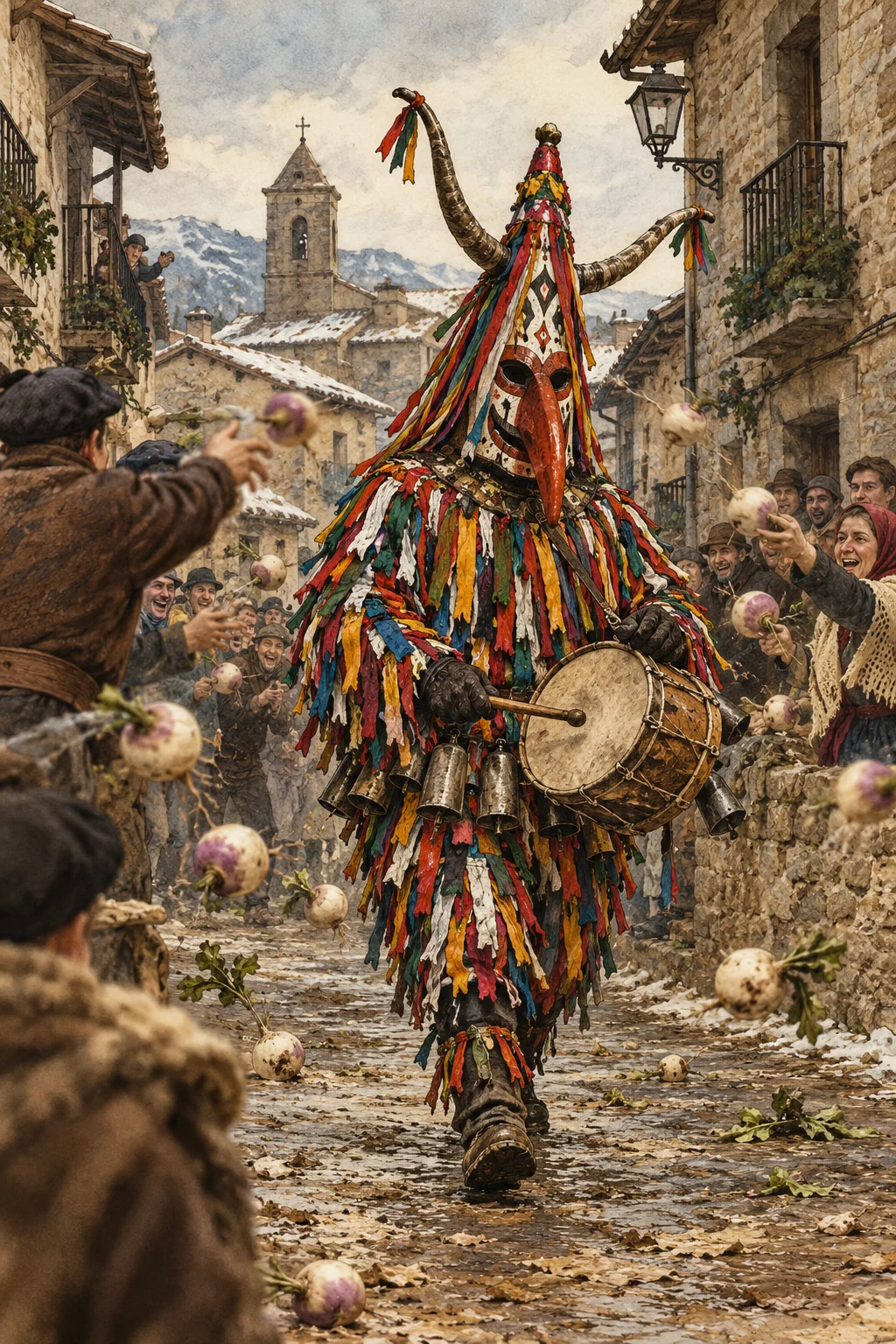
Every January, in a mountain village in western Spain, a horned monster appears in the streets. Its face is grotesque, its body covered in brightly coloured ribbons, and a drum beats as it moves through the crowd.
Then the vegetables begin to fly.
From doorways, windows and crowded streets, villagers hurl turnips at the strange figure. Not a handful of turnips, either. Thousands upon thousands are thrown with astonishing enthusiasm, until the streets are littered with battered vegetables.
The monster does not run away. It keeps walking, beating its drum and accepting the punishment.
This is Jarramplas, one of Spain's most extraordinary traditional festivals. And the strangest part is that the person beneath the mask has volunteered for the ordeal.
In fact, being chosen to endure it is considered an enormous honour.
The Monster Who Comes Every January
The village of Piornal lies high in the mountains of Extremadura, in the province of Cáceres, overlooking the beautiful Valle del Jerte.
For most of the year, it is a quiet place associated with mountain scenery, agriculture and traditional village life.
But on 19 and 20 January, Piornal becomes the setting for a spectacle unlike almost anything else in Europe.
The central character, Jarramplas, wears an extraordinary costume. Long strips of coloured fabric cover the body, while a conical mask features a prominent nose and two projecting horns. The figure carries a drum, which it beats while moving through the village.
The costume is theatrical, unsettling and unmistakable.
As Jarramplas appears, villagers and visitors begin throwing turnips. The bombardment can be ferocious. Modern participants wear substantial protective equipment beneath their costumes, because being struck repeatedly by hard vegetables is no laughing matter.
And yet the masked figure continues through the streets, performing a role that has become inseparable from the identity of Piornal.
Why?
To understand that, we must first meet a legendary cattle thief.
Was Jarramplas Once a Cattle Thief?
According to the best-known local explanation, Jarramplas represents a cattle rustler who once terrorised the surrounding countryside.
The story tells of a thief who stole livestock from the villagers, until the people finally decided they had endured enough.
When the culprit appeared, the villagers drove him away by pelting him with whatever vegetables they could find.
Over time, the punishment supposedly developed into an annual ritual. The thief became a costumed character, the vegetables became turnips, and the angry crowd became a community celebrating its own traditions.
It is an appealing explanation. It accounts for the pursuit, the punishment and the apparent villainy of the masked figure.
There is only one problem.
Nobody can establish that the incident actually happened.
The cattle-thief story is folklore rather than documented history. Although widely repeated, it is one of several competing attempts to explain a custom whose beginnings remain uncertain.
And some of the alternatives are considerably older and stranger.
An Ancient Monster, a Roman Hero and a Missing History
One theory connects Jarramplas with the Roman myth of Cacus, a monstrous cattle thief associated with the hero Hercules.
In the classical story, Cacus steals cattle belonging to Hercules and conceals them in his cave. Hercules eventually discovers the theft and kills the monster.
The resemblance to the local tale is intriguing: a cattle thief, a monstrous figure and a violent punishment.
But resemblance is not proof.
There is no established documentary chain showing that the Jarramplas festival developed directly from the story of Hercules and Cacus.
Other explanations have suggested much older seasonal masquerades or influences brought from beyond Spain.
Winter festivals across Europe frequently feature masked figures, animal-like costumes, bells, mock confrontations and symbolic punishments. These similarities have encouraged comparisons with pre-Christian rituals intended to mark the passing of winter or protect the community from misfortune.
Yet it would be misleading to declare Jarramplas a surviving pagan ceremony without qualification.
The precise origin of the festival remains unknown. What survives is the custom itself, together with generations of stories attempting to explain it.
Perhaps the mystery is part of its appeal.
Why Is the Festival Connected to Saint Sebastian?
For all its monstrous masks and flying vegetables, Jarramplas is closely connected with a Christian celebration.
The festival takes place around 20 January, the feast day of Saint Sebastian.
Sebastian was an early Christian martyr traditionally depicted as a young man pierced by arrows. His image became familiar throughout European religious art, and he was widely venerated as a protector against plague.
In Piornal, devotion to Saint Sebastian forms an essential part of the celebration.
There are religious processions, prayers, offerings and traditional songs. The masked figure's appearances are woven into a wider sequence of communal and devotional ceremonies.
One of the most evocative moments is the singing of the Alborás, a traditional musical ritual performed during the festival.
The juxtaposition is remarkable.
On one side stands a revered Christian saint. On the other is a horned, brightly coloured figure receiving a relentless shower of turnips.
It is tempting to interpret the contrast as Christianity absorbing a much older folk ritual. That is possible, but the surviving evidence does not establish precisely how the religious and masked traditions became joined.
What is certain is that the two are now inseparable in Piornal.
Jarramplas is not simply a monster being punished. He is a central participant in a celebration that expresses the village's religious devotion, collective memory and identity.
Why Would Anyone Volunteer to Be Jarramplas?
This is perhaps the most surprising aspect of the entire tradition.
The person wearing the costume is not selected as a punishment.
They volunteer.
Far from being a disgrace, taking on the role is regarded as one of the greatest honours available to someone from Piornal.
The commitment is considerable.
The protective clothing and elaborate costume can be extremely heavy. The participant must withstand repeated impacts while walking through crowded streets and continuing to play the drum.
The physical and psychological demands are substantial.
And the waiting list is extraordinary.
The popularity of the role has become so great that prospective participants can wait decades for their opportunity. For many, becoming Jarramplas is a lifelong ambition.
This transforms the meaning of the spectacle.
To an outsider, the masked figure might appear to be a criminal enduring a public humiliation.
To the villagers, the person inside the costume is demonstrating courage, commitment and devotion to the community.
The supposed villain has become a local hero.
How Many Turnips Are Thrown?
The scale of the modern festival is astonishing.
Tens of thousands of kilograms of turnips may be supplied for the celebration, transforming a humble root vegetable into the ammunition for an elaborate public ritual.
The vegetables are thrown at Jarramplas during designated appearances, with the crowd gathering to take part in the spectacle.
In earlier accounts, the objects thrown were not necessarily limited to turnips. Various vegetables and fruits formed part of the custom.
Today, turnips have become the defining feature.
The costume has also changed with the times.
Modern protective armour is essential for reducing the risk of injury, while the distinctive mask and multicoloured ribbons preserve the traditional appearance.
The festival has grown beyond a small village gathering into a nationally recognised event, attracting visitors, photographers and journalists.
In 2014, Jarramplas was officially declared a Festival of National Tourist Interest in Spain.
But despite its fame, the celebration remains deeply rooted in the people of Piornal.
The Strange Power of a Shared Ritual
There is something fascinating about the way a community can transform an act of aggression into a gesture of belonging.
On the surface, Jarramplas is a story about punishment.
A frightening figure appears. The villagers confront it. The monster suffers beneath a barrage of vegetables.
But beneath the spectacle lies a different story.
The person enduring the blows is admired rather than despised. The crowd is participating in a tradition rather than settling a genuine grievance. The ritual reinforces the bonds between generations who have witnessed, remembered and repeated it.
The festival has become a way of expressing what it means to belong to Piornal.
The mask, the drum, the turnips and the religious ceremonies are all parts of a shared cultural inheritance.
Their exact origins may be uncertain, but their importance to the community is not.
So Why Do They Throw Turnips at a Masked Monster?
The traditional explanation is that Jarramplas represents a cattle thief who was punished by angry villagers.
But historians cannot confirm that story, and alternative theories point towards older masquerades, mythological parallels and the complex evolution of winter celebrations.
What began as a symbolic punishment, or perhaps something quite different, has become an extraordinary expression of local identity.
Every January, the horned figure returns. The drum sounds through the streets. The turnips fly once more.
And beneath the battered mask is not a monster at all, but someone fulfilling a cherished ambition.
In Piornal, the greatest honour is to become the person everyone throws vegetables at.