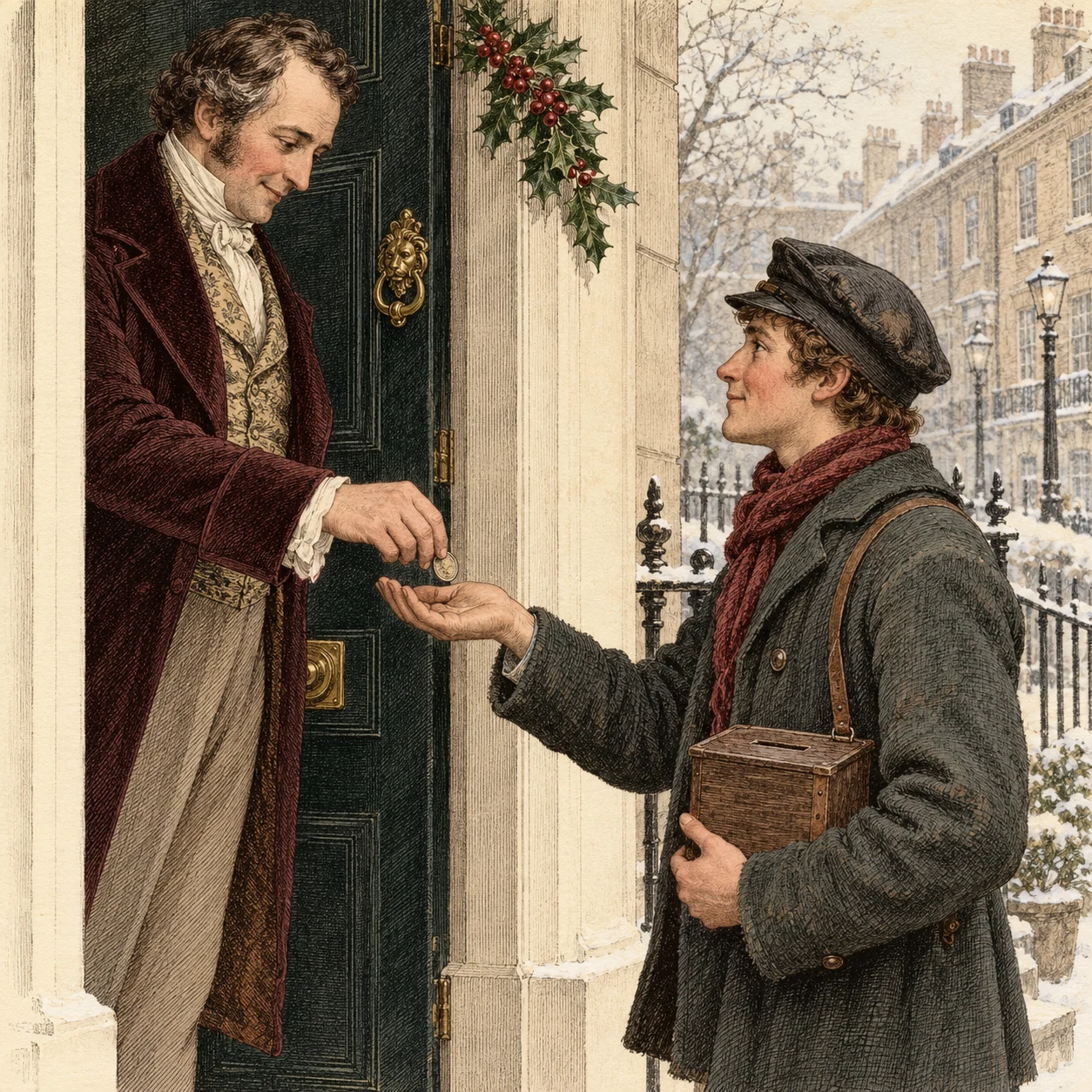
The name remembers a Christmas gift you might never have put beneath a tree: a tip for someone who had worked for you.
But the neat story of servants carrying boxes of leftovers home is only part of a much broader history.
THE SHORT ANSWER
Boxing Day takes its name from Christmas boxes: seasonal gifts, often money, given to servants, apprentices and people who provided services.
“Box” could mean the container used to collect contributions, then the gift itself. The name became attached to the day associated with receiving those gifts, rather than to boxing matches or clearing away Christmas packaging.
The connection is well supported. The precise beginnings of all the customs gathered under it are harder to pin down.
WHAT WE KNOW
Christmas boxes were familiar long before Victorian Christmas cards.
On 19 December 1663, Samuel Pepys recorded visiting his shoemaker and giving something to the boys’ Christmas box. His entry shows the custom operating through an ordinary commercial relationship, before Christmas Day itself.
The holiday’s name came later than the practice. Language historian Dave Wilton identifies “Boxing Day” in testimony from a London criminal trial in January 1743, and in a newspaper advertisement from December 1747.
That is a useful correction to accounts dating the expression only to the 1830s. It establishes eighteenth-century use, not the first occasion on which anyone spoke the words.
By the early nineteenth century, household records show how widely Christmas gratuities could reach. Sir John Soane’s Museum documents payments to watchmen, postmen and the worker responsible for the water supply. The cook handled smaller gifts to the dustman, sweep and newspaper boy.
On 26 December 1815, Soane also gave a coachman three shillings for his Christmas dinner.
HOW IT BECAME A HABIT
The Christmas box fitted a world in which households depended on a network of familiar workers. A seasonal payment acknowledged service and reinforced relationships.
It could also become an expectation.
State Library Victoria preserves examples of Christmas-box cards and newspaper verses used by delivery workers to encourage customers’ generosity. These were reminders that someone had brought the milk, carried the news or collected the rubbish throughout the year.
The library’s account includes memories of the practice in twentieth-century Melbourne. The custom had travelled far beyond an English country-house doorway.
The evidence also shows that Christmas-box giving was not confined to a single date. A name could settle on the day after Christmas even while gifts were requested and distributed across the festive period.
THE STORY EVERYONE TELLS
The familiar explanation goes like this: servants spent Christmas Day attending their employers, then received the following day off. They went home carrying boxes of money, presents or food.
This is a recognisable part of the tradition, and it helps explain why 26 December was a convenient day for giving. But it is too narrow to explain every Christmas box.
Pepys’s shoemaker’s boys and Soane’s postmen belong to a wider world of seasonal gratuities. They were not simply domestic servants taking the family’s leftover dinner home.
Another explanation points to church alms boxes and the distribution of charity around St Stephen’s Day, also 26 December.
That religious setting is relevant. It does not establish that one particular church box supplied the name for every later custom.
WHAT THE EVIDENCE ACTUALLY SAYS
The evidence label is WELL SUPPORTED — Christmas-box connection documented; deeper origins complex.
The strongest explanation connects the name with seasonal gifts for service. The Oxford Dictionary of English Folklore explicitly identifies Christmas boxes as its source and explains the shift from a receptacle to the gift.
That distinction matters. Receiving a Christmas box did not necessarily mean receiving an actual box.
There is less certainty about a single starting point. Household gifts, workplace collections and charitable giving belong to overlapping histories; shared language does not prove that they all began with one ceremony.
Nor should “Victorian tradition” become shorthand for “invented by the Victorians”. Pepys’s entry and the eighteenth-century examples of the holiday’s name are earlier.
The records reveal social obligation as well as generosity. A Christmas box could thank a worker, supplement earnings or feel like another payment that the giver was expected to make.
WHY IT STUCK
The words survived more easily than the custom that made them obvious.
Once Boxing Day became the familiar name of a place in the Christmas calendar, it no longer needed everyone to collect coins or distribute presents in boxes.
That leaves us with an everyday expression hiding an older relationship: the annual moment when people who provided service could expect something back.
RELATED CURIOSITIES
Why Do We Hang Stockings at Christmas?
Why Do Children Leave Shoes Out for St Nicholas?
Why Is Halloween Called Halloween?
SOURCES & FURTHER READING
Jacqueline Simpson and Steve Roud — The Oxford Dictionary of English Folklore, excerpted by Oxford University Press as “What is Boxing Day?”; Christmas boxes, gratuities and the development of the name.
https://blog.oup.com/2011/12/boxing-day/
Samuel Pepys — The Diary, 19 December 1663; contribution to the shoemaker’s boys’ box. Full 1663 text, edited by Henry B. Wheatley.
https://www.gutenberg.org/files/4145/4145-h/4145-h.htm
Dave Wilton — “Boxing Day”, Wordorigins; eighteenth-century examples and references to the 1743 Old Bailey proceedings and 1747 newspaper advertisement.
https://wordorigins-org.ghost.io/boxing-day/
Sue Palmer — “Christmas with the Soanes”, Sir John Soane’s Museum; Christmas gratuities recorded in household accounts.
https://www.soane.org/features/christmas-soanes
Kylie Best — “‘I’m the boy that brings the news, so a Christmas box I won’t refuse’”, State Library Victoria; delivery workers’ cards, verses and Australian memories of Christmas-box giving.