Before panic was an emotion, it was a god.
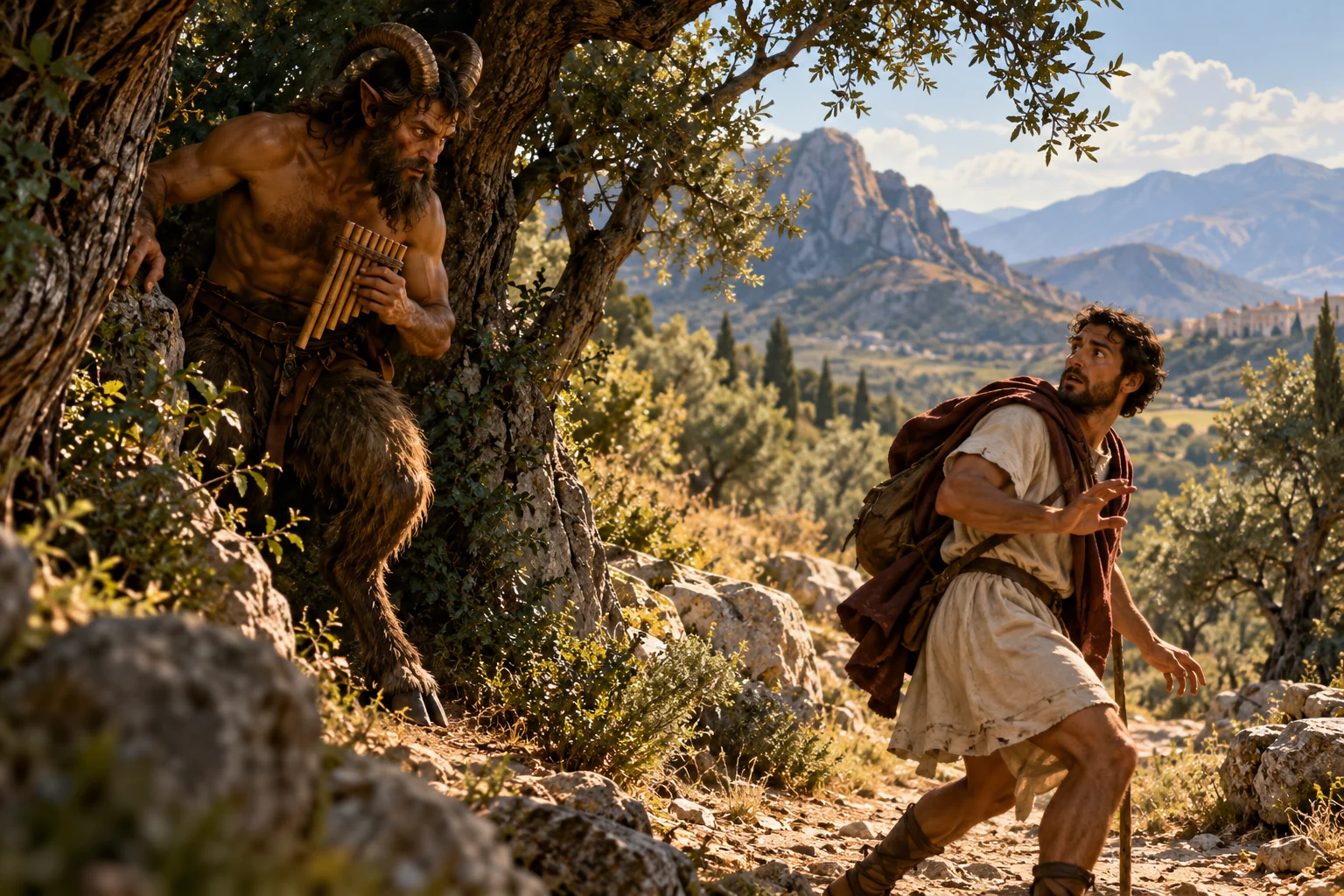
Imagine walking alone through the mountains of ancient Greece.
The afternoon is still. The trees barely move. Somewhere in the distance, a shepherd's pipes drift across the hillside.
Then, without warning, a terrible cry erupts from among the rocks.
You cannot see who made it. You cannot explain it. But suddenly your heart is racing, your thoughts are confused, and every instinct tells you to run.
To the ancient Greeks, such terror might have had a name — and a source.
Pan.
The goat-legged god of the wilderness was believed capable of inspiring sudden, overwhelming fear in those who wandered through his territory.
And more than two thousand years later, his name survives in a word we use almost every day.
Panic.
The Short Answer
The English word panic ultimately comes from the ancient Greek word panikos, meaning relating to Pan, the Greek god associated with shepherds, flocks, wild places and rustic music.
Pan was also believed to inspire sudden, inexplicable terror, particularly in lonely wildernesses and, in some ancient accounts, among groups of soldiers.
The expression developed through Greek and later European languages before entering English in the early seventeenth century.
Although the supernatural explanations belong to mythology, the linguistic connection is firmly established.
Every time we describe someone as panicking, we unknowingly preserve the name of an ancient Greek god.
Who Was Pan?
Among the gods of ancient Greece, Pan was an unusual figure.
Unlike Zeus, who ruled the heavens, or Poseidon, who commanded the seas, Pan belonged to the untamed countryside.
He was associated especially with Arcadia, a mountainous region of the Peloponnese, where shepherds tended their flocks among wooded valleys, rocky slopes and isolated pastures.
Pan was commonly depicted with the upper body of a man and the legs, horns and hooves of a goat. He often carried a shepherd's staff or played a set of reed pipes known as the syrinx.
He was a god of music, fertility, animals and the countryside.
But he was not always a comforting presence.
The same god who entertained shepherds with music could also inspire fear.
The Greeks imagined the natural world as a place inhabited by divine powers. Remote caves, shadowy woodland and deserted hillsides were not necessarily empty places.
They could be places where gods and spirits were encountered.
Pan belonged to precisely this unpredictable landscape.
He was sometimes playful, sometimes lustful, sometimes helpful — and sometimes terrifying.
His frightening character would eventually leave a permanent mark on the English language.
The God Who Could Frighten an Army
The ancient Greeks believed that fear did not always require an obvious cause.
A traveller might suddenly become overwhelmed by terror in an otherwise peaceful landscape.
An army might be seized by confusion, imagining enemies where none existed.
Such experiences could be interpreted as the work of Pan.
The idea was not simply that the god looked frightening.
He was associated with a special kind of fear: sudden, disorientating and seemingly without explanation.
An especially striking account appears in the writings of Pausanias, a Greek traveller and author of the second century CE.
Describing a conflict involving invading Gauls at Delphi in 279 BCE, Pausanias tells of soldiers becoming terrified during the night.
Some imagined that they could hear approaching cavalry and attacking enemies. Their alarm spread until the army fell into such confusion that men attacked one another.
Pausanias explicitly associates this kind of causeless terror with Pan.
His account provides a remarkable example of how ancient writers understood collective fear.
Today, we might look for explanations involving darkness, exhaustion, rumours, mistaken perceptions or the confusion of battle.
But for people who believed divine forces could intervene in human affairs, the sudden collapse of courage might be attributed to a god.
And Pan was particularly suited to the role.
Did Pan Help the Greeks Win the Battle of Marathon?
One of the most fascinating stories connecting Pan with Greek warfare concerns the Battle of Marathon in 490 BCE.
At the time, Athens faced an invading Persian army.
According to the historian Herodotus, the Athenians sent a professional long-distance runner named Philippides, also known in other versions as Pheidippides, to Sparta to request military assistance.
During his journey, the runner reportedly encountered Pan near Mount Parthenion, above the city of Tegea.
The god called to him and asked why the Athenians neglected him when he had shown them goodwill and had helped them in the past.
Philippides carried the message back to Athens.
The Athenians subsequently defeated the Persian forces at Marathon.
Herodotus records that, after their fortunes improved, they established a sanctuary to Pan beneath the Acropolis.
They also honoured him with annual sacrifices and a torch race.
It is an extraordinary account: a city at war, a runner crossing the mountains and an encounter with a god who believed he deserved recognition.
But there is an important distinction.
Herodotus does not explicitly state that Pan caused the Persian army to flee in panic at Marathon.
The idea that Pan frightened the enemy is a traditional interpretation associated with the god's reputation, rather than a specific battlefield action demonstrated by Herodotus's account.
What the ancient source does establish is that the Athenians connected Pan with their fortunes and subsequently incorporated him into their religious life.
The story shows how seriously the Greeks could take encounters with divine beings.
Whether Pan appeared to the runner is a matter of religious tradition.
That the story was recorded by Herodotus is a matter of historical evidence.
What We Know
There are three particularly strong pieces of evidence behind the story of panic.
First, the linguistic connection is established.
The Greek adjective panikos was formed from the name Pan. It became associated with sudden fear and eventually contributed to the English word panic, through French and Latin forms.
Second, ancient writers explicitly connected Pan with inexplicable terror.
Pausanias's description of the confusion among the Gauls near Delphi provides a clear literary example of fear attributed to the god.
Third, the worship of Pan at Athens was connected with the story of Marathon.
Herodotus records the runner's alleged encounter with Pan and the subsequent establishment of a sanctuary beneath the Acropolis.
Together, these sources demonstrate that the relationship between Pan, fear and the word panic is much more than a modern folk etymology.
What they do not demonstrate is that a supernatural being actually frightened travellers or soldiers.
The evidence supports the history of the belief, not the supernatural explanation.
How It Became a Habit
The journey from an ancient god to a modern everyday expression took many centuries.
In Greek, panikos meant belonging or relating to Pan.
Because Pan was associated with sudden terror, the word developed a connection with fear that seemed to strike without warning.
Later forms passed through Latin and French before the word entered English in the early seventeenth century.
By then, speakers did not need to believe in Pan to use the expression.
The name had become detached from the god.
Panic could describe a frightened crowd, an alarmed community or an individual overcome by fear.
As the word became established, it expanded into ordinary language.
We began to speak of people panicking, of financial panics, of panic buying and of situations in which everything suddenly became confused.
The supernatural explanation faded.
The feeling remained.
And the ancient god's name survived inside the word.
Why Was Pan Associated with Such Sudden Fear?
Part of the answer may lie in the landscape over which he presided.
Ancient shepherds and travellers often spent long periods in remote countryside, far from towns and settlements.
The natural world could be unpredictable.
A sudden animal cry, the movement of something unseen among the trees, or an unexpected noise echoing through a rocky valley might produce an intense feeling of alarm.
Without an obvious explanation, such experiences could acquire a supernatural meaning.
Pan offered a way of understanding fear that seemed to come from nowhere.
There is an interesting contrast here.
Pan was also associated with music and pleasure. His pipes could evoke the peaceful life of shepherds and their flocks.
Yet the same landscape that inspired rustic music could also produce terror.
The god embodied both possibilities.
He represented the countryside as a place of beauty, freedom and unpredictability.
This interpretation helps explain the appeal of Pan's frightening reputation, although it should not be mistaken for a proven account of how the belief first arose.
From Ancient Superstition to Modern Psychology
Today, panic is understood without reference to gods or supernatural forces.
The word can describe a sudden surge of fear, sometimes accompanied by a racing heartbeat, rapid breathing, dizziness or an overwhelming urge to escape.
Psychologists and medical professionals distinguish between ordinary panic, panic attacks and panic disorder.
These are modern clinical concepts, not direct continuations of ancient Greek religious beliefs.
Nevertheless, the historical connection is fascinating.
The ancient Greeks recognised that fear could arrive suddenly, overwhelm rational thought and spread rapidly through groups.
Their explanation sometimes involved divine intervention.
Our explanations draw upon psychology, physiology and the behaviour of people under stress.
The interpretation has changed dramatically.
But the experience of sudden fear remains recognisable across the centuries.
The Curious Survival of an Ancient God
Pan no longer occupies the same place in everyday religious life that he did in parts of ancient Greece.
His worship declined as the religious world of the Mediterranean changed.
Yet his name never entirely disappeared.
It survived in literature, art, music and mythology.
And it survived in something far more ordinary.
A word spoken in moments of fear.
A parent might panic when a child disappears from sight.
A traveller might panic after losing a passport.
A crowd might panic at an unexpected noise.
None of these people needs to know anything about ancient Greece.
Yet each time the word is used, the name of a goat-legged god from the mountains of Arcadia quietly returns.
The Strange by Habit Conclusion
The next time someone tells you not to panic, remember that the word carries a history stretching back to ancient Greek religion.
To the Greeks, sudden terror could be more than an emotion.
It could be the unseen presence of a god.
Pan might lurk in the mountains, disturb a lonely traveller or, according to ancient accounts, inspire confusion among soldiers.
We no longer need a horned deity to explain why fear sometimes overwhelms us.
But we still use his name.
The god has vanished from the hillside. His fear has never left our language.
EVIDENCE & SOURCES
Evidence rating: WELL SUPPORTED
The derivation of panic from Pan is established by historical linguistics. Ancient literary sources independently document Pan's association with sudden terror and his place in Athenian religious tradition.
The supernatural events described in these sources should be understood as ancient beliefs or reported experiences rather than verified historical occurrences.
Primary historical sources
1. Herodotus — Histories, Book 6, sections 105–106
Records the reported encounter between Philippides and Pan during the mission to Sparta before the Battle of Marathon, and the Athenians' subsequent establishment of a sanctuary to the god.
Source:
https://www.perseus.tufts.edu/hopper/text?doc=Perseus:text:1999.01.0126:book=6:chapter=105
2. Pausanias — Description of Greece, Book 10, section 23
Describes the confusion among Gaulish forces during the campaign against Delphi and explicitly associates causeless terror with Pan.
Source:
https://www.theoi.com/Text/Pausanias10B.html
Linguistic reference
3. Oxford Advanced Learner's Dictionary — Panic
Confirms the development of the English word through French and Latin from Greek panikos, derived from Pan's name.
Source:
https://www.oxfordlearnersdictionaries.com/definition/english/panic_1
Editorial qualification
The Battle of Marathon took place in 490 BCE, but the claim that Pan personally caused the Persian army to panic is not explicitly stated in Herodotus's account.
Do not present supernatural intervention as historical fact.
The opening woodland encounter is an illustrative reconstruction, not a documented individual incident.