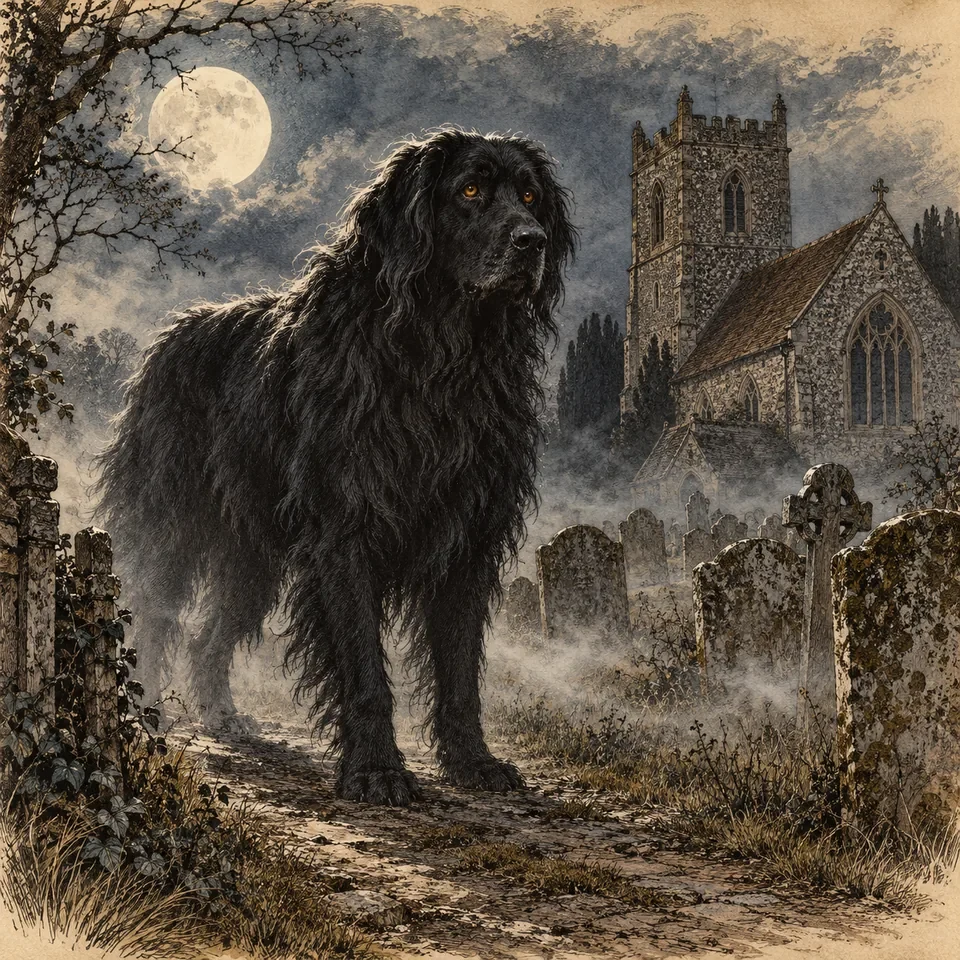
A large black dog appears on a lonely road. It makes no ordinary sound, and its eyes seem to catch a light that is not there. In some British traditions, meeting it meant that death was approaching.
But the supernatural dog had more than one job. The creature that terrified one community might protect travellers in another.
THE SHORT ANSWER
Ghostly black dogs became death omens in some traditions because stories associated them with graves, dangerous journeys and encounters with the supernatural. A dog appearing where the living met the dead made a memorable warning.
That explains the pattern more securely than it identifies an origin. There was no single British belief, and no demonstrated moment when black dogs acquired their sinister reputation. Recorded tales include threatening apparitions, guardians and apparently harmless companions.
WHAT WE KNOW
One exceptionally vivid early account concerns a storm in Suffolk on 4 August 1577. Abraham Fleming’s pamphlet, A Straunge and Terrible Wunder, described a black dog appearing among worshippers at Bungay, with deaths and injuries also reported at nearby Blythburgh.
Fleming presented the creature as a manifestation of the Devil. His pamphlet is evidence of a supernatural interpretation circulating in 1577, rather than proof that a spectral animal entered either church. He was compiling an account, not supplying his own eyewitness testimony.
Nor should we quietly rename every early apparition Black Shuck. That familiar name does not appear in Fleming’s account.
Later records reveal a much broader tradition. Ethel Rudkin’s 1938 study and Theo Brown’s 1958 survey gathered black-dog stories associated with roads, water, boundaries and burial places. Their collections also show why a single description is misleading: the dogs’ appearances and behaviour varied.
HOW IT BECAME A HABIT
A supernatural warning could become part of the practical geography of a place. A particular lane, bridge or churchyard was somewhere to avoid after dark because everyone knew what was supposed to walk there.
This is a plausible explanation of how the stories worked, rather than a proven account of how they began.
Galway City Museum describes a related Irish legend in which a frightening dog followed people crossing a bridge after midnight. The museum suggests that such stories could discourage late-night wandering, drinking and card-playing.
The warning travelled easily because it attached an extraordinary consequence to an ordinary decision: which way to walk home.
THE STORY EVERYONE TELLS
The familiar Black Shuck story gives East Anglia an enormous dark hound, uncanny eyes and an encounter that may announce death or disaster.
Its most dramatic historical setting is the Suffolk storm. In modern retellings, a hellhound tears through churches and leaves physical traces of its passage.
The distinction matters: an apparition attacking people is not quite the same belief as an apparition predicting a later death. Modern summaries often combine these different supernatural roles.
Nor does a mark on an old building establish what made it. A compelling local tradition can outlast the evidence needed to verify its details.
WHAT THE EVIDENCE ACTUALLY SAYS
The evidence label is DOCUMENTED FOLKLORE — exact origins uncertain.
The records establish that people told these stories. They do not establish that seeing a dog predicted anyone’s death.
The 1577 account also had a religious purpose. Christian Owen’s study places Bungay’s disaster within the tensions of the Elizabethan Reformation and examines Fleming’s interpretation of it as divine judgement. Reading it simply as a modern monster report misses that context.
Black-dog folklore was not uniformly hostile. Rudkin’s Lincolnshire material includes a protective tradition, while later scholarship discusses the contrast between ominous and helpful dogs.
Churchyard associations therefore need care too. Haunting a burial place, guarding it and warning of a future funeral are different ideas; they should not be assembled into one universal rule.
The recurring settings offer a reasonable interpretation. Roads, bridges and boundaries were places of passage; burial grounds made the connection with death explicit. An uncanny animal could personify the danger of crossing between familiar safety and an unknown world.
But interpretation is not a family tree. Similarities with ancient underworld hounds do not, by themselves, prove an unbroken line of descent. Nor can we demonstrate that the tradition began solely because black fur was frightening at night.
WHY IT STUCK
A ghost dog is unsettling partly because a dog ought to be familiar. It belongs beside a hearth, at a gate or walking with a person. Put it alone beside a grave, make it impossibly large, and reassurance becomes uncertainty.
The stories also leave room for a particularly effective question: is the animal following you to harm you, warn you or keep you safe?
You may not discover which until you reach home.
RELATED CURIOSITIES
Why Are Black Cats Considered Unlucky?
Why Did People Cover Mirrors After a Death?
Why Were People Afraid to Step Inside a Fairy Ring?
SOURCES & FURTHER READING
Christian Owen — “The Black Dog of Bungay: Religious Conflict and Supernatural Terror in a Suffolk Parish”, Journal of Religious History 48 (2024), 393–408; historical context and Fleming’s religious interpretation.
https://onlinelibrary.wiley.com/doi/full/10.1111/1467-9809.13099
Norfolk Record Office — “Black Shuck: The Hell Hound that Terrorises Blickling Hall”; archival examples and discussion of the 1577 account.
Adam Zmarzlinski — “The Black Dog”, Cultural Analysis 18.2 (2020); discussion of Ethel Rudkin’s and Theo Brown’s collections, including protective dogs and recurring settings.
https://www.ocf.berkeley.edu/~culturalanalysis/preview/volume18_2/vol18_2_Zmarzlinski.html
Theo Brown — “The Black Dog”, Folklore 69.3 (1958), 175–192; foundational comparative study. Publisher record; access to the full article may require a subscription.
https://www.tandfonline.com/doi/abs/10.1080/0015587X.1958.9717142
Galway City Museum — “The Black Dog of Wolfe Tone Bridge”; a related Irish tradition and discussion of warnings against late-night wandering.
https://galwaycitymuseum.ie/blog/the-black-dog-of-wolfe-tone-bridge/