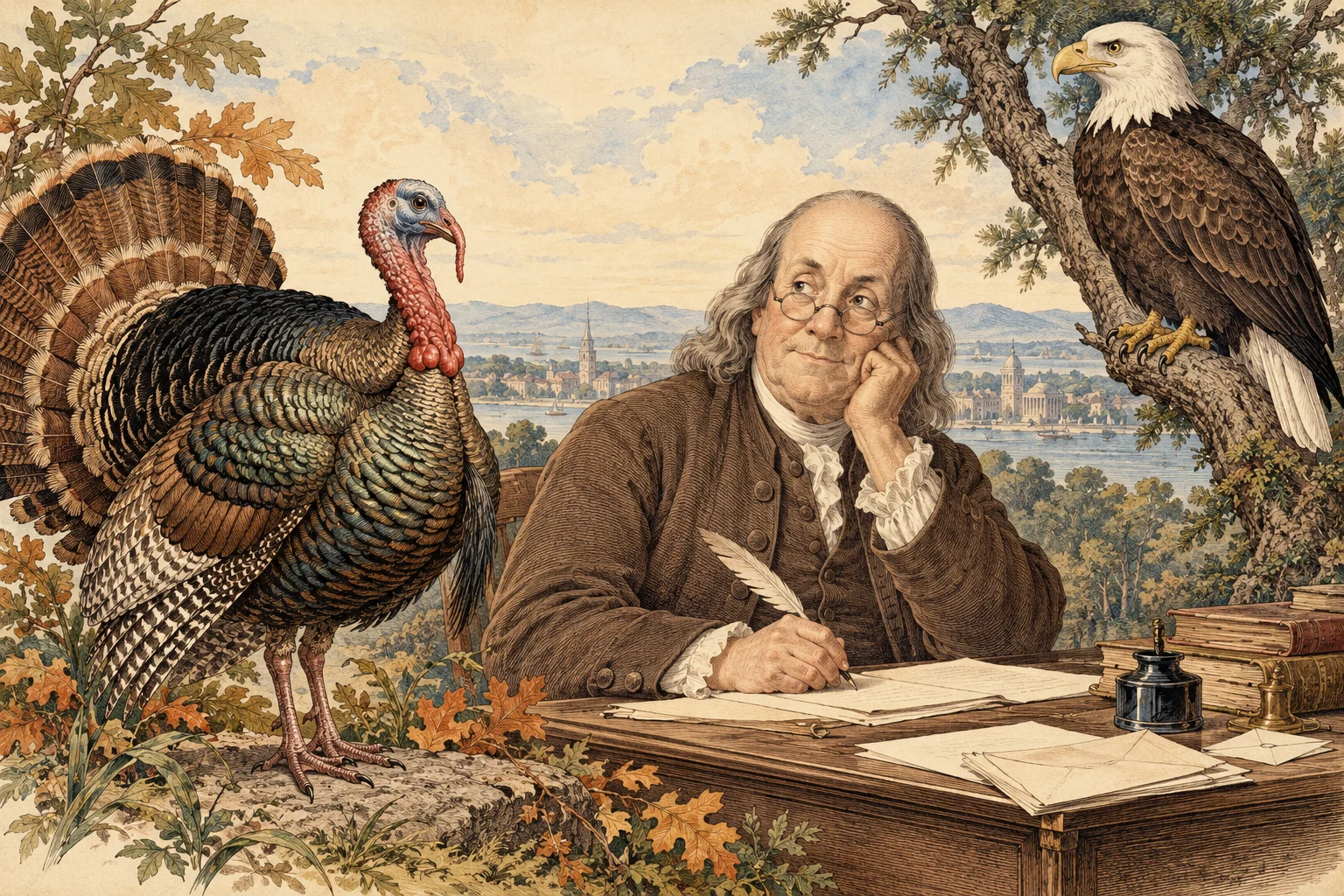
It is an irresistible piece of Thanksgiving trivia: Benjamin Franklin wanted America represented by a turkey, but the bald eagle won instead.
Franklin certainly supplied some splendid insults about the eagle. What he did not supply was the national contest that later storytellers built around them.
THE SHORT ANSWER
The belief grew from a real letter whose context was gradually lost.
On 26 January 1784, Franklin wrote to his daughter Sarah Bache about the Society of the Cincinnati, an organisation of Revolutionary War officers. Discussing its eagle insignia, he criticised the bald eagle and favourably compared it with the turkey.
Those comments became the basis of the claim that he had proposed the turkey as America’s national bird.
But praising a bird in a satirical letter is different from submitting it as a national emblem. The documented record of Franklin’s involvement in designing the Great Seal contains a proposal featuring Moses and Pharaoh, rather than a turkey.
WHAT WE KNOW
On 4 July 1776, Congress appointed Franklin, Thomas Jefferson and John Adams to devise a seal for the newly independent United States.
Franklin’s suggested scene showed Moses and the destruction of Pharaoh’s forces in the Red Sea. Its political message concerned liberation from tyranny.
Congress did not adopt the committee’s submission. Further committees followed, and the eventual design drew together several people’s contributions.
On 20 June 1782, Congress adopted the Great Seal, with an American bald eagle at the centre of its front face.
Franklin’s famous letter came more than eighteen months later.
The sequence matters. His turkey comments were not an intervention in the original committee’s deliberations, nor evidence of a congressional vote between two rival birds.
WHAT DID FRANKLIN ACTUALLY WRITE?
The letter’s immediate subject was the Society of the Cincinnati and its hereditary character: membership could pass to descendants, raising uncomfortable questions about creating distinctions in a republic.
Its eagle badge gave Franklin an opportunity for a character assessment.
He called the bald eagle a “Bird of bad moral Character”, describing it taking fish caught by another bird and allowing itself to be driven away by a much smaller kingbird.
Then came the comparison that would outlive the surrounding argument.
The turkey, he wrote, was “a much more respectable Bird” and “a true original Native of America”.
His defence was hardly solemn. He acknowledged its vanity and silliness, then imagined it attacking a British guardsman who entered its farmyard wearing a red coat.
The passage mixes political satire, observations about birds and a patriotic joke. Read alone, it can sound like an endorsement. Read in context, it is not a formal nomination.
HOW IT BECAME A HABIT
The story becomes easier to repeat each time a qualification disappears.
Franklin criticised the eagle.
Franklin praised the turkey.
Franklin preferred the turkey.
Franklin wanted it chosen as America’s national bird.
The first two statements are directly documented. The last turns his comparison into an account of official decision-making.
Popular culture helped make that imagined contest familiar. The musical 1776 dramatised a debate involving competing birds. A 1962 New Yorker cover imagined a turkey occupying the eagle’s place in the national emblem.
Neither example establishes where the myth first began. They show how comfortably it fitted entertainment and visual humour.
Thanksgiving provides an especially convenient occasion for its retelling. The bird is already the centre of attention; Franklin supplies the surprising historical guest.
THE STORY EVERYONE TELLS
In the familiar version, the founders are choosing America’s bird.
Others favour the magnificent eagle. Franklin objects that it is dishonest and cowardly, then argues for the brave, native turkey.
The eagle wins. America narrowly avoids putting its Thanksgiving dinner on its national emblem.
It is a wonderfully compact story, with a famous character, a comic alternative and an unexpected fact.
Its weakness is that the supposed contest is not what the surviving evidence records.
WHAT THE EVIDENCE ACTUALLY SAYS
Our evidence label is WELL SUPPORTED for the correction.
Franklin genuinely criticised the eagle and praised the turkey. It would be misleading to suggest the whole comparison was invented.
He also explicitly expressed regret about the eagle representing the country. His comments therefore cannot be dismissed as having no connection with national symbolism.
But the particular eagle image under discussion belonged to the Society of the Cincinnati. The letter does not document an earlier proposal to Congress to choose a turkey.
Meanwhile, his actual 1776 seal proposal survives in the historical record and concerns Moses and Pharaoh.
The evidence supports a distinction between a personal, humorous comparison and an official campaign. It does not establish the first person who blurred that distinction, or a single moment when Americans collectively adopted the myth.
WHY IT STUCK
The misunderstanding preserves Franklin’s wit while removing the political explanation needed to understand it.
A hereditary officers’ society takes a little unpacking. A turkey challenging an eagle can be pictured immediately.
It also offers an entertaining alternative America: the same republic, but with a rather different bird above the lectern.
The real story remains amusing. Franklin did give the turkey a surprisingly favourable reference. Later generations turned that reference into an application for office.
RELATED CURIOSITIES
Why Do People Break a Turkey’s Wishbone to Make a Wish?
Why Do We Say “Go Cold Turkey”?
Where Did “Rule of Thumb” Really Come From?
SOURCES & FURTHER READING
National Archives, “Talking Turkey” — reproduces Franklin’s bird comparison from his letter to Sarah Franklin Bache, dated 26 January 1784.
https://annotation.blogs.archives.gov/2020/11/25/talking-turkey/
Library of Congress, “Transcript of Benjamin Franklin to Sarah Bache” — a short transcription of the turkey passage.
https://www.loc.gov/exhibits/franklin/bf-trans29.html
American Revolution Institute, “The Great Seal of the United States” — committee chronology, primary documents and the Society of the Cincinnati context.
National Archives, “Original Design of the Great Seal of the United States (1782)” — the adoption and development of the seal.
https://www.archives.gov/milestone-documents/original-design-of-the-great-seal-of-the-united-states
Thomas Jefferson’s Monticello, “Seal of the United States” — Franklin’s biblical proposal and his later comments about the Cincinnati insignia.
https://www.monticello.org/encyclopedia/seal-united-states
National Constitution Center, “Why we don’t have a turkey on our Great Seal” — the unsupported turkey candidacy and its dramatisation in 1776.
https://constitutioncenter.org/blog/why-we-dont-have-a-turkey-on-our-great-seal
Smithsonian Magazine, “American Myths: Benjamin Franklin’s Turkey and the Presidential Seal” — the popular story and the 1962 New Yorker illustration.