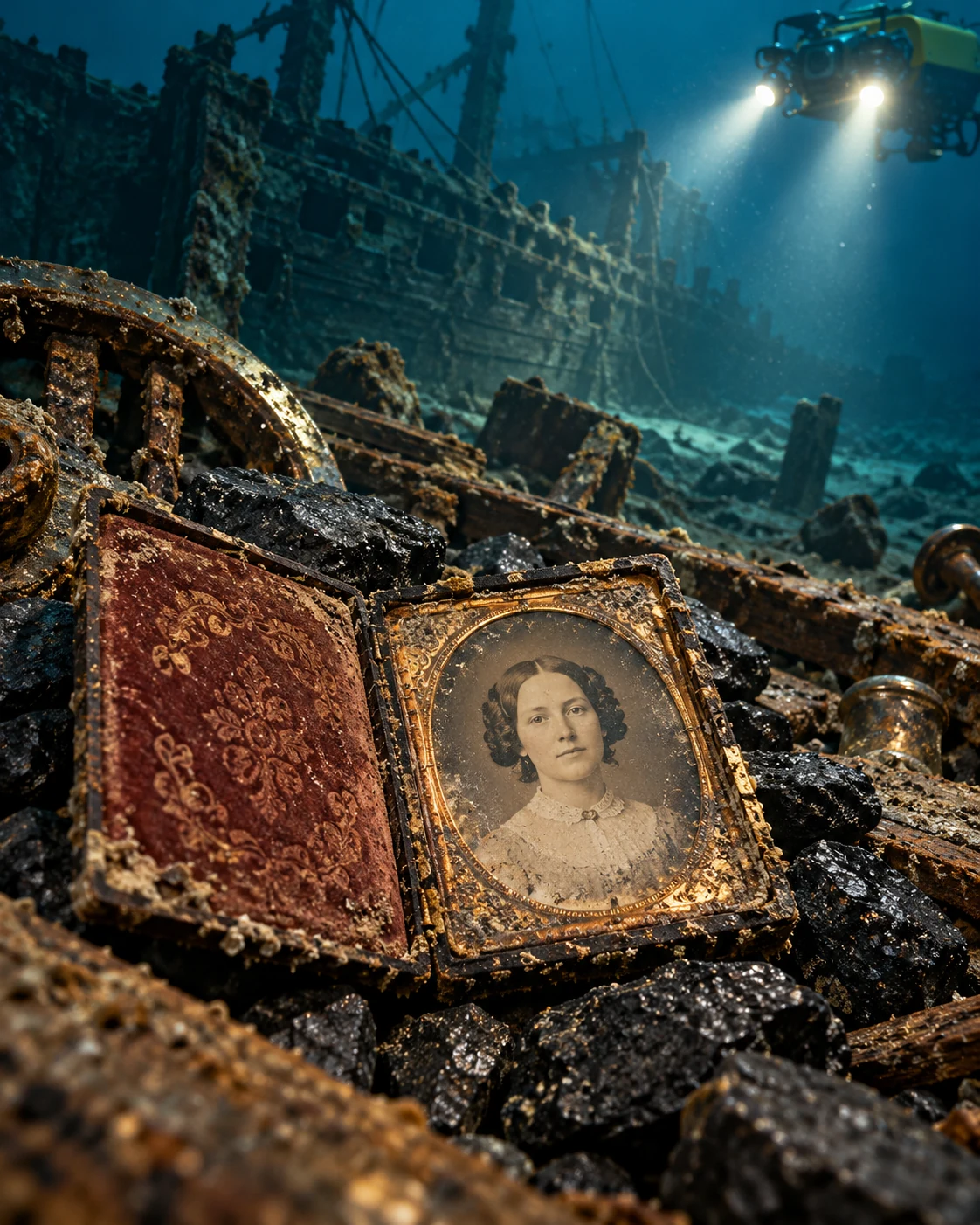
When treasure hunters explored a nineteenth-century shipwreck beneath the Atlantic Ocean, they expected to find gold. Instead, among the wreckage lay a haunting photograph of an unidentified young woman. She had been waiting in the darkness since 1857.
In the cold darkness of the Atlantic Ocean, more than 2,000 metres beneath the surface, something extraordinary lay among the scattered remains of a Victorian steamship.
It was not a gold coin.
It was not a jewel, a pocket watch or a precious ornament.
It was the face of a young woman.
Her hair fell in carefully arranged curls around her shoulders. She wore a delicate blouse and jewellery, and her expression seemed almost impossibly calm.
She looked directly towards the camera, as though waiting to be recognised.
But nobody knew her name.
The photograph had travelled aboard the SS Central America, a steamship that sank during a violent hurricane in September 1857.
For more than 150 years, the image remained beneath the Atlantic, apparently lost forever.
Then, in 2014, an underwater recovery team discovered it among the ship's scattered coal.
The photograph became known as the Mona Lisa of the Deep.
And although the portrait survived one of the nineteenth century's most notorious maritime disasters, the identity of the woman remains a mystery.
The Ship That Carried a Fortune
In September 1857, the SS Central America was making its way towards New York.
The vessel was a large wooden-hulled paddle steamer, built to transport passengers, mail and cargo between Central America and the eastern United States.
Among those aboard were travellers returning from California during the great Gold Rush.
Before the completion of the transcontinental railway, travelling between California and the American East Coast was a complicated undertaking.
Passengers commonly sailed from California to Panama, crossed the narrow strip of land separating the Pacific and Atlantic oceans, and boarded another steamship for the journey north.
The Central America was part of this important transportation network.
Its passengers included businessmen, miners, families and people carrying the results of years of work in the California goldfields.
But the ship also carried something of enormous financial importance.
Hidden within its cargo were tons of gold in the form of coins, bars and dust.
Some of this gold was destined for American banks.
The vessel was therefore carrying not only passengers and personal possessions, but a substantial part of the wealth generated by the California Gold Rush.
It was a valuable cargo.
And it was about to disappear.
A Hurricane in the Atlantic
On 8 September 1857, the Central America departed Havana for New York.
The voyage initially appeared routine.
But as the ship travelled northwards, the weather deteriorated.
Powerful winds and enormous seas battered the vessel.
Water began entering the hull, and the crew struggled to keep the ship afloat.
The steam engines eventually lost power, leaving the vessel increasingly helpless in the storm.
Passengers and crew formed desperate lines to bail water from the ship.
For days, they fought against the Atlantic.
On 12 September, another vessel, the brig Marine, reached the stricken steamship.
A rescue operation began, with women and children among those transferred to safety.
But the conditions were dreadful, and the rescue could not save everyone.
That evening, the Central America finally sank.
Approximately 425 people lost their lives.
The disaster became one of the deadliest American peacetime maritime tragedies of the nineteenth century.
Along with the passengers, the ship carried tons of California gold to the ocean floor.
The financial loss added to the pressures already affecting the American banking system during the Panic of 1857.
For the families of those who died, however, the greatest loss had nothing to do with money.
The ship had taken their loved ones, their possessions and countless personal memories into the depths.
Among those possessions was a small photographic portrait.
The Ship of Gold Is Rediscovered
For generations, the wreck of the Central America remained hidden beneath the Atlantic.
Its enormous cargo of gold inspired speculation, exploration and increasingly ambitious attempts to locate the vessel.
By the late twentieth century, advances in underwater technology had made it possible to explore depths that earlier treasure hunters could scarcely have imagined.
In the late 1980s, a team led by ocean engineer Tommy Thompson located the wreck.
The discovery attracted enormous attention.
The Central America became widely known as the Ship of Gold.
Recovery operations brought gold coins, bars and other objects back to the surface.
But the salvage operation was also surrounded by legal disputes, financial controversy and long interruptions.
In 2014, another major recovery expedition began.
Using sophisticated remotely operated underwater equipment, researchers explored the wreck and recovered additional objects.
Some were financially valuable.
Others offered intimate glimpses of everyday nineteenth-century life.
There were pieces of clothing, personal accessories, bottles, tools and photographs.
And among a scattered pile of coal, the underwater cameras revealed something astonishing.
A young woman's face.
The Woman Who Looked Back from the Deep
The photograph was discovered lying face upwards among the coal on the seabed.
According to accounts from the recovery team, the woman's portrait appeared to be looking directly towards the underwater camera.
It was a remarkable sight.
The image had spent approximately 157 years beneath the ocean.
Yet the woman's features remained recognisable.
Her hair, clothing and expression could still be seen.
The recovery team nicknamed the portrait the Mona Lisa of the Deep, recalling the enigmatic expression of Leonardo da Vinci's famous painting.
But unlike the Mona Lisa in the Louvre, this woman's identity was unknown.
There was no established name to accompany her face.
No confirmed biography.
No reliable explanation of why her portrait had been aboard the ship.
Was it carried by a husband returning home?
Was it a treasured keepsake belonging to a traveller?
Had someone brought the portrait as a gift for a relative or sweetheart?
These are intriguing possibilities.
But they remain possibilities, not established historical facts.
The surviving photograph tells us what the woman looked like.
It does not tell us who she was.
How Could a Photograph Survive Underwater for 157 Years?
One of the most remarkable aspects of the discovery is the photographic technology involved.
The portrait was a daguerreotype.
Introduced publicly in 1839, the daguerreotype was one of the earliest successful photographic processes.
Unlike modern photographs printed on paper, daguerreotypes were produced on polished, silver-coated copper plates.
The plate was sensitised, exposed inside a camera and chemically developed to create a remarkably detailed image.
Because the photographic image existed on a metal surface, a daguerreotype could possess extraordinary sharpness.
But these images were also delicate.
Their surfaces were vulnerable to damage, tarnishing and physical contact.
Daguerreotypes were commonly protected behind glass and placed inside decorative cases.
That protective construction could help shield the image from some forms of deterioration.
In the case of the Central America, the exact conditions responsible for the survival of individual photographs are not fully established.
The wreck lay in deep water, where conditions differ considerably from those at the surface.
Its recovered photographic objects also varied enormously in condition.
Many were damaged beyond recognition.
Others retained remarkable detail.
The Mona Lisa of the Deep was among the exceptional survivors.
Its survival was not evidence that daguerreotypes are generally waterproof.
Rather, it reflected an unusual combination of photographic materials, protection, environmental conditions and conservation.
What makes the discovery extraordinary is precisely how unlikely such survival seems.
A Shipwreck Full of Forgotten Faces
The Mona Lisa of the Deep was not the only photograph recovered from the wreck.
During the 2014 expedition, researchers recovered more than 100 photographic objects.
Many had deteriorated so badly that their subjects could no longer be identified.
But approximately ten daguerreotypes and ambrotypes survived with unusually clear images.
An ambrotype was another nineteenth-century photographic process, typically producing an image on glass.
These photographs represented something different from the gold that had originally attracted treasure hunters.
They were personal possessions.
A gold coin could be weighed, dated and valued.
A photograph carried a more intimate meaning.
It might preserve the face of a wife, husband, child, parent or friend.
For nineteenth-century travellers, photographic portraits offered a way to carry the likeness of someone they loved.
In an age before digital photography, smartphones or instant communication, such an image could be deeply precious.
The presence of photographs aboard the Central America reminds us that its passengers were not merely names in a shipping record.
They were individuals with families, relationships and personal histories.
Many of those histories disappeared with the ship.
Who Was the Mona Lisa of the Deep?
The photograph shows a young woman wearing a light-coloured garment with decorative detailing.
Her hair falls in curls around her shoulders.
She sits with her hands resting in her lap.
The image has the careful composition associated with nineteenth-century studio portraiture.
But beyond these visible details, surprisingly little can be established.
There is no confirmed identification of the woman.
It is not known whether she was travelling aboard the Central America.
Indeed, the portrait may have belonged to someone else entirely.
A passenger could have been carrying a photograph of a person who remained safely at home.
It might have been a gift, a family keepsake or a treasured remembrance.
Without a reliable inscription, associated documentation or a confirmed link to a particular passenger, assigning the woman a name would be speculation.
Her clothing and hairstyle may help establish an approximate period, but they cannot independently reveal her identity.
The mystery therefore remains unresolved.
More than a century and a half after the ship sank, the woman's face has returned to public view.
Her name has not.
The Photograph That Sold for $73,200
In March 2023, the Mona Lisa of the Deep appeared at auction.
It was offered as part of a major sale of artefacts recovered from the SS Central America.
The auction included objects ranging from gold coins and ingots to everyday possessions that had spent generations beneath the Atlantic.
The photograph attracted particular interest.
It was a genuine nineteenth-century daguerreotype, recovered from a historically important shipwreck and accompanied by an extraordinary story.
Its combination of rarity, preservation and mystery made it one of the most memorable objects in the sale.
The winning bid was $61,000.
With the buyer's premium included, the final price reached $73,200.
The photograph was purchased by Finest Known, a company specialising in rare coins and historical collectibles.
The company subsequently announced that it intended to preserve the photograph rather than offer it for resale.
For an image whose subject remains unidentified, the price was extraordinary.
But its appeal went beyond monetary value.
It was a photograph that had seemingly returned from another world.
Why the Mystery Still Matters
The SS Central America is remembered primarily for its enormous cargo of gold.
Its loss contributed to an already unstable financial situation in the United States, and its eventual discovery became one of the great stories of modern deep-sea salvage.
But the Mona Lisa of the Deep offers a different perspective.
The photograph has no confirmed connection to a wealthy passenger, a celebrated historical figure or an important political event.
It shows an ordinary human face.
Someone who lived, dressed, posed for a camera and was important enough to another person that her likeness was preserved.
That is what makes the image so moving.
The woman may never have travelled aboard the ship.
She may never have seen the Atlantic.
She might have lived for decades after the Central America disappeared.
Or her own life may have ended long before the portrait was rediscovered.
We simply do not know.
Yet her face survived a disaster that destroyed so many lives and possessions.
For 157 years, the image lay hidden in darkness.
Then, through an extraordinary combination of technology, exploration and chance, it emerged once more.
The ship's gold was valuable because of what it was worth.
The photograph is fascinating because of what it cannot tell us.
Who was she?
Who carried her picture?
And did anyone waiting on shore ever learn what happened to the portrait?
The answers may be lost forever.
But the young woman who became the Mona Lisa of the Deep has achieved something remarkable.
More than 160 years after her photograph was taken, people are still looking into her eyes.
And wondering about her life.
What Does the Evidence Say?
WELL SUPPORTED
The sinking of the SS Central America on 12 September 1857, the recovery of photographic artefacts during the 2014 expedition, and the 2023 auction of the Mona Lisa of the Deep are well documented.
The photograph is confirmed as a nineteenth-century daguerreotype recovered from the shipwreck. Its sale for $73,200, including the buyer's premium, is supported by the auction records.
The woman's identity, her relationship to any passenger, and the original reason her portrait was aboard the vessel remain unknown.
The precise combination of environmental and physical factors that allowed this particular photograph to survive underwater has not been conclusively established.
Sources and Further Reading
1. Smithsonian National Museum of American History — The Sea Ran Mountains High. An account of the SS Central America disaster and its historical consequences.
2. Smithsonian National Postal Museum — Sinking of the Central America — and Its Rebirth. Historical background on the vessel, its cargo and the discovery of the wreck.
3. Professional Photographers of America — Mona Lisa of the Deep, November 2022. Documentation of the recovered photographs and their condition.
https://www.ppa.com/ppmag/articles/mona-lisa-of-the-deep
4. Finest Known — Mona Lisa of the Deep, March 2023. Account from the photograph's purchaser, including recovery details and the auction result.
https://finestknown.com/mona-lisa-of-the-deep/
6. North Carolina Department of Natural and Cultural Resources — Bounty Off Cape Hatteras in Shipwreck of the Central America. Historical overview of the sinking and recovery.
https://www.dncr.nc.gov/blog/2016/09/12/bounty-cape-hatteras-shipwreck-central-america