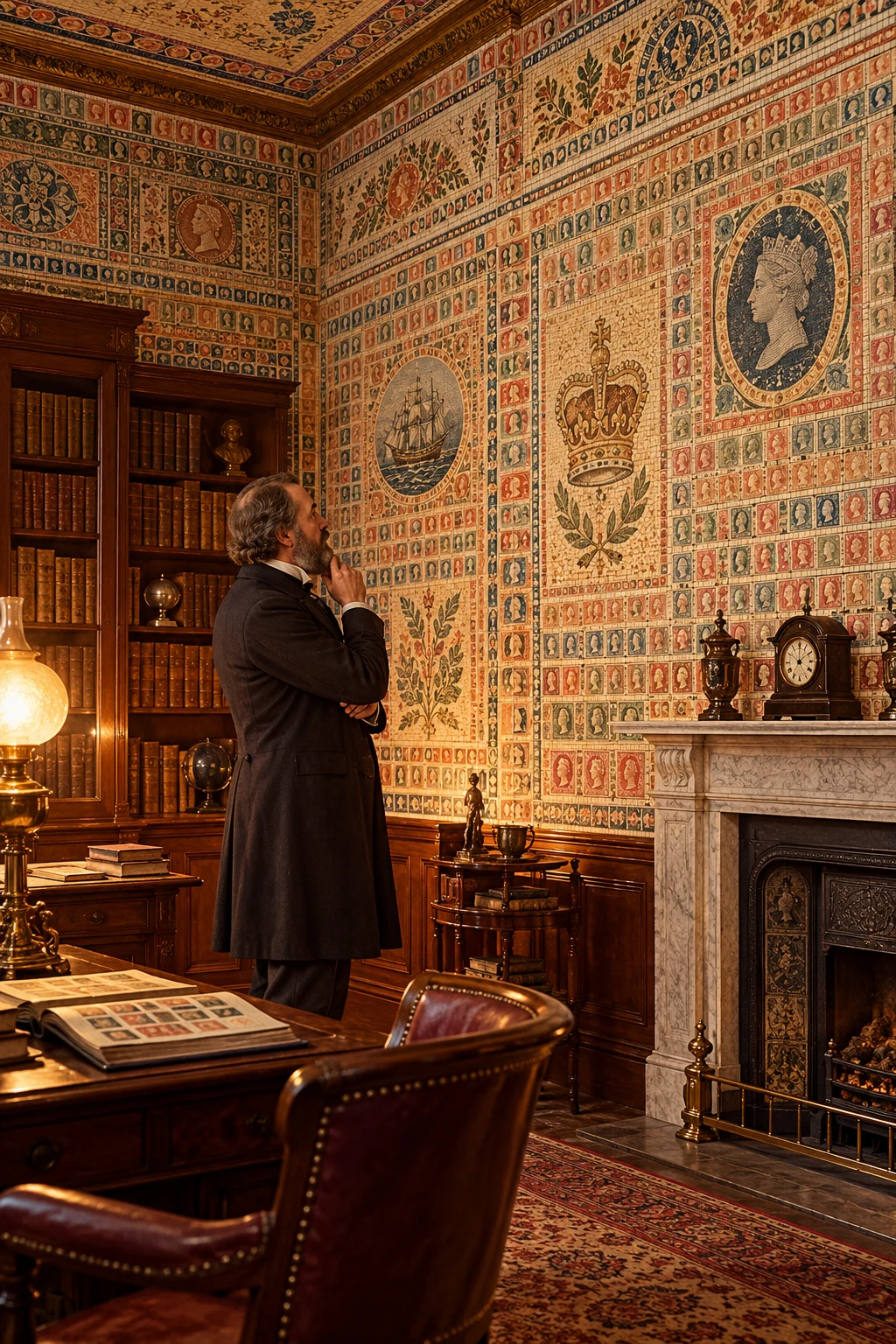
In 1892, an eccentric English businessman turned an ordinary room into a dazzling mosaic of more than 44,000 postage stamps. It took three months to complete, attracted visitors from across Britain, and became one of the strangest interiors of the Victorian age.
Imagine stepping into a handsome Victorian house in Ipswich, Suffolk, and discovering that its walls are covered not with wallpaper, paintings or expensive tapestries, but with postage stamps.
Thousands upon thousands of them.
Stamps arranged into elaborate geometric patterns, decorative borders and colourful mosaics. Stamps from countries across the world, painstakingly positioned to transform an ordinary room into something extraordinary.
This was no imaginary scene from a Victorian novel.
In 1892, a successful stamp dealer named Charles Whitfield King commissioned a decorator to cover the walls of a room in his home with an astonishing 44,068 postage stamps.
Their combined face value was recorded as £699 16s 9d — a considerable sum in Victorian money.
The finished room became a local curiosity, a talking point among collectors and a remarkable monument to one man's unusual relationship with the humble postage stamp.
But why did he do it?
And what became of this extraordinary room?
The Boy Who Built an Empire from One Shilling and Fivepence
Charles Whitfield King was born in 1855, at a time when postage stamps were still a relatively recent invention.
Britain had introduced the Penny Black in 1840, revolutionising the way letters were paid for and delivered. Within a few decades, stamps had become objects of fascination in their own right.
Collectors searched for unusual designs, distant countries, printing errors and rare examples. Stamp dealing was developing into a serious commercial enterprise.
King recognised the opportunity remarkably early.
According to an account published in The Postage Stamp in July 1910, he began dealing in stamps in 1869, when he was just fourteen years old.
Working for a shipping firm in Ipswich, he bought stamps removed from business correspondence and resold them to other collectors.
His starting capital was just one shilling and fivepence.
Rather than spending his profits, he reinvested them in more stamps.
He advertised in boys' magazines and gradually developed a business that would grow far beyond his original teenage enterprise.
Eventually, Whitfield King & Co. became one of Britain's leading stamp-dealing firms, trading with customers and suppliers around the world.
Yet King's most unusual achievement was not a rare stamp or an impressive business transaction.
It was a room in his own house.
Morpeth House: The Home of the Stamp King
By the late nineteenth century, King had become a prosperous businessman.
His home, Morpeth House, stood at 99 Lacey Street in Ipswich. Built in 1887, it was a substantial Victorian residence with spacious rooms and extensive gardens.
Directly across the street stood his business premises.
This arrangement allowed King to move easily between his private life and the commercial world of stamps.
Visitors to the house encountered a man whose interests extended well beyond philately, the formal name for stamp collecting.
He was also an enthusiastic horticulturalist, particularly interested in orchids.
His gardens and greenhouses contained an impressive collection of plants, while the house itself reflected the tastes of a prosperous Victorian businessman.
But one room stood apart from everything else.
In 1892, King decided to decorate his library with postage stamps.
Not framed collections.
Not albums displayed on shelves.
Actual stamps pasted directly onto the walls.
A Wallpaper Made from 44,068 Stamps
The undertaking required an extraordinary amount of patience.
King employed a professional decorator who worked on the room for approximately three months.
Historical accounts describe the decorator spending eleven hours a day arranging and attaching the stamps.
The stamps were not simply pasted randomly.
They were organised into decorative mosaics, borders, friezes and repeating geometric designs.
Different colours and denominations could be combined to create patterns, transforming small pieces of printed paper into an elaborate decorative surface.
The recorded total was 44,068 stamps, with a combined face value of £699 16s 9d.
To appreciate the scale of the undertaking, imagine counting, positioning and fixing more than forty-four thousand individual pieces of paper, each only a few centimetres across.
It was a feat of craftsmanship as much as eccentricity.
And the project did not necessarily end with the original decoration.
A later historical account records that, when a bookcase was removed in 1894, another 5,474 stamps were added to the newly exposed wall space.
The room continued to evolve.
Why Use Postage Stamps Instead of Wallpaper?
At first glance, the project seems like an extravagant way to demonstrate wealth.
But there was a more practical explanation.
A later philatelic account describes how certain obsolete or officially reprinted stamps had become difficult for dealers to sell during the 1880s.
Among them were issues associated with places such as Argentina, Cuba, Hanover, Samoa and the former Roman States.
Some stamps that might once have been attractive to collectors had become commercially troublesome.
King had access to enormous quantities of stamps through his business.
Rather than leaving some of this stock unused, he could turn it into an extraordinary decorative display.
The room therefore combined several purposes.
It was an expression of his personal fascination with stamps, a demonstration of decorative ingenuity and a striking advertisement for the business that had made him wealthy.
A visitor who saw the stamp-covered walls was unlikely to forget the name Whitfield King.
There is no surviving statement establishing every motive behind King's decision, but the combination of surplus stock, craftsmanship and commercial showmanship provides a persuasive explanation.
It was eccentricity with a practical side.
When the Stamp Room Became a Victorian Attraction
The unusual room soon acquired a reputation beyond Ipswich.
Contemporary philatelic publications described it, and visitors came to Morpeth House to see the extraordinary decoration.
In 1897, The Philatelic Record published an account of a visit to Whitfield King & Co.
The writer described being shown into the celebrated stamp room before meeting King and touring his business premises.
By July 1910, The Postage Stamp was describing the room as a well-known attraction that had received thousands of visitors.
The publication also noted that King's visitors' books contained signatures from notable collectors and people associated with public, literary and theatrical life.
For a successful businessman, the room offered something more memorable than an ordinary drawing room.
It was a spectacle.
Visitors could admire the patterns, marvel at the number of stamps and discuss the extraordinary labour involved.
In an age fascinated by collecting, cataloguing and displaying objects from around the world, King's creation was particularly well suited to attracting attention.
The stamps were tiny objects, but together they produced something monumental.
The Victorian Obsession with Collecting
King's room may seem bizarre today, but it belonged to a wider nineteenth-century culture of collecting.
Victorians accumulated coins, fossils, butterflies, shells, postcards, curiosities and objects from across the expanding commercial world.
Collections could demonstrate learning, wealth, taste or personal dedication.
Some were carefully arranged in cabinets.
Others filled entire rooms.
Stamp collecting offered something particularly appealing.
For a relatively modest sum, an enthusiast could acquire small printed objects representing distant places, unfamiliar monarchs and foreign postal systems.
A stamp album could become a miniature geographical museum.
For collectors, stamps were not merely proof that postage had been paid.
They were pieces of history, design and international communication.
King took that fascination one step further.
Instead of keeping the stamps within an album, he transformed the room itself into a gigantic display.
The result blurred the boundaries between collecting, decoration and commercial spectacle.
Was It the Most Expensive Wallpaper in the World?
Newspaper and philatelic accounts sometimes described the room in extravagant terms.
A report reproduced in Philatelic West in the early twentieth century called attention to what was believed to be an exceptionally expensive wallpapered room.
Such claims were part of the publicity surrounding King's remarkable interior.
But the figures need careful interpretation.
The recorded £699 16s 9d represented the combined face value of the stamps used in the original decoration.
That was not necessarily the amount King had paid to acquire them, nor did it establish what the stamps would have fetched on the collectors' market.
Some had become difficult to sell, which helps explain why they were available for decoration.
Nor is there sufficient evidence to establish a definitive world record for the room.
What can be said with confidence is that King created an unusually elaborate and well-documented Victorian interior using tens of thousands of genuine postage stamps.
Its historical significance lies less in an uncertain price comparison than in the extraordinary imagination behind it.
What Happened to the Room?
For decades, the stamp room remained one of the most remarkable features of Morpeth House.
But extraordinary interiors do not always survive changing fashions and new owners.
During the twentieth century, the building passed into other hands and was used for different purposes, including as a dancing school.
The elaborate stamp decoration gradually disappeared.
Accounts of the building's later history describe the room losing much of its original character as its use changed.
Today, almost all of the original stamp-covered walls have vanished.
Yet a small fragment survives.
Above the fireplace at Morpeth House, a decorative arrangement of stamps still forms the date 1892, surrounded by a mosaic border.
It is a remarkable survivor from a room that once contained more than forty-four thousand stamps.
The house itself is recognised on Ipswich's local heritage list, while a blue plaque commemorates Charles Whitfield King as the stamp king of East Anglia.
The surviving fragment offers a tangible connection to one of the town's most unusual Victorian businessmen.
The Man Who Turned Ordinary Stamps into Something Extraordinary
Charles Whitfield King died in 1930.
His stamp business and the extraordinary room he created became part of Ipswich's local history.
What makes the story memorable is not simply the astonishing number of stamps.
It is the transformation of an everyday object into something nobody expected.
A postage stamp was designed to carry a letter from one place to another.
King turned thousands of them into a decorative environment, an advertisement, a conversation piece and a monument to the collecting culture of his age.
The room was extravagant, painstaking and undeniably strange.
Yet it also revealed the resourcefulness of a businessman who understood that even an ordinary object could become extraordinary when viewed differently.
More than a century later, almost everything has disappeared.
But above a fireplace in Ipswich, the year 1892 still survives in postage stamps.
A small reminder of the Victorian man who decided that wallpaper simply wasn't interesting enough.
What Does the Evidence Say?
WELL SUPPORTED
Charles Whitfield King's stamp business, Morpeth House and the decorated room are documented in contemporary philatelic publications and local historical records.
The original total of 44,068 stamps, the 1892 decoration date and the recorded face value are well attested. Sources differ slightly over the decorator's daily working hours and the precise number of stamps subsequently added.
The suggestion that commercially difficult stock influenced King's decision is supported by later philatelic research, but his complete personal motives cannot be established with certainty.
Claims that the room contained the world's most expensive wallpaper should be treated as historical publicity rather than a verified record.
Sources and Further Reading
- Ipswich Borough Council — Local List of Buildings of Townscape Interest, entry for Morpeth House, 99 Lacey Street.
- Ipswich Society — Charles Whitfield King, local historical profile.
- The Philatelic Record, 1897 — contemporary interview with Whitfield King and description of the stamp room.
- The Postage Stamp, 23 July 1910 — The Stamp “King” of East Anglia.
- Ipswich Historic Lettering — Morpeth House and the Whitfield King Empire, including historical photographs and surviving decoration.
- Royal Philatelic Society of Canada — Michael Peach, Stamp Rooms, discussing the stamps used in the decoration.