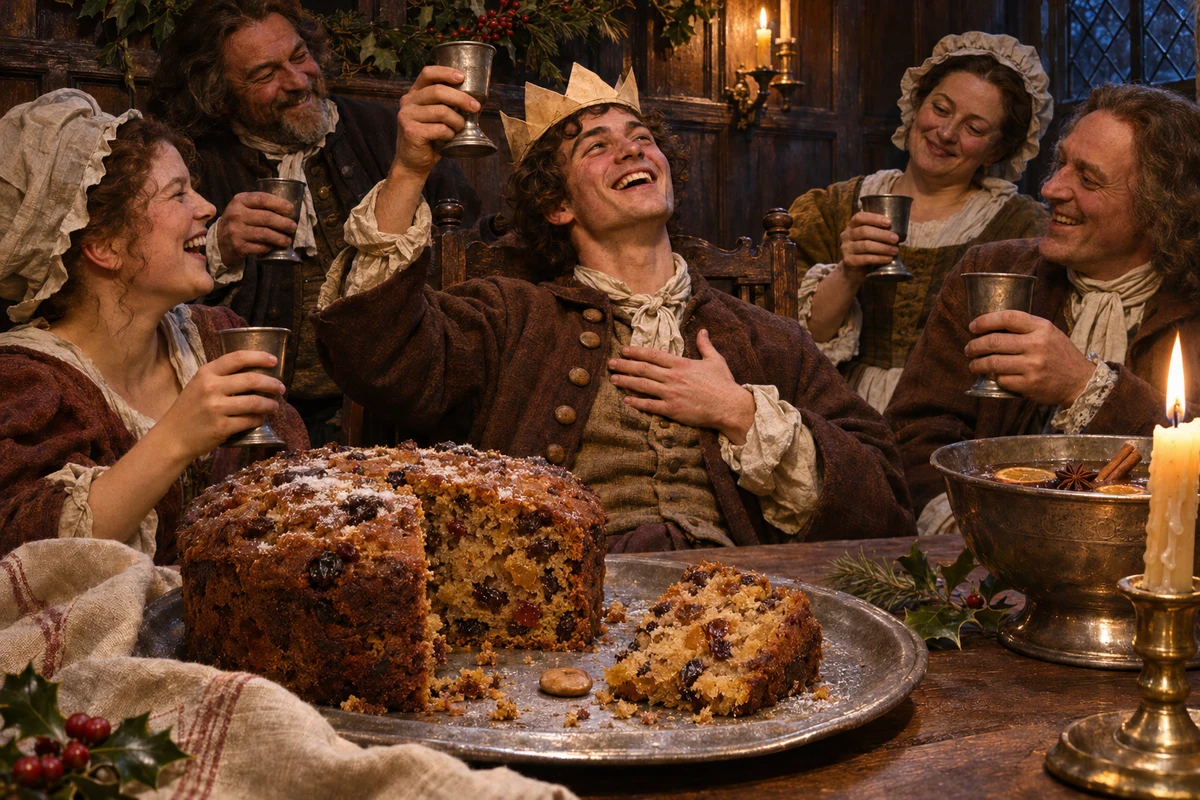
A slice of cake could once deliver an unexpected promotion. Find the bean and you might become king of the evening; find the pea and you could be queen. The history of Twelfth Night reveals how a shared cake became a lottery, a performance and a small experiment in turning the world upside down.
THE SHORT ANSWER
In recorded versions of the Twelfth Night custom, a bean hidden in a cake selected a temporary king. A pea could choose a queen. Their authority belonged to the celebration: a playful court, drinking toasts and an evening of assumed identities.
The custom formed part of the festivities surrounding the end of the Twelve Days of Christmas and Epiphany. Its rules varied. Later parties could allocate characters through drawn tickets rather than discoveries inside the cake.
The bean king is historically documented. Exactly where the custom began is harder to establish.
WHAT WE KNOW
One particularly clear description comes from the seventeenth-century poet Robert Herrick.
His poem “Twelfth Night: or, King and Queen” brings together a fruit-filled cake, a bean choosing the king and a pea choosing the queen. The company drinks to its temporary rulers, with sugar, nutmeg, ginger and ale contributing to the merriment.
This is valuable evidence because the objects have stated jobs. We do not have to guess what the bean meant.
The royal theme also appears in surviving European art. Gabriël Metsu’s painting “The King Drinks”, dated around 1653–1655 and held by Munich’s Alte Pinakothek, depicts a subject the museum identifies with an Epiphany bean-feast role-playing game.
A painting is a composed scene, rather than a photograph of an ordinary household. Nevertheless, it supplies a useful comparison: festive kingship was recognisable beyond England.
HOW IT BECAME A HABIT
The cake game belonged to a much wider culture of Christmas entertainment.
English Heritage records bean kings at the courts of Edward II and Edward III. Later Lords of Misrule could preside over elaborate festivities, complete with attendants and mock punishments.
These examples help establish the setting, but they should not be squeezed into one universal instruction sheet. A court official directing Christmas entertainments and a guest winning a household cake lottery could occupy related festive worlds without having identical duties.
The game could also change its machinery.
In his nineteenth-century “Every-Day Book”, William Hone reproduces instructions for buying Twelfth Night characters and drawing folded tickets. Guests then recited the verses belonging to their allotted identities before cake and refreshments circulated.
The lottery survived even when nobody needed to find a bean.
THE STORY EVERYONE TELLS
The familiar explanation takes the custom straight back to Roman Saturnalia.
The comparison is understandable. Saturnalia included temporary reversals of ordinary social behaviour, and later Christmas celebrations also made room for mock authority and licensed disorder.
But similarity does not establish every stage of transmission.
A Roman winter festival, a medieval Lord of Misrule and an English Twelfth Night cake are different historical subjects. Connecting them requires more than observing that all three could involve merrymaking and an unusual person giving orders.
WHAT THE EVIDENCE ACTUALLY SAYS
WELL SUPPORTED: Beans and peas could allocate festive kingship and queenship. Herrick describes that arrangement explicitly.
WELL SUPPORTED: Twelfth Night entertainment changed over time. Hone’s ticket-drawing instructions demonstrate a version in which roles were distributed separately from the cake.
WELL SUPPORTED: The celebration generated objects worth preserving. The Folger Shakespeare Library holds a hand-coloured print, “Park’s Shakspearean Twelfth-Night Characters”, dated around 1830.
That print imagines Shakespeare celebrating with characters from his plays. It is evidence of a later representation of the festival, not an eyewitness record of Shakespeare’s own party.
UNPROVEN: A single, uninterrupted chain carrying the precise bean-in-cake game from ancient Rome into every later European version.
There is also a useful distinction from Irish Halloween barmbrack. In recorded Halloween customs, hidden objects could predict marriage or poverty. In the Twelfth Night game described by Herrick, they assigned a role for the celebration.
One cake supposedly revealed your future. The other supplied your part for the evening.
WHY IT STUCK
The attraction is easy to recognise.
A shared cake already gathers people around a table. Conceal a small object inside it and every slice creates suspense. Give its finder a title and the meal acquires a leading character.
A lottery also provides an entertaining excuse for an unexpected person to take centre stage.
That is an interpretation of the game’s appeal, rather than a surviving explanation from its inventor. No inventor has been securely identified.
The records do show how adaptable the idea was: beans, peas, tickets, verses and imaginary courts could all serve the same evening’s amusement.
For a little while, chance could rearrange the company.
Then the cake was finished, and the kingdom closed.
RELATED CURIOSITIES
[Why Did the Irish Hide Rings and Rags in Halloween Cakes?](/articles/irish-halloween-cakes-rings-rags)
[Why Do We Kiss Under Mistletoe?](/articles/kiss-under-mistletoe)
[Why Do We Put Candles on Birthday Cakes?](/articles/birthday-cake-candles)
SOURCES & FURTHER READING
Robert Herrick — “Twelfth Night: or, King and Queen”. Primary literary evidence for the bean, pea, cake and drinking toasts.
https://www.luminarium.org/sevenlit/herrick/twelfthnight.htm
Bayerische Staatsgemäldesammlungen, Alte Pinakothek — Gabriël Metsu, “The King Drinks”, around 1653–1655, inventory number 871.
https://www.sammlung.pinakothek.de/en/artwork/gR4k3A94Ee/gabriel-metsu/der-koenig-trinkt
William Hone — The Every-Day Book, January 6. Historical descriptions of Twelfth cakes, character tickets and festive gatherings.
https://honearchive.org/etexts/edb/day-pages/006-january06.html
Folger Shakespeare Library — “A recipe for Twelfth Night cake”. Includes the collection’s circa-1830 “Park’s Shakspearean Twelfth-Night Characters” print.
https://www.folger.edu/blogs/shakespeare-and-beyond/recipe-twelfth-night-cake/
English Heritage — “Medieval Misrule and Mayhem”, by Dr Michael Carter. Bean kings, Lords of Misrule and the wider history of festive role reversal.
https://www.english-heritage.org.uk/members-area/members-magazine/2021/the-lord-of-misrule/
University of Reading — “Christmas 2016: Twelfth Cake”, by Professor Anne Lawrence. Historical context for the cake and Christmas misrule.