Standfirst
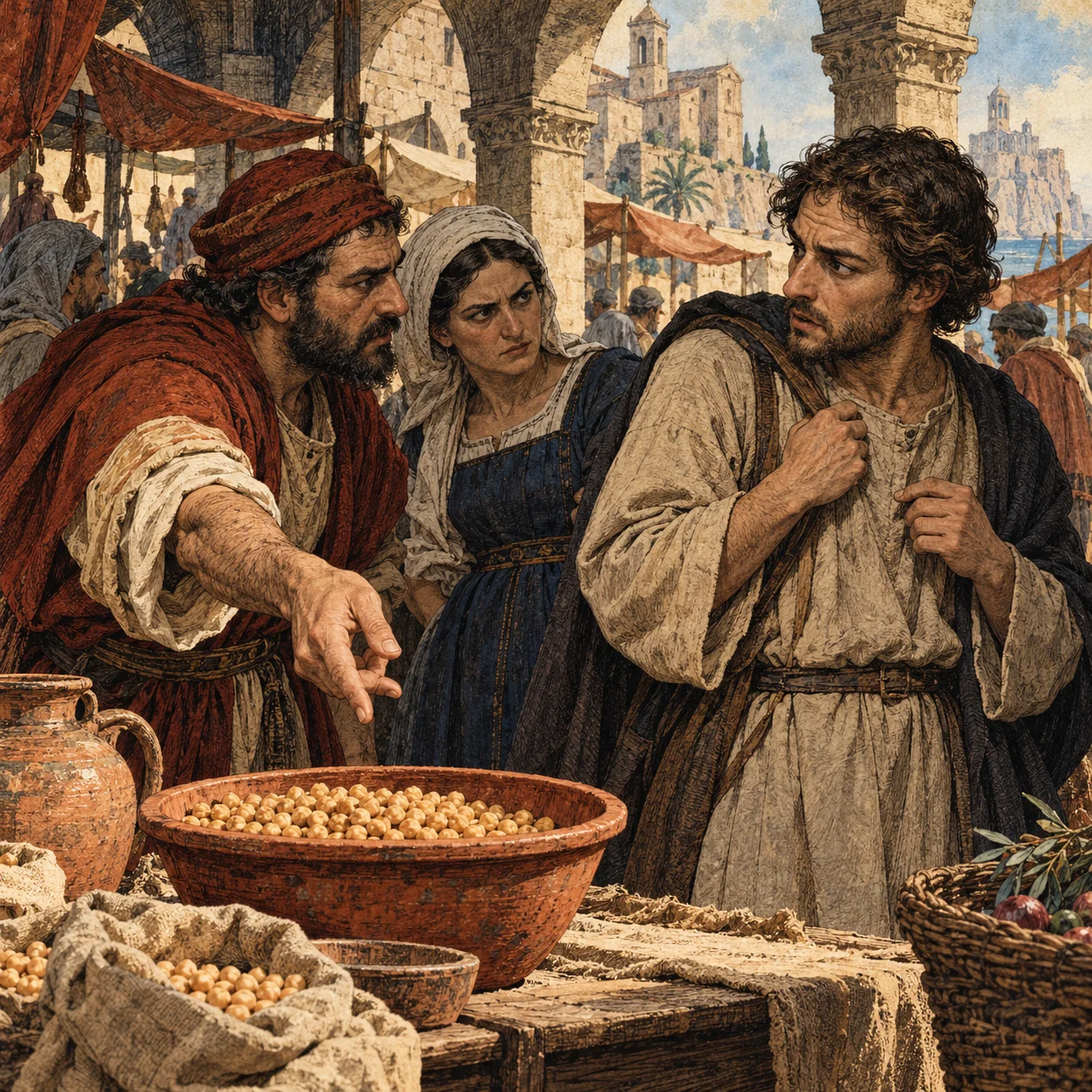
Imagine being stopped by an angry crowd and asked to name a handful of chickpeas.
Answer correctly and you might survive.
Pronounce the word incorrectly and, according to a chilling Sicilian tradition, you could be killed.
The Short Answer
During the Sicilian Vespers of 1282, Sicilians rose against the French Angevin authorities who ruled their island.
According to a longstanding tradition, rebels trying to identify French people used a simple pronunciation test.
Suspected foreigners were asked to say ciciri, the Sicilian word for chickpeas.
French speakers supposedly struggled to pronounce the word in the local manner.
Anyone who failed could be identified as French and killed.
The story is widely repeated in accounts of the uprising, but the precise historical evidence for the test is less secure than the evidence for the rebellion itself.
It belongs to a much wider and darker tradition: using the way someone speaks to decide whether they belong to a particular community.
What We Know
On 30 March 1282, a revolt began near Palermo against the rule of Charles I of Anjou.
Charles was a French prince whose government had controlled Sicily since the 1260s.
The rebellion spread rapidly.
French officials, soldiers and civilians were attacked, and thousands were reported killed.
The precise number of victims remains uncertain.
In the confusion of such an uprising, identifying who belonged to the hated ruling group could be difficult.
Clothing was not necessarily reliable.
Nor could appearance always reveal someone's origins.
Language, however, offered another possibility.
People raised speaking a particular dialect acquire sounds, rhythms and pronunciations that outsiders may find difficult to reproduce.
According to the Sicilian tradition, that difference could become a matter of life and death.
How It Became a Habit
The Sicilian word ciciri means chickpeas.
It refers to an ordinary food that was familiar throughout the Mediterranean.
There is nothing threatening about the word itself.
Its significance in the Sicilian Vespers story lies in pronunciation.
The tradition says that French speakers struggled to reproduce the Sicilian sounds convincingly.
Rebels could therefore ask a suspected foreigner to identify chickpeas or repeat their local name.
A hesitation, an unfamiliar accent or an incorrect pronunciation might expose the speaker as an outsider.
The method belongs to a broader phenomenon known as a shibboleth.
A shibboleth is a word, expression or pronunciation used to distinguish members of one linguistic or social group from another.
The term comes from the biblical Book of Judges.
In that account, pronunciation of the Hebrew word shibboleth was used to identify fleeing Ephraimites, with fatal consequences for those who could not produce the required sound.
The Sicilian chickpea story follows the same disturbing pattern.
A common word becomes a test of identity.
An accent becomes evidence.
And a linguistic difference becomes a possible death sentence.
The Story Everyone Tells
Picture a street in medieval Palermo.
A man is trying to escape the violence.
He has removed anything that might identify him as a French soldier or official.
He hopes to disappear among the local population.
But a group of Sicilian rebels stops him.
One produces a handful of chickpeas.
The man is asked what they are called.
He knows the answer, or thinks he does.
But his pronunciation betrays him.
The crowd recognises a French accent.
According to the tradition, his fate is decided immediately.
It is a terrifying story because the test seems so ordinary.
No written document is required.
No official uniform needs to be discovered.
A person may be condemned by the sound of a single word.
What the Evidence Actually Says
The Sicilian Vespers itself is securely established in medieval history.
The pronunciation-test story is a different matter.
It appears in historical retellings and remains part of Sicilian cultural memory.
The Italian-language publication Sicilia Agricoltura, for example, recounts the use of cìciri to distinguish French speakers during the revolt.
A March 2026 article in History Today also describes the test.
Older nineteenth-century accounts mention similar practices.
These sources demonstrate that the story has a substantial history.
They do not, on their own, establish how often the test was actually used in 1282, precisely where it occurred or how many people died because of it.
The University of Cagliari's digital history project provides another revealing perspective.
It discusses how a similar chickpea pronunciation story became attached to Sardinian historical memory, with cixiri replacing the Sicilian word.
That suggests the anecdote was sufficiently memorable to travel between different accounts of political resistance.
It also illustrates why historians must be careful.
A story repeated in several places is not necessarily independently confirmed in each one.
The fact that a pronunciation test would have been possible does not prove that it was systematically used.
Evidence assessment:
- DOCUMENTED: The Sicilian Vespers occurred in 1282.
- DOCUMENTED: Ciciri is a Sicilian word for chickpeas.
- DOCUMENTED: Historical and cultural accounts preserve a story of rebels using the word to identify French people.
- PLAUSIBLE: Differences in pronunciation could have exposed non-native speakers.
- UNPROVEN: The precise scale, organisation and consequences of the test during the uprising.
- DISPUTED: Whether later retellings accurately preserve an established practice from 1282.
Why It Stuck
The chickpea story survives because it turns something familiar into something frightening.
Chickpeas are an everyday ingredient.
A person's accent is usually an unremarkable part of their identity.
Neither seems capable of causing harm.
But in a moment of collective violence, ordinary distinctions can acquire extraordinary consequences.
The story also captures a disturbing feature of persecution.
People may be judged not by anything they have done, but by whether they sound like members of a hated group.
The word becomes a border.
The speaker either belongs or does not.
Whether every detail of the Sicilian account can be proved is another question.
What makes the tradition so memorable is its terrible simplicity.
A handful of chickpeas.
One unfamiliar word.
And, supposedly, no second chance.
Related Curiosities
- Why Did Church Bells Signal a Massacre in Sicily? — The uprising that gave rise to the chickpea story.
- Why Is a Londoner Called a Cockney — and What Do Bow Bells Have to Do With It? — Another example of how speech and local identity become connected.
- Why Is a Time Limit Called a Deadline? — The disturbing history behind another familiar word.
Sources & Further Reading
1. Mathew Lyons, “The Sicilian Vespers”, History Today, March 2026.
https://www.historytoday.com/archive/months-past/sicilian-vespers
2. Sicilia Agricoltura, “La storica panella di Lercara Friddi”, 2013. Includes the Sicilian ciciri tradition.
https://www.siciliaagricoltura.it/2013/03/04/la-storica-panella-di-lercara-friddi/
3. University of Cagliari, Storia Digitale, “Sant’Efisio, i Vespri (siciliani) e la memoria dei ceci”, 2022. Discusses the movement of the chickpea story into Sardinian historical memory.
https://storia.dh.unica.it/2022/04/28/santefisio-i-vespri-siciliani-e-la-memoria-dei-ceci/
4. The New International Encyclopaedia, “Sicilian Vespers”. Historical background on the rebellion.
https://en.wikisource.org/wiki/The_New_International_Encyclop%C3%A6dia/Sicilian_Vespers
5. Book of Judges, Chapter 12, verses 5–6. The biblical pronunciation test from which the term shibboleth derives.
Last Checked: 19 October 2026