Standfirst
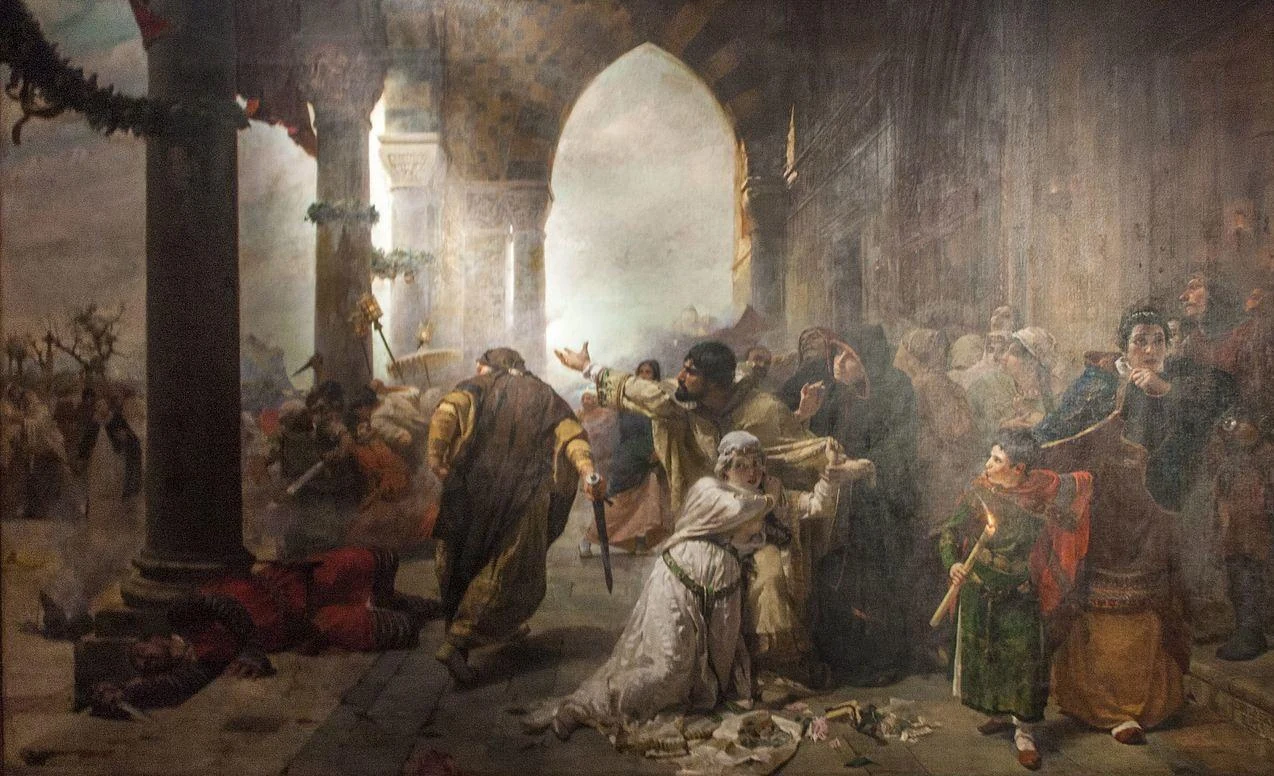
On an Easter Monday in 1282, violence erupted outside a church near Palermo. Thousands would die, a French dynasty would lose control of Sicily, and the uprising would forever be associated with the sound of evening prayer.
But did church bells really give the signal for a massacre?
The Short Answer
The Sicilian Vespers was a genuine uprising against French Angevin rule that began near Palermo on 30 March 1282.
Its name comes from vespers, the Christian evening prayer service, because the violence began around the time of that observance.
According to the best-known story, the offensive treatment of a Sicilian woman by a French soldier provoked a confrontation that escalated into rebellion.
Later accounts sometimes describe church bells ringing as the signal for a coordinated attack.
The uprising and its association with vespers are well established. What is much less certain is whether the bells were deliberately rung to launch a prearranged massacre.
What We Know
By 1282, Sicily had endured sixteen years of rule by Charles I of Anjou, a French prince who had defeated the island's previous ruling dynasty.
His government was deeply unpopular.
Heavy taxation, the behaviour of foreign officials and the loss of established privileges had created widespread resentment.
Charles also had ambitions far beyond Sicily. He was preparing an expedition against the Byzantine Empire, while his enemies included Peter III of Aragon and the Byzantine emperor Michael VIII Palaiologos.
On Easter Monday, 30 March 1282, a confrontation occurred during festivities near the Church of the Holy Spirit outside Palermo.
Violence broke out between Sicilians and Frenchmen.
The uprising spread into Palermo and subsequently across the island.
French officials, soldiers and civilians were attacked. Contemporary and later accounts describe killings on a large scale, although the precise numbers cannot be established confidently.
By the end of April, Charles had lost control of much of Sicily, including Messina.
The rebellion developed into a wider Mediterranean struggle, with Peter III of Aragon eventually taking the Sicilian crown.
How It Became a Habit
Vespers was not an unusual or mysterious ceremony.
It was part of the regular cycle of Christian worship, traditionally observed towards evening.
In medieval communities, church bells helped mark religious services and organise daily life.
They announced occasions, summoned worshippers and communicated across distances long before modern forms of public notification.
That made the hour of vespers a natural point of reference when describing an event.
The rebellion became known as the Sicilian Vespers because of its association with that time of day.
Over centuries, the connection between the uprising and evening prayer helped create a more dramatic popular image: the bells ringing, the people rising and the massacre beginning.
The distinction matters.
An uprising beginning at the hour of vespers is not necessarily the same thing as an uprising deliberately triggered by church bells.
The Story Everyone Tells
The familiar story begins outside a church.
A crowd has gathered during the Easter celebrations. Among the people are Sicilian families and French soldiers serving the Angevin authorities.
One soldier approaches a Sicilian woman.
Depending on the account, he insults her, searches her indecently or assaults her.
Her husband or other bystanders intervene.
The soldier is killed.
The French attempt to retaliate, but the crowd turns upon them.
Soon the anger spreads into Palermo.
The story is sometimes told with the church bells ringing as the signal for the population to rise.
Men seize weapons. French officials are hunted through the streets. The violence spreads from town to town.
In this version, a single act of arrogance brings down an entire regime.
It is a compelling story.
It is also considerably neater than the complicated political events surrounding the rebellion.
What the Evidence Actually Says
The basic historical event is not in doubt.
The Sicilian Vespers began in 1282 and brought an end to Angevin control of the island.
The story of the insulted woman is not simply a modern invention. The medieval Florentine chronicler Giovanni Villani included an account of a Frenchman's offensive treatment of a Sicilian woman and the violence that followed.
That gives the tradition historical weight.
It does not independently prove every detail.
Villani was writing after the events, and other accounts differ over the precise circumstances.
The political background is equally important.
Charles of Anjou had powerful enemies. Peter III of Aragon possessed a dynastic claim to Sicily, while Michael VIII Palaiologos had reason to oppose Charles's plans against Constantinople.
John of Procida, a Sicilian opponent of Angevin rule, became closely associated with stories of the rebellion's political preparation.
Historians have long debated whether the uprising was essentially spontaneous, deliberately organised or a spontaneous outbreak exploited by existing conspirators.
The church-bell story requires particular care.
The name Sicilian Vespers establishes an association with evening prayer. It does not, by itself, demonstrate that church bells were used as a secret signal.
Descriptions of bells ringing at the time should therefore be distinguished from claims that someone deliberately rang them to coordinate a massacre.
Evidence assessment:
- DOCUMENTED: A major uprising against Angevin rule began near Palermo in March 1282.
- WELL SUPPORTED: The uprising became associated with the hour of vespers.
- HISTORICALLY ATTESTED TRADITION: A French soldier's treatment of a Sicilian woman triggered the first confrontation.
- DISPUTED: The extent to which the rebellion had been planned in advance.
- UNPROVEN: Church bells were deliberately rung as a coordinated signal to begin killing.
Why It Stuck
History often remembers enormous events through surprisingly small details.
A woman outside a church.
A soldier's insult.
The sound of a bell.
Each provides something tangible in a story otherwise dominated by kings, alliances and territorial ambitions.
The Sicilian Vespers also offered later generations a powerful symbol of resistance to foreign rule.
The bells fitted that symbolism perfectly.
An ordinary religious sound could be imagined as a call to collective action.
But the historical reality was neither a simple heroic uprising nor an uncomplicated struggle between good and evil.
The rebellion involved mass killing, including civilians, and its aftermath transferred power into the hands of another monarchy.
The story remains memorable partly because it compresses all those uncomfortable complexities into one dramatic moment.
A church bell rings.
A crowd turns.
And an island changes rulers.
Whether the bells were truly the signal remains an unanswered question.
Related Curiosities
- Why Are Funeral Bells Tolled for the Dead? — How bells became a way of announcing death.
- Why Do Morris Dancers Wear Bells? — The historical evidence behind another familiar use of bells.
- Why Could Saying the Word for Chickpeas Get You Killed? — Another extraordinary tradition associated with the Sicilian Vespers.
Sources & Further Reading
1. Mathew Lyons, “The Sicilian Vespers”, History Today, March 2026.
https://www.historytoday.com/archive/months-past/sicilian-vespers
2. Princeton Dante Project, Toynbee's entry on the Sicilian Vespers, including Giovanni Villani's medieval account.
https://dante.princeton.edu/cgi-bin/dante/DispToynbeeByTitOrId.pl?INP_ID=213674
3. Encyclopaedia Britannica, 1911 edition, “Vespers, Sicilian”. A historical reference reflecting older scholarship.
https://en.wikisource.org/wiki/1911_Encyclop%C3%A6dia_Britannica/Vespers%2C_Sicilian
4. The New International Encyclopaedia, “Sicilian Vespers”. An older account of the rebellion and its competing interpretations.
https://en.wikisource.org/wiki/The_New_International_Encyclop%C3%A6dia/Sicilian_Vespers
Last Checked: 19 October 2026