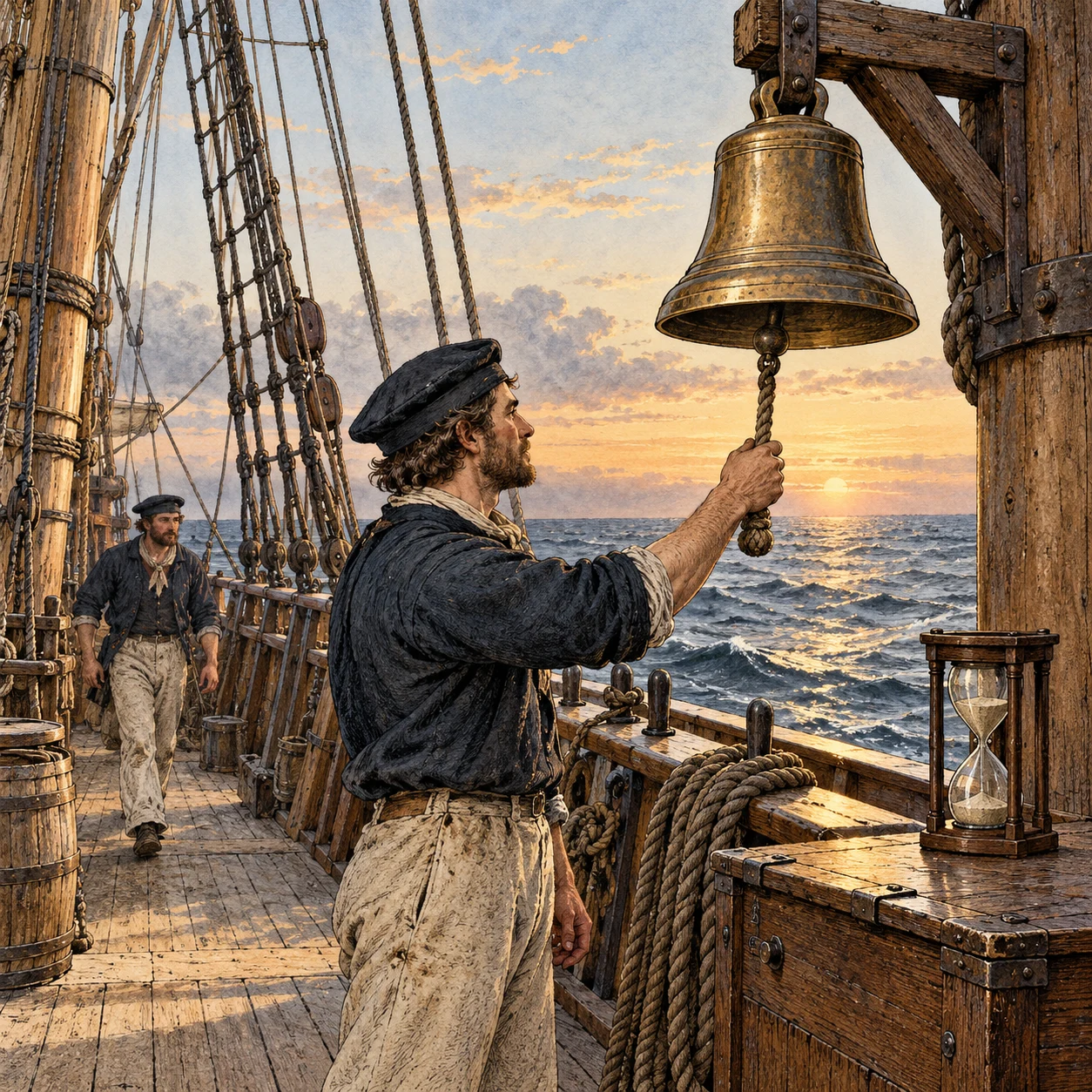
On land, a clock striking eight usually announces eight o’clock. Aboard a sailing ship, eight bells could announce midnight, noon or another change of watch.
The bell was counting something different: the half-hours a sailor had spent on duty.
THE SHORT ANSWER
Eight bells marked the completion of a standard four-hour watch because the bell count increased every half-hour. One bell meant thirty minutes had passed; two meant an hour; eight meant four hours.
The count then began again during the next watch. It measured progress through a working period rather than simply sounding the hour shown on a clock.
This was a practical system for organising a ship that needed people on duty throughout the day and night. Shorter watches and differences in shipboard practice mean it should not be treated as a universal timetable for every vessel.
WHAT WE KNOW
A ship could not stop operating while its crew slept. Steering, keeping lookout and attending to the vessel continued through darkness as well as daylight.
The USS Constitution Museum describes a routine in which the crew was divided so that groups could alternate duty and rest. Its account of life around the War of 1812 explains the relationship between the bell and a half-hour sandglass.
When the sand ran out, the glass was turned and the bell sounded. Another stroke was added to the count at each half-hour until eight signalled the completion of four hours.
The Naval History and Heritage Command records the same progression. Its historical account connects the ringing to the duty of watching and turning the glass: an elapsed interval became a sound the ship’s company could hear.
The bell did not measure the time by itself. The glass measured the interval; the bell announced it.
HOW IT BECAME A HABIT
The arrangement made time a shared signal.
A sailor did not need to be standing beside the sandglass to know how far the watch had advanced. A familiar sequence could reach people occupied elsewhere aboard.
For a four-hour watch beginning at eight in the morning, the count worked like this:
| Time | Bell count |
|---|---|
| 08:30 | one bell |
| 09:00 | two bells |
| 09:30 | three bells |
| 10:00 | four bells |
| 10:30 | five bells |
| 11:00 | six bells |
| 11:30 | seven bells |
| 12:00 | eight bells |
The same progression could serve another four-hour period later in the day. Hearing four bells therefore did not, by itself, tell a listener whether it was morning, afternoon or night.
The listener supplied the context. The bell supplied the progress.
THE STORY EVERYONE TELLS
The familiar shorthand is that eight bells meant a sailor could go below and sleep.
At the end of an ordinary watch, it could indeed announce a welcome change of duty. But the bell was not a guarantee of uninterrupted rest.
Royal Museums Greenwich explains that Cutty Sark’s crew was divided into port and starboard watches, with one group on duty while the other was off watch. Its bells also summoned assistance when emergencies demanded it.
Storm conditions or a person overboard could require everyone on deck. The sea did not necessarily respect the timetable.
Cutty Sark carried two bells, and the museum preserves its original bell dating from 1869. This familiar maritime sound belonged to working equipment, not merely shipboard ceremony.
WHAT THE EVIDENCE ACTUALLY SAYS
WELL SUPPORTED describes the arithmetic and its documented use: eight half-hour intervals complete four hours.
It does not mean that every watch lasted four hours. A familiar naval arrangement divided the evening into two shorter dog watches, from 4 to 6 pm and from 6 to 8 pm.
Splitting a period in this way changed the alternation of duty between groups. Without such an adjustment, a simple sequence of six four-hour watches could repeatedly put the same group on duty at the same times each day.
The USS Constitution Museum’s timetable shows these two evening watches alongside longer watches. The Naval History and Heritage Command also describes their role in preventing an unchanging daily allocation of duty.
The name “dog watch” is a separate etymological question. An explanation of the scheduling does not, by itself, prove an explanation of the name.
Nor should the bell system be confused with precision navigation. Counting half-hour intervals for daily routine was a different task from obtaining the accurate time needed for determining longitude.
The sources establish an enduring working convention. They do not identify a single inventor or a securely dated moment when every ship adopted it.
WHY IT STUCK
The system made a demanding day understandable in small, audible portions.
One bell meant the watch had barely begun. Seven meant its end was approaching. Eight marked a boundary: one group’s working period completed, another’s beginning.
For anyone listening in darkness, the bell gave time a shape without requiring a clock face. For a tired sailor, it could also give the next half-hour considerable importance.
RELATED CURIOSITIES
Why Did Ships Carry Carved Figureheads?
Why Did Sailors Hold Mock Trials When Crossing the Equator?
Why Did Royal Navy Sailors Wear Bell-Bottom Trousers?
SOURCES & FURTHER READING
Naval History and Heritage Command — Bells on Ships. Half-hour glasses, progressive bell counting and the end of a four-hour watch.
USS Constitution Museum — Daily Routine, Join the Crew. Half-hour timekeeping and a watch timetable including evening dog watches.
https://jointhecrew.ussconstitutionmuseum.org/daily-routine/
Royal Museums Greenwich — Cutty Sark Ship’s Bell. Port and starboard watches, eight strokes, emergency uses and the original 1869 bell.
https://www.rmg.co.uk/cutty-sark/attractions/cutty-sark-ships-bell
Naval History and Heritage Command — Origin of Navy Terminology, “Dog Watch”. Used here for the function of the split evening watches, not as proof of its proposed word origin.