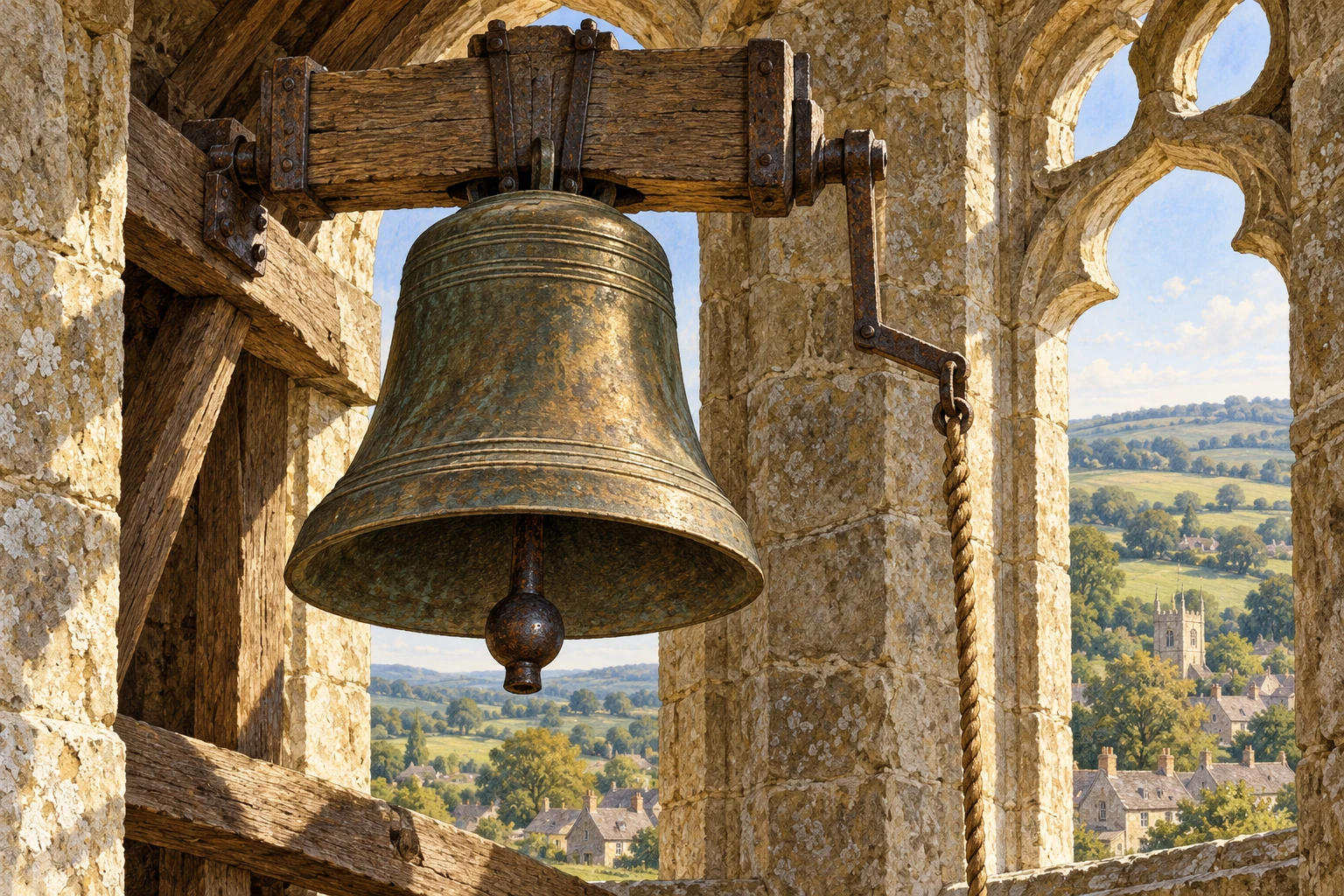
Imagine the larger church bells falling silent. Then a smaller bell sounds: a thinner, more insistent voice with an unexpectedly cheerful name.
The ting-tang belonged to the practical business of parish life. Its story takes us from the threshold of worship to Pancake Day — with a complaint from the fairies along the way.
THE SHORT ANSWER
“Ting-tang” was a name for a small bell, including the priest’s bell rung shortly before a church service began. The name imitates a ringing sound.
Its exact job depended on the parish. It might give the final summons to worship or call church officers to their duties. Describing it simply as a bell announcing the priest’s arrival misses some of that variety.
The custom also has connections with medieval sanctus bells, which sounded during Mass. But the name alone cannot establish a bell’s age or original purpose.
WHAT WE KNOW
One particularly useful record comes from Ware in Hertfordshire. An inventory of 1552 lists a little bell intended to call the priest, clerk or sexton when they were absent.
That is wonderfully practical evidence. The bell was part of organising worship, and its message could be directed at the people responsible for the service.
Later bell historians recorded related customs. Thomas North’s nineteenth-century survey of Northamptonshire describes the priest’s bell, or ting-tang, sounding immediately before services. H. B. Walters also records the name among the informal terms for these smaller church bells.
The word itself had a wider life. The historical dictionary entry reproduced by the World English Historical Dictionary includes a 1680 example imitating a bell’s sound. Later examples apply the name to bells summoning people to prayers or dinner.
“Ting-tang” therefore described a sound and could become a name for the object making it. It was never a single standard model issued to every English parish.
HOW IT BECAME A HABIT
The medieval connection helps explain why a church might possess a smaller bell alongside its principal bells.
North describes sanctus bells positioned in a roof bellcote or a suitable part of the tower, with a rope accessible from the church. Their sound could reach people outside as well as those attending Mass.
He treated later priest’s bells as successors to this older provision, while acknowledging that many were comparatively recent castings. That gives us a plausible history of adaptation, rather than proof that every ting-tang had survived unchanged from the Middle Ages.
A bell could remain useful even when its duties changed. The important questions are local ones: when was it cast, where did it hang, and what do the parish records say it was rung for?
WHEN THE TING-TANG MEANT PANCAKES
At East Leake in Nottinghamshire, a parish history published in 1903 records the ting-tang being rung at noon on Shrove Tuesday within living memory. On that occasion it was known as the Pancake Bell.
The same account says it was rehung in the tower’s east window during repairs in 1902. Here the small bell is a physical object with a recorded location, as well as a remembered sound.
Ashford-in-the-Water in Derbyshire offers another example. A history published on the parish website identifies its old sanctus bell as both the ting-tang and the pancake bell.
It recounts Thomas Brushfield’s 1864 description of an eleven o’clock Shrove Tuesday bell that released schoolchildren for a holiday. The afternoon’s attractions included football.
These examples establish local practice. They do not mean every pancake bell was a ting-tang, or that every ting-tang had a Shrove Tuesday role.
THE STORY EVERYONE TELLS
At Inkberrow in Worcestershire, the bell enters a different kind of history.
A tale attributed to the antiquarian Jabez Allies says that fairies objected when the church was rebuilt on a new site. At night they carried the building materials back to the old location.
The builders eventually prevailed. In the version reproduced in English Fairy and Other Folk Tales, the fairies’ complaint survives as a couplet:
“Neither sleep, neither lie,
For Inkbro’s ting-tang hangs so high.”
It is a memorable reversal. A sound summoning villagers to church becomes an intolerable disturbance to their supernatural neighbours.
WHAT THE EVIDENCE ACTUALLY SAYS
WELL SUPPORTED applies to the bell name and the documented customs described here.
It does not establish one uninterrupted national tradition. A medieval sanctus bell, a later priest’s bell and a Shrove Tuesday bell could overlap in a particular parish, but their names are not interchangeable in every record.
Nor does the Inkberrow story prove that fairies moved building materials, or that a historical relocation happened exactly as the tale describes. Its value is as a recorded tradition about the church and its sound.
The distinction makes the subject more interesting. We can follow an ordinary piece of church equipment into local memory without asking the fairy story to serve as an architectural survey.
WHY IT STUCK
The name is easy to hear even when the bell is silent.
“Priest’s bell” explains a duty. “Ting-tang” supplies a voice. In the records examined here, that voice could mean worship was beginning, a holiday had arrived, or the fairies were losing sleep.
A modest bell had acquired a surprisingly busy cultural life.
RELATED CURIOSITIES
Why Is a Londoner Called a “Cockney” — and What Do Bow Bells Have to Do With It?
Why Do Japanese Temples Ring Bells 108 Times on New Year’s Eve?
Why Did Church Bells Signal a Massacre in Sicily?
SOURCES & FURTHER READING
1. Thomas North, The Church Bells of Northamptonshire, pp. 136–138: sanctus bells and the priest’s bell or ting-tang.
https://whitingsociety.org.uk/old-ringing-books/north-northamptonshire-03.pdf
2. H. B. Walters, Church Bells of England, chapter on smaller bells: terminology and the Ware inventory.
https://whitingsociety.org.uk/old-ringing-books/walters-church-bells-of-england-file-02.pdf
3. World English Historical Dictionary, “Ting-tang”: historical dictionary entry and dated examples.
https://wehd.com/95/Ting-tang.html
4. A History of East Leake (1903), church bells section, hosted by Nottinghamshire History.
https://www.nottshistory.org.uk/books/eastleake1903/eleake06p2.htm
5. Ashford parish website, bell history and Ian Pykett’s 2021 notes, including Brushfield’s Shrove Tuesday account.
6. English Fairy and Other Folk Tales, “Worcestershire Fairies”, reproducing a tradition attributed to Jabez Allies.
https://sacred-texts.com/neu/eng/efft/efft19.htm
Last checked: 25 October 2026