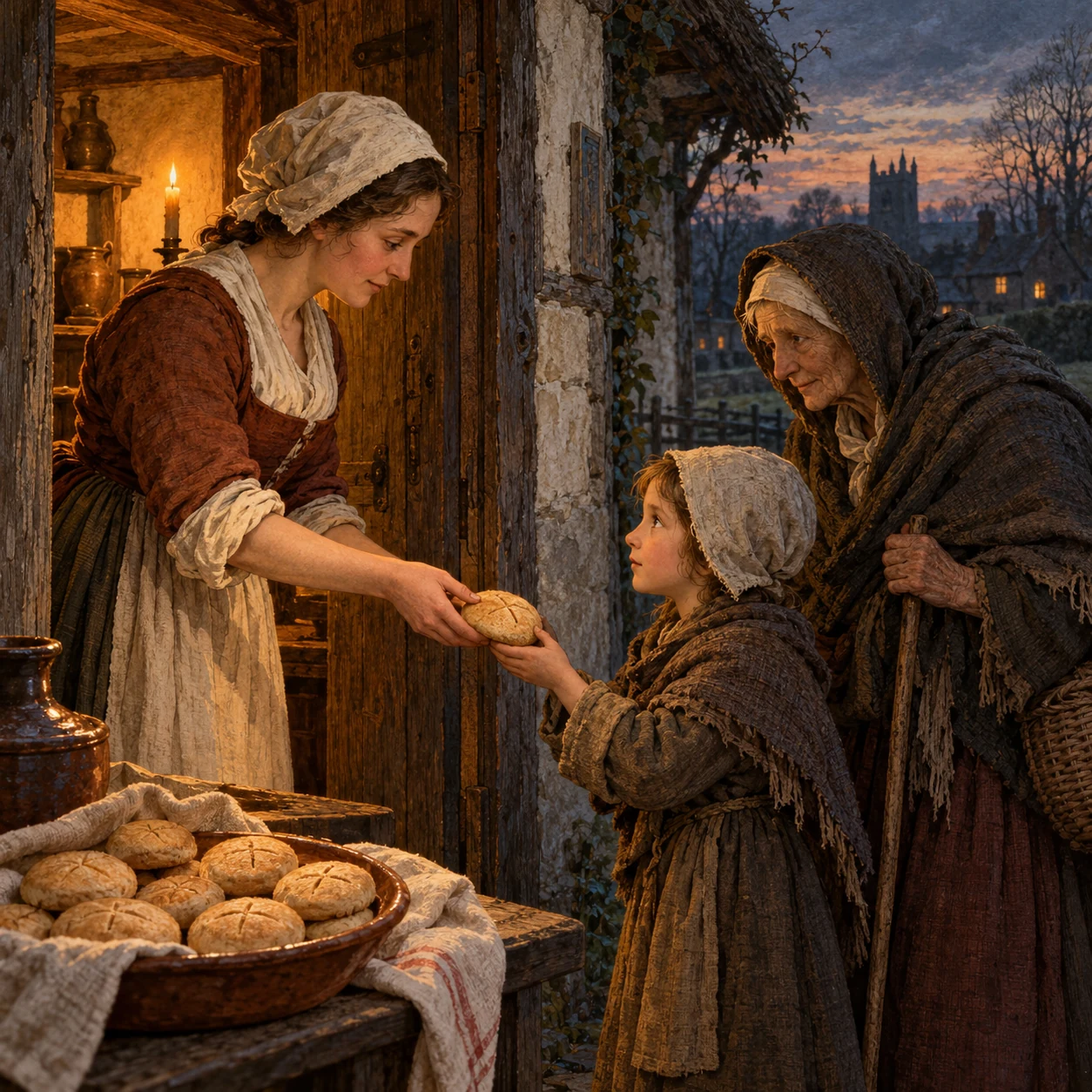
Imagine answering a knock at the door and being asked for a cake. The visitor offers something in return: a prayer for someone you have buried.
THE SHORT ANSWER
In parts of England, people distributed soul cakes around All Saints' and All Souls' Days in return for prayers for departed relatives and friends.
The exchange fitted Christian beliefs about purgatory: the living could pray for souls undergoing purification before entering heaven. Food helped the person at the door; prayer was believed to help the person who had died.
The custom is historically documented. Its precise starting point is uncertain.
WHAT WE KNOW
All Saints' Day falls on 1 November and All Souls' Day on 2 November. Halloween is the evening before All Saints', placing these observances close together.
English Heritage identifies evidence for soul cakes from around 1400. John Mirk, a Shropshire religious writer, described an already established practice of distributing bread for Christian souls. This records the custom; it does not tell us when it began.
Later accounts make its domestic setting easier to picture. The seventeenth-century antiquary John Aubrey described a stack of soul cakes on a Shropshire table, from which visitors took a cake.
Aubrey's accompanying rhyme asked for mercy for Christian souls. The food and the act of remembrance belonged together.
HOW IT BECAME A HABIT
A household did not need to organise an elaborate ceremony. It could prepare food, receive callers and remember its dead through a familiar annual exchange.
Over time, local versions became increasingly varied. Robert Holland's 1886 glossary of Cheshire words describes children visiting farmhouses and cottages in unusual costumes, singing and asking for cakes, apples, money or other gifts.
Holland also recognised a problem for anyone trying to give the custom one tidy history: activities formerly associated with different occasions had become mixed together. Souling, plays and a horse-head performance could appear within the same seasonal celebrations.
A tradition could keep its name while changing what people actually did.
THE STORY EVERYONE TELLS
Soul cakes are often presented as the original Halloween treat, with medieval soulers becoming today's trick-or-treaters.
The resemblance is easy to recognise: seasonal visitors knock at doors and receive food.
However, that resemblance cannot establish the whole route between the two customs. As SBH's separate investigation into trick-or-treating explains, guising, festive visiting and North American mischief also belong to the story.
Another tempting explanation treats every soul cake as food left for returning ghosts. That should not replace the documented exchange of charity and prayer.
WHAT THE EVIDENCE ACTUALLY SAYS
WELL SUPPORTED describes the historical practice and the beliefs attached to it. It does not verify that prayers changed anyone's fate after death.
Nor was there one universal soul cake. Memorials of Old Cheshire, published in 1910, preserves an account of cakes given to Shropshire children until 1884: they were round or oval, made from light dough, sweetened and spiced.
The same collection records songs requesting fruit, beer and money, alongside verses explicitly recalling prayers for departed souls. These details show both religious remembrance and festive collecting.
Older writers sometimes supplied confident explanations for the customs they recorded. Their descriptions and songs are valuable evidence; their claims about remote origins require separate proof.
The safest conclusion is that soul-caking was a varied, changing tradition with a clearly documented Christian meaning. An unbroken descent from a particular ancient pagan ritual has not been established.
WHY IT STUCK
A cake made remembrance something people could do together.
The householder could offer practical generosity. The caller could contribute a prayer, a song or a blessing. Someone absent from the table remained part of the occasion.
Even when the original religious purpose weakened, the visit still offered food, company and an excuse to sing outside somebody else's door.
RELATED CURIOSITIES
Why Do Children Say “Trick or Treat”?
Why Is Halloween Called Halloween?
Why Did Galicians Fear Meeting a Procession of the Dead?
SOURCES & FURTHER READING
English Heritage — Michael Carter, “What are soul cakes and what's their link with Halloween?” Historical overview, John Mirk and later records.
https://www.english-heritage.org.uk/halloween/soul-cakes/
Robert Holland — A Glossary of Words Used in the County of Chester (1886), “Souling or Soul-caking”. Historical account hosted by the University of Salamanca.
Joseph C. Bridge — “Some Cheshire Customs, Proverbs, and Folk-lore”, in Memorials of Old Cheshire (1910), especially the souling discussion on pp. 230–237.
https://www.gutenberg.org/cache/epub/69492/pg69492-images.html
James George Frazer — The Golden Bough, third edition, volume VI (1911), “Feasts of All Souls”, pp. 78–79. Useful for collected descriptions; its wider origin theories require caution.
https://www.gutenberg.org/cache/epub/41923/pg41923-images.html