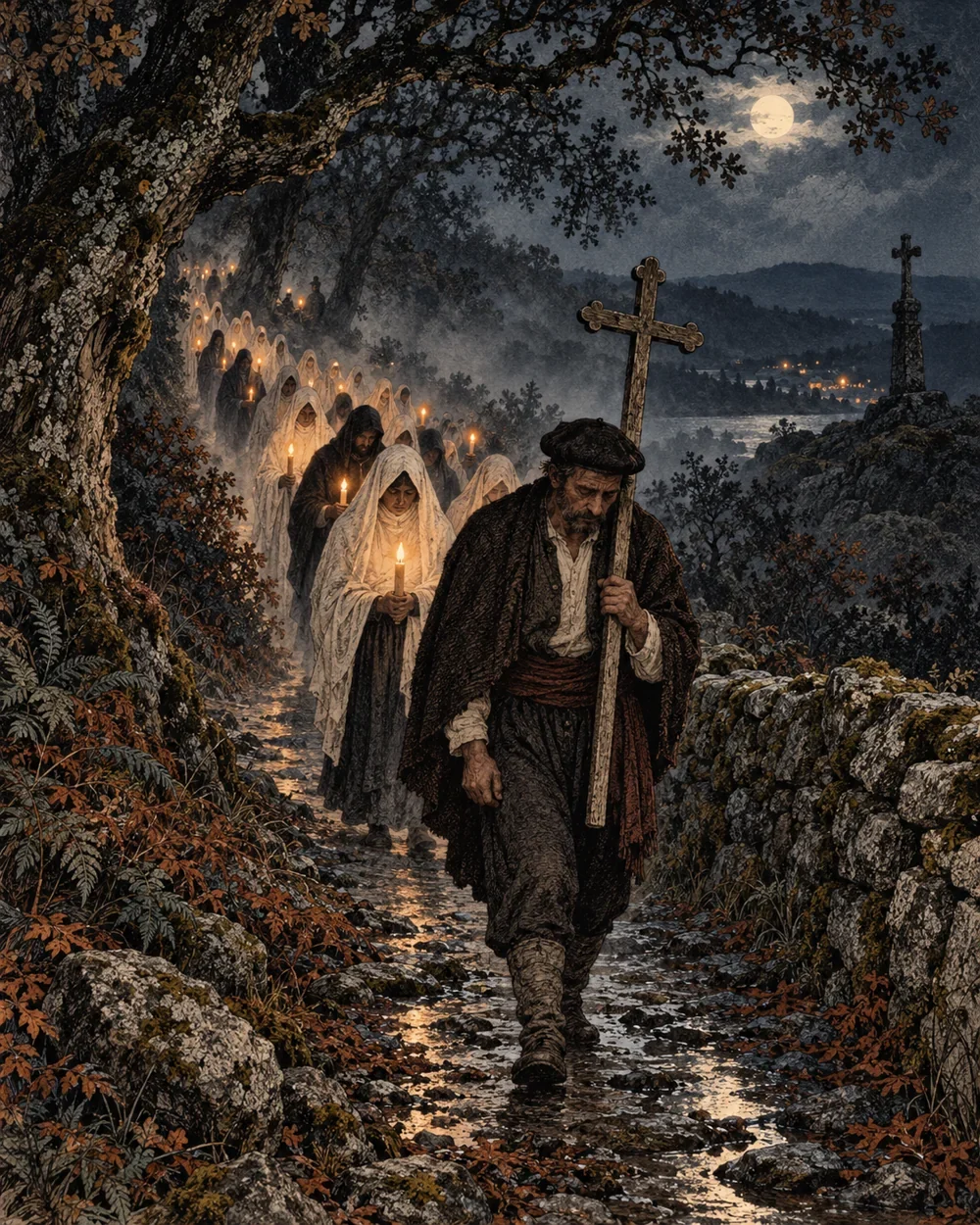
In the villages of north-western Spain, a ghostly procession was said to travel after dark. Those unfortunate enough to encounter it might be forced to join the dead — and lead them through the night.
THE SHORT ANSWER
Galicians feared the Santa Compaña because meeting it could mean more than seeing a ghost. In recorded versions of the legend, a traveller might receive a warning of death or become the living bearer of its cross, obliged to return night after night.
The procession belongs to documented folklore. Its appearances, powers and supposed ancient beginnings do not have the same evidential standing. There was also no single version believed everywhere.
WHAT WE KNOW
Imagine a traveller on a wooded lane. Ahead, small lights move between the trees. A murmur becomes prayer. The figure at the front carries a cross, but looks exhausted rather than dead.
That scene is an imaginative reconstruction of recurring motifs, not a reported historical encounter.
For an actual written account, turn to George Borrow. In The Bible in Spain, first published in 1843, he describes his guide fearing the Estadea as darkness approached in Galicia. The guide recalled lights appearing in mist and women falling to the ground. He explained them as candle-bearing spirits.
Borrow records a story told to him, not a procession he witnessed. His dismissive description of his guide also reminds us that travel writing carries its author's prejudices. Nevertheless, the passage places the belief firmly in the nineteenth-century record.
Names varied. Compaña, Compañía and Procesión das ánimas appear alongside Estadea and other local terms. They should not be treated as a rigid list of interchangeable creatures: storytellers differed over what, exactly, was passing along the road.
HOW IT BECAME A HABIT
The procession borrowed the recognisable equipment of religious life: lights, a cross and, in some descriptions, holy water. These were familiar objects placed in an alarming setting.
Jesús Rodríguez López describes the Compaña in Supersticiones de Galicia y preocupaciones vulgares. In the 1943 edition consulted here, the dead rise at midnight, while a living person leads with the cross and holy-water vessel. The bearer must not turn round.
Even seeing the company was uncertain. His account allows for lights that cannot be seen, although burning wax can be smelt. This was not always a row of conveniently visible ghosts.
Rodríguez López's earlier book on Galician superstitions appeared in 1895. The Real Academia Galega explains that he collected beliefs partly to challenge them. It also records that the bishop of Lugo prohibited that first book. Describing popular religion could be contentious; folklore collectors were participants in their own society, not neutral recording machines.
THE STORY EVERYONE TELLS
The living cross-bearer gives the legend its particularly uncomfortable twist. Death's procession has a vacancy, and the next stranger might fill it.
In the version published by Rodríguez López, the bearer can escape by handing the cross and vessel to somebody else before that person draws a protective circle.
This makes an ordinary social gesture dangerous. Taking an object from another person becomes accepting an obligation with no agreed finishing time.
Vicente Risco's account, discussed by folklorist Camiño Noia Campos, describes the compulsion to return and the wasting effects associated with involvement: pallor, exhaustion and declining health. These are features of the belief, not a diagnosis or evidence that supernatural activity caused illness.
The familiar picture of shrouded figures belongs to some tellings. It should not erase versions in which the company was perceived differently.
WHAT THE EVIDENCE ACTUALLY SAYS
The evidence label is WELL SUPPORTED because the tradition has a substantial written record. It does not certify the dead as walkers.
The protective measures also need attribution. Manuel Alberro's comparative study lists avoiding the procession's gaze, stepping quietly aside, making a circle with a protective sign, and lying face down until it passes.
Turismo de Galicia's modern retelling also describes a circle, dropping to the ground with eyes closed while praying, and sheltering beside a cruceiro, Galicia's characteristic stone cross. These are recorded ways of escaping within the legend, rather than practical instructions supported by evidence.
The omen of death is equally explicit. Rodríguez López describes a procession stopping before a neighbour's house and announcing death by throwing stones onto its roof. Alberro discusses variants involving a coffin left at a house. Such differences matter: the story was not a fixed script.
Its age requires more care. Noia's scholarly survey points to an eighteenth-century reference by Martín Sarmiento and, following Carmelo Lisón Tolosana, earlier references in sixteenth- and seventeenth-century Inquisition documents. Those earlier materials are cited here through her study, not presented as archival documents independently examined for this article.
None supplies an unbroken trail back to pre-Christian Galicia. Comparisons with other European supernatural companies are suggestive, but resemblance cannot establish a common origin. Noia also notes that Risco favoured a Christian explanation and rejected a Celtic one. The origin remains an interpretation, not a settled discovery.
WHY IT STUCK
One reason for the legend's force may be its reversal of something familiar. A procession normally gives people a place in a community. This one threatens to recruit them against their will.
That is interpretation, but it helps explain the memorable combination: a recognised road, recognisable religious objects and an obligation nobody wants.
The seasonal connection is real in modern retelling. Turismo de Galicia revisits the story around the Night of the Dead, while also mentioning St John's Eve. It is therefore misleading to confine the Compaña to Halloween or present today's Samaín associations as proof of an ancient origin.
Its continued place in Galicia's cultural storytelling is easier to establish than its beginnings. The procession still travels through books and retellings, even when listeners do not believe it travels through their village.
And its most unsettling figure remains the person at the front: someone who has not died, but can no longer go home and stay there.
RELATED CURIOSITIES
Why Were Ghostly Black Dogs Believed to Foretell Death?
The Gwyllion — Why Did Welsh Travellers Fear the Women in the Mist?
Why Was a Dead Serbian Villager Blamed for Nine Deaths?
SOURCES & FURTHER READING
George Borrow — The Bible in Spain, chapter XXIX; first published 1843. Linked transcription is of the 1896 edition.
https://www.gutenberg.org/files/35676/35676-h/35676-h.htm
Jesús Rodríguez López — Supersticiones de Galicia y preocupaciones vulgares, 1943 edition, printed pages 128–129.
Camiño Noia Campos — “Lendas galegas de ánimas”, Studies in Oral Folk Literature, no. 8, 2019; especially the section on the Compaña. Includes discussion and citations of Vicente Risco's 1962 ethnography.
https://repositori.urv.cat/repositori/getDocument/RP:4088?ds=DocumentPrincipal&mime=application/pdf
Manuel Alberro — “La Santa Compaña en el NO de la Península Ibérica y en otros países célticos como Irlanda, Escocia y Gales”, Biblioteca Virtual Miguel de Cervantes. Comparative interpretation, not proof of Celtic descent.
Real Academia Galega — “Jesús Rodríguez López e as ‘supersticiones de Galicia’”.
https://academia.gal/-/jesus-rodriguez-lopez-e-as-supersticiones-de-galicia
Turismo de Galicia — “Túnica, cánticos y rezos. Terror en torno a la Santa Compaña”, 1 November 2018. Modern public retelling.
https://blog.turismo.gal/tunica-canticos-y-rezos-terror-en-torno-a-la-santa-compana/