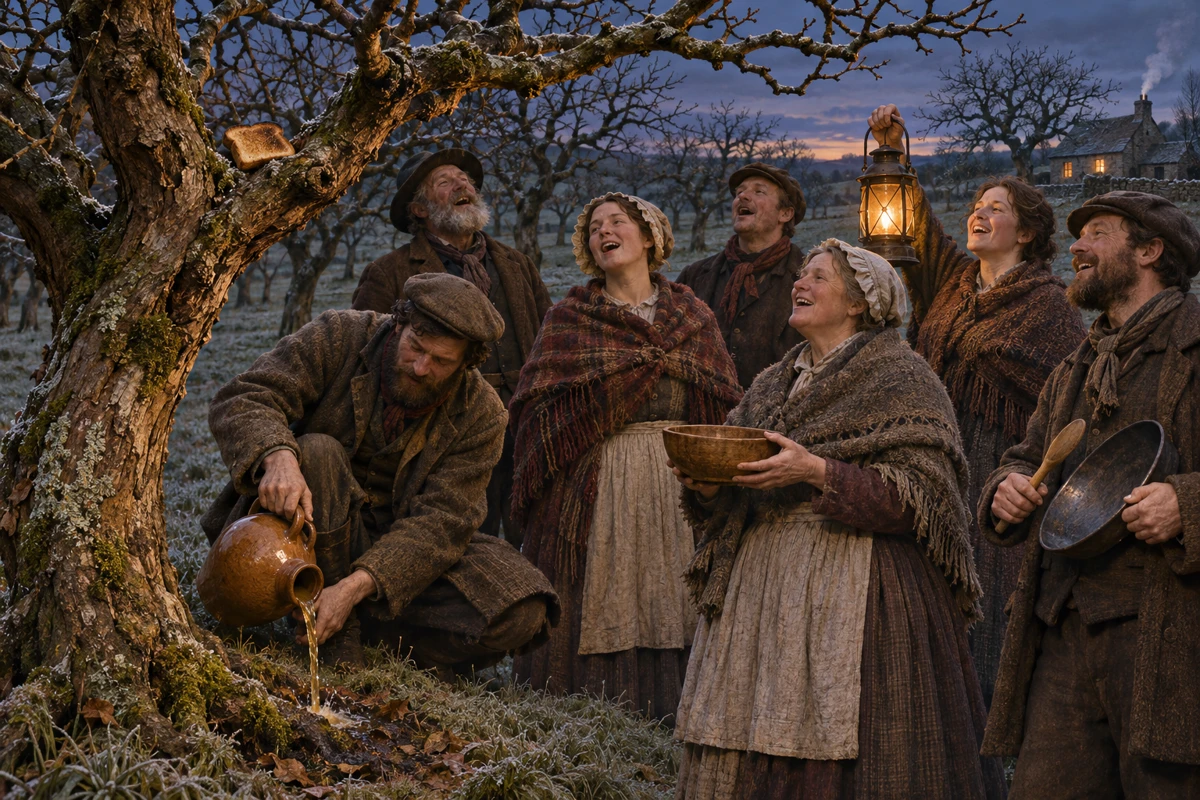
A bare apple tree, a piece of toast and a crowd determined to make a noise. Winter wassailing gave orchards an unusual audience. But a surviving drinking bowl and an old description of throwing bread reveal a history more varied than the familiar story of an ancient pagan ritual.
THE SHORT ANSWER
People wassailed fruit trees to encourage a good harvest. Songs, drink and offerings made the hope for next season's crop into something a community could perform together.
Toast belonged to some recorded versions. It could be thrown towards trees; present-day celebrations also place cider-soaked pieces among the branches. There was no single rulebook, and not every wassail happened in an orchard. The name also covered festive drinking and visits to neighbours' houses.
WHAT WE KNOW
Start with a bowl rather than a supposed ancient priest.
Amgueddfa Cymru – Museum Wales preserves an elaborate wassail bowl and lid from Claypits Pottery at Ewenny, collection number 92.49. Its yellow-glazed decoration includes plants and small figures. The catalogue notes that bowl and lid may not originally have belonged together: even an attractive museum object needs qualifications.
The accompanying history describes nineteenth-century Welsh parties carrying a bowl between houses. Greetings brought wishes for the occupants' health and prosperity; the hospitality involved spiced ale, sometimes with apples and cakes.
That is evidence for a social custom, not proof that this particular vessel once stood beneath an apple tree.
For tree wassailing, a different sort of object helps: a printed poem. Robert Herrick's Hesperides, published in 1648, includes verses urging people to wassail trees so that they produce plums and pears. His little instruction makes the intended connection between ceremony and fruit explicit. It also reminds us that apple trees were not the only possible recipients.
HOW IT BECAME A HABIT
The word belonged to a vocabulary of wishing good health. Accounts connect it with early English and Norse forms of greeting and drinking toast. The history of a word, however, is not automatically the history of every ceremony later given its name.
A useful comparison comes from York Museums Trust. It distinguishes large sharing bowls used within prosperous households from smaller vessels associated with going door to door. Its account cites an 1870s description of families carrying ribbon-decorated bowls on New Year's Eve and asking for contributions.
An orchard gathering addressed the coming crop. A household toast addressed the company. A visit to a neighbour could also be an opportunity to obtain food, drink or money. These customs overlapped without being identical.
The Cornish National Music Archive identifies banquet, visiting and apple wassails as useful categories, while warning that their boundaries are blurred. Local practice mattered more than a tidy modern definition.
WHY THE TOAST MATTERED
A later contribution to Devon & Cornwall Notes & Queries reproduces an Exmoor description published in The Gentleman's Magazine in 1746. It describes drinking on Twelfth-day eve and throwing toast to apple trees to encourage a fruitful year.
That gives us a recorded action and an expressed purpose. It does not require us to imagine that all communities arranged bread in precisely the same way.
The National Trust illustrates a modern version with cider-soaked toast tied among branches. Bread, cider and the tree's next crop become connected through the ceremony. Calling this an offering describes what participants do; identifying exactly when it began requires evidence we do not possess.
Nor should a photograph of a present-day gathering be mistaken for a complete record of an eighteenth-century one.
THE STORY EVERYONE TELLS
Wassailing is often described as an ancient pagan survival: villagers wake the trees, frighten away evil spirits and repeat a ceremony inherited intact from a remote past.
The explanation fits the scene beautifully. Bare branches, darkness and a noisy crowd make the orchard feel older than its written records.
Some accounts describe the ritual in terms of spirits and protection. But that does not establish one original ceremony or an unbroken chain of identical performances.
Even the 1746 account suggested a connection with sacrifice to Pomona, the Roman goddess associated with fruit. That suggestion is valuable evidence of how an earlier writer interpreted the custom. It is not contemporary testimony from Roman worshippers.
WHAT THE EVIDENCE ACTUALLY SAYS
WELL SUPPORTED: People performed ceremonies intended to encourage fruitfulness. Herrick's verse provides seventeenth-century evidence; later descriptions supply regional details.
WELL SUPPORTED: Toast formed part of some versions. The Exmoor account connects throwing it with the hoped-for harvest. Modern examples document other arrangements.
WELL SUPPORTED: Wassailing also involved people wishing health to other people. Museum vessels and accounts of house visits prevent us from reducing the whole tradition to tree worship.
UNCERTAIN: A single beginning for all these practices. A health greeting, a drinking vessel and a harvest ceremony can share a name without having developed together at one moment.
UNPROVEN: The claim that a modern orchard wassail reproduces an unchanged prehistoric ritual. A custom can be old, locally meaningful and repeatedly renewed without being frozen in time.
This distinction makes the story richer. There were songs to remember, neighbours to visit, drinks to share and crops to worry about. The evidence leaves room for enjoyment as well as belief.
WHY IT STUCK
A harvest depends on conditions people cannot fully control. Gathering beneath a tree turned uncertainty into a shared occasion.
The practical rewards were easier to guarantee: company, warmth, music and refreshment. Whatever happened to the apples, the people had spent an evening together.
The bowl and the toast preserve two sides of that relationship. One carries hospitality between people. The other directs human hopes towards a tree.
The tree's contribution would have to wait until later in the year.
RELATED CURIOSITIES
Why Do We Bob for Apples at Halloween—and What Did It Have to Do With Marriage?
Why Do We Kiss Under Mistletoe?
Why Did People Give Out Soul Cakes to Help the Dead?
SOURCES & FURTHER READING
Amgueddfa Cymru – Museum Wales — Wassail bowl, collection number 92.49; Claypits Pottery, Ewenny, and the accompanying account of Welsh house-visiting customs.
https://museum.wales/collections/online/object/ba0aa7ee-94e9-354e-a0cd-0c2cdd5c2338/Wassail-bowl/
Robert Herrick — Another [Another to the Maids], in Hesperides (1648); text reproduced from the 1891 Pollard edition by Luminarium.
https://luminarium.org/sevenlit/herrick/anothermaids2.htm
Devon & Cornwall Notes & Queries, page 207 — historical discussion reproducing the 1746 Exmoor description and citing later orchard accounts. Digitised page and transcription; this is a later quotation of the earlier magazine, not a newly examined original magazine copy.
https://en.wikisource.org/wiki/Page:Devon_%26_Cornwall_Notes_%26_Queries.djvu/286
York Museums Trust — The Christmas and New Year Tradition of Wassailing; communal vessels, household differences and nineteenth-century visiting customs.
https://www.yorkmuseumstrust.org.uk/blog/wassailing/
Cornish National Music Archive — Cornish Wassails; regional variations, historical records and the distinction between visiting, banquet and apple wassails.
https://cornishnationalmusicarchive.co.uk/content/cornish-wassails/
National Trust, Sally-Anne Huxtable — Wassailing: ritual and revelry; orchard practices, health toasts and a photographed example of cider-soaked toast in branches. Its broad description of pagan roots is distinguished here from proof of unchanged continuity.
https://www.nationaltrust.org.uk/discover/history/art-collections/wassailing-ritual-and-revelry