An ancient fox, an unreachable bunch of grapes and a remarkably human excuse.
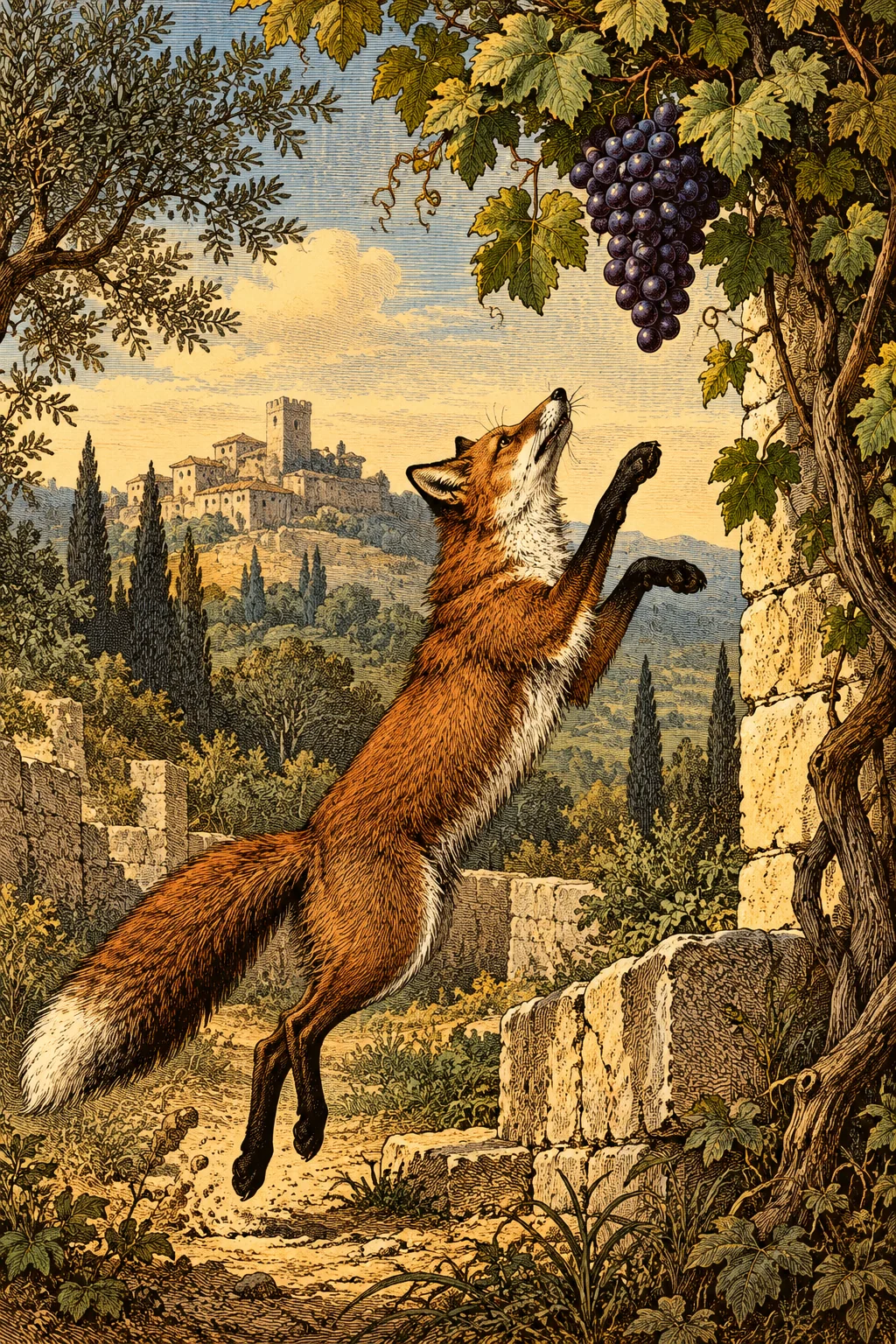
Imagine a hungry fox wandering through a vineyard on a warm afternoon. Above its head hangs a magnificent bunch of grapes, ripe, purple and almost bursting with juice.
The fox jumps. It misses. It tries again, and again, until exhaustion finally wins.
Then, rather than admit defeat, it turns away with a dismissive remark: the grapes were probably sour anyway.
It is a tiny story, but it has survived for more than two thousand years. And whenever we dismiss something we secretly wanted, we may be repeating the excuse of an ancient Greek fox.
Short Answer
The expression 'sour grapes' comes from The Fox and the Grapes, one of the fables traditionally attributed to Aesop.
In the story, a hungry fox repeatedly attempts to reach grapes hanging from a vine. When it fails, it declares that the fruit is unripe or sour and therefore not worth eating.
The moral is that people sometimes belittle things they cannot obtain.
Today, describing someone's reaction as sour grapes suggests that their criticism may be motivated by disappointment, resentment or envy rather than genuine dislike.
The fable is ancient, but the exact date when sour grapes became an established English idiom is less certain.
What We Know
The ancient Greek connection
The story belongs to the collection of animal fables associated with Aesop, the legendary Greek storyteller traditionally placed in the sixth century BC.
Aesop's name has become almost inseparable from short moral tales featuring animals that behave like people.
However, there is an important distinction between the traditional attribution and the surviving evidence.
We do not possess an original sixth-century BC manuscript of The Fox and the Grapes written by Aesop. The fables circulated through oral storytelling, written collections and later adaptations.
Among the surviving ancient versions are those of the Roman fabulist Phaedrus, who wrote in Latin during the first century AD, and Babrius, who composed Greek verse fables.
Both preserve the essential story: a fox desires grapes, fails to reach them and dismisses them as unripe.
The Roman version by Phaedrus makes the lesson particularly clear. Those who belittle what they cannot accomplish should recognise themselves in the fox.
Were the grapes really sour?
Here lies the cleverest part of the story.
The fox never tastes the grapes.
It has no evidence that they are sour.
In some ancient versions, the fox calls them unripe rather than simply sour. Phaedrus uses language referring to fruit that is not yet mature and would be unpleasantly sharp to eat.
The difference is small but revealing.
The fox is not making an informed judgement about the fruit. It is finding a reason to stop wanting something it cannot have.
That distinction is the entire point of the fable.
The grapes might have been delicious. The fox will never know.
How It Became a Habit
From Greek fable to English expression
The story travelled through centuries of European literature.
Medieval collections preserved and reshaped Aesop's tales, while the development of printing helped them reach new audiences.
William Caxton published an English collection of Aesop's fables in 1484, helping establish the stories among English readers.
The fox's complaint appears in that early English tradition, showing that the idea was familiar long before the modern expression became commonplace.
In seventeenth-century France, Jean de La Fontaine retold the story in his celebrated collection of fables, published in 1668.
Later English versions continued to popularise the fox's excuse.
Eventually, the words sour grapes became a convenient shorthand for a recognisable human reaction.
Someone who fails to win a prize might declare that the competition was worthless.
A disappointed applicant might insist that the job was undesirable.
A rejected admirer might suddenly discover endless faults in the person they had been pursuing.
In each case, the implication is the same.
The grapes were desirable until they proved unreachable.
A different kind of sour grapes
There is another historical expression involving sour grapes that can cause confusion.
The Bible contains a proverb about fathers eating sour grapes and their children's teeth being set on edge, appearing in passages including Ezekiel 18 and Jeremiah 31.
That saying concerns the consequences of one generation's actions for another.
Although the imagery is similar, its meaning is quite different from the fox's excuse.
The modern expression describing disappointed desire is traced to the fable, not to the biblical proverb.
The Fox That Changed Its Fruit
One of the most delightful details in the history of this story is that the grapes did not always remain grapes.
As the fable travelled between languages and cultures, storytellers sometimes changed the fruit.
In Scandinavian traditions, versions of the fox's excuse became associated with rowanberries.
This made practical sense. Rowan trees and their bright berries were familiar in northern European landscapes, while grapevines were less characteristic of the local countryside.
Other recorded adaptations substituted fruit such as cherries or pomegranates.
The scenery could change without disturbing the moral.
Whether the fox rejected grapes, berries or some other unreachable prize, its excuse remained recognisable.
The story survived because its message did not depend on the fruit.
It depended on the fox.
Why We Still Behave Like the Fox
Modern psychology provides another way of understanding the ancient tale.
People are not always comfortable acknowledging failure, disappointment or rejection.
When we want something but cannot obtain it, the gap between desire and reality can become unpleasant.
One possible response is to reconsider whether the thing was desirable in the first place.
Psychologists describe this kind of excuse-making as rationalisation.
The fable also resembles certain examples of cognitive dissonance, a concept developed in modern psychology to describe discomfort arising from conflicting beliefs, attitudes or behaviour.
The fox wants the grapes but cannot reach them. By deciding that they were undesirable, it reduces the discomfort of failure.
This does not mean Aesop anticipated modern psychological theory in any scientific sense.
Rather, the story captures a pattern of human behaviour that psychologists would much later examine systematically.
There is also an important qualification.
Sometimes people genuinely change their minds after a disappointment. Not every criticism following failure is sour grapes.
The expression applies when the dismissal appears to be a convenient way of protecting wounded pride.
Why the Expression Has Lasted
Many ancient fables teach complicated lessons about justice, loyalty, ambition or the dangers of pride.
The Fox and the Grapes succeeds through extraordinary simplicity.
There is no villain.
No dramatic punishment.
No elaborate trick.
There is only a hungry animal, something it wants and a story it tells itself when it cannot get it.
The fox's behaviour is instantly recognisable because it is so human.
We may laugh at the animal's excuse, but the laughter becomes less comfortable when we recognise ourselves.
That is perhaps why the fable has endured for so long.
Its moral requires no explanation beyond the fox walking away.
The Curious Conclusion
More than two thousand years after the earliest surviving traditions of Aesop's fables, we still use the fox's excuse in everyday conversation.
The phrase has crossed languages, centuries and cultures while retaining its essential meaning.
And perhaps the most remarkable part of the story is what we never discover.
Were the grapes actually sour?
We have no idea.
Neither did the fox.
Sometimes the easiest way to stop wanting something is to convince ourselves it was never worth having.
Evidence and Sources
Evidence rating: WELL SUPPORTED
The connection between the English expression and The Fox and the Grapes is well documented. Ancient versions survive in Latin and Greek, and the story's transmission through later European fable collections is established.
The precise date of the fable's first composition, Aesop's personal authorship and the earliest fixed English idiomatic usage remain uncertain.
Principal sources
1. Phaedrus, Fabulae, Book IV, Fable 3, The Fox and the Grapes. Perseus Digital Library.
https://www.perseus.tufts.edu/hopper/text?doc=Perseus:text:1999.02.0119:book=4:poem=3
2. Babrius, Aesop's Fables, Fable 19, The Fox and the Grapes. Alpheios.
https://www.alpheios.net/alpheios-texts/Alpheios.text.Aesop.01/book1_poem19.html
3. Library of Congress, The Fox & the Grapes, illustrated Aesop collection.
https://www.read.gov/aesop/005.html
4. Joseph Jacobs, The Fables of Aesop, notes on the Fox and the Grapes, including references to Phaedrus, Babrius and variant fruits.
https://en.wikisource.org/wiki/The_Fables_of_%C3%86sop_(Jacobs)/Notes
5. The Phrase Finder, Sour Grapes — Meaning and Origin, including discussion of the distinct biblical proverb.
https://www.phrases.org.uk/meanings/sour-grapes.html
Editorial note: The psychological interpretation is a modern explanatory comparison, not evidence of ancient scientific knowledge.