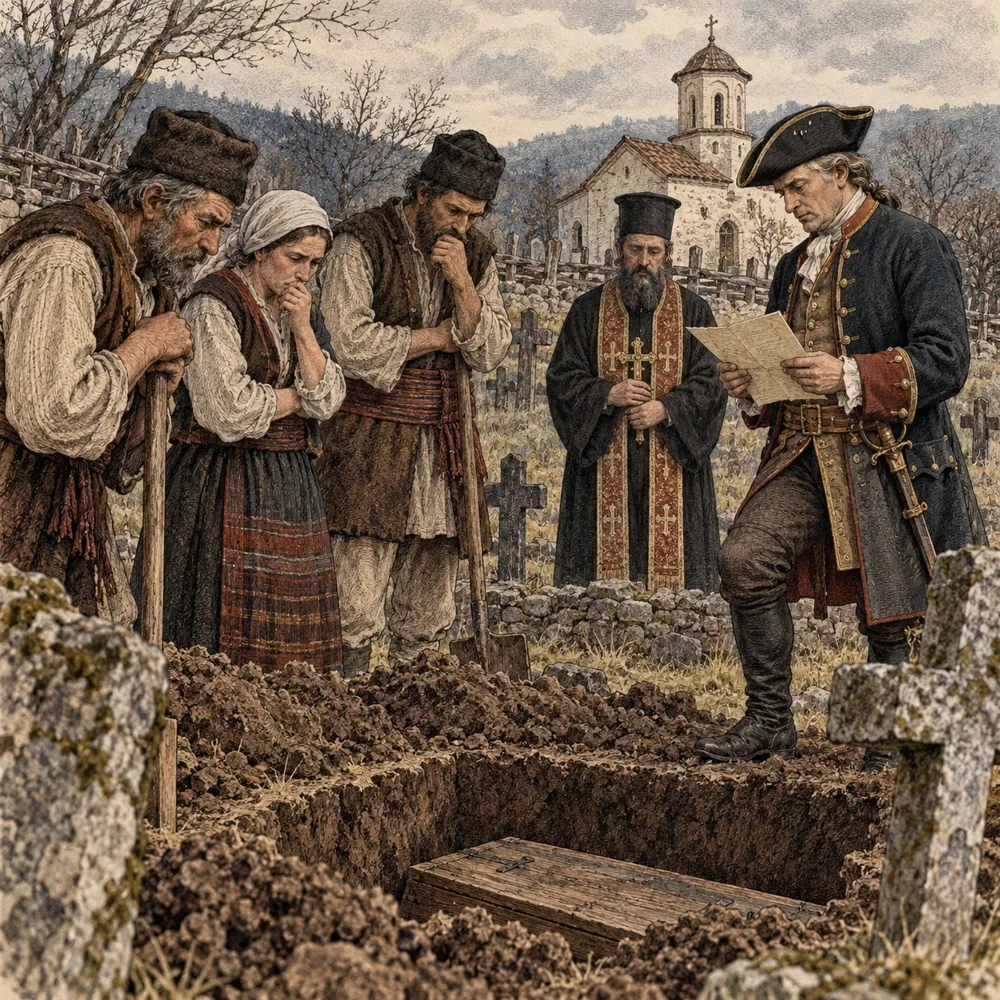
The villagers wanted a dead neighbour stopped. The imperial official wanted permission from his superiors. According to the account that survives, nobody thought there was time to wait.
In 1725, a Serbian vampire scare crossed an extraordinary threshold: it became government business, then newspaper news.
THE SHORT ANSWER
Petar Blagojević was blamed because villagers interpreted a cluster of deaths through an existing belief in dangerous returning corpses. A contemporary report said nine people died within eight days and described accusations that the dead man had attacked them during sleep.
The document records a community’s explanation and the destruction of a suspected vampire’s body. It does not establish that a corpse killed anyone.
WHAT WE KNOW
The village appears in the report as Kisolova, identified with modern Kisiljevo in Serbia. It then lay under Habsburg administration. Blagojević’s name appears in German-language accounts in forms including Peter Plogojowitz.
The report places his death about ten weeks before the events it describes. An imperial administrator, conventionally identified as Frombald, attended the viewing of his exhumed body with an Orthodox priest.
The administrator described apparent freshness, changes to the skin and nails, and blood in the mouth. Villagers drove a sharpened wooden stake into the body and burned it.
A version of the report appeared in the Wienerisches Diarium on 21 July 1725. That surviving publication is the firm anchor of the story.
HOW IT BECAME A HABIT
The remedy was already familiar to those demanding it. They expected particular bodily signs to identify a dangerous dead person and treated destroying the remains as protection for the living.
The Austrian National Library’s account places this case within a wider sequence of vampire investigations. Further Serbian reports in 1731–32 drew medical officers, administrators and scholars into the argument. Local explanations travelled through imperial correspondence and print.
The paperwork helped make the vampire a subject that educated Europeans could debate. It did not create the underlying village belief.
THE STORY EVERYONE TELLS
The familiar version is wonderfully compact: nine deaths, an astonishingly fresh corpse, blood at its mouth, then a stake through the heart.
It sounds like a vampire film that accidentally acquired an official witness.
But the document contains a less cinematic complication. The administrator wanted instructions from Belgrade. The villagers threatened to abandon their homes if prevented from dealing with the body. His concluding concern was that any wrongdoing should not be blamed on him.
He was recording a crisis under pressure, rather than conducting a controlled investigation.
WHAT THE EVIDENCE ACTUALLY SAYS
WELL SUPPORTED — the contemporary report is documented; supernatural attacks are unsubstantiated.
Three kinds of evidence need separating: what villagers reportedly said, what the official described seeing, and what either party concluded.
The alleged nocturnal attacks belong to reported testimony. The account does not give us independently verified observations of a dead man leaving his grave. Likewise, calling fluid in a corpse’s mouth the blood of victims adds an explanation to an observation.
Folklorist Paul Barber’s research offers a practical way to understand such descriptions. Decomposition can produce misleading signs of continuing life: changes in skin can alter the appearance of hair and nails, while fluids and gases can emerge from the body. Preservation also varies with burial conditions. A corpse need not resemble the neat, dry skeleton expected by someone opening its grave.
These processes explain why apparently alarming observations need not imply anything supernatural. They cannot reconstruct every detail of this particular body from a centuries-old description.
Nor can we securely diagnose the villagers’ fatal illnesses from this short report. Naming one disease would supply a certainty the evidence does not contain.
WHY IT STUCK
This case survives because it joins two powerful forms of storytelling: a frightened village’s accusation and an administrator’s written account.
An official document makes the fear historically tangible. It also tempts later readers to treat official involvement as proof of the accusation.
That is the enduring curiosity of Blagojević’s story. The vampire reached the newspaper; the evidence never showed that he had left his grave.
RELATED CURIOSITIES
Why Were Ghostly Black Dogs Believed to Foretell Death?
Why Did People Cover Mirrors After a Death?
SOURCES & FURTHER READING
1. Wienerisches Diarium, 21 July 1725 — the contemporary report; German transcription and English translation provided by Twice Told, with a link to the Austrian National Library scan. The scan was not independently readable during this research.
https://twicetold.org/documents/wienerisches-diarium-1725-07-21/
2. Austrian National Library — Tobias Dittmoser-Pfeifer, “Untot seit dem 18. Jahrhundert: Der erste Vampirhype” (2022). Institutional overview of the reports and their reception.
https://www.onb.ac.at/mehr/blogs/detail/untot-seit-dem-18-jahrhundert-der-erste-vampirhype
3. Paul Barber — “Forensic Pathology and the European Vampire”, Journal of Folklore Research, 24(1), 1987, pp. 1–32. Scholarly analysis of reported vampire signs and decomposition.
https://gwern.net/doc/biology/1987-barber.pdf
4. Paul Barber — Vampires, Burial, and Death: Folklore and Reality. Further reading; publisher’s description and publication details, rather than a separately consulted full text.
https://yalebooks.co.uk/book/9780300164817/vampires-burial-and-death/