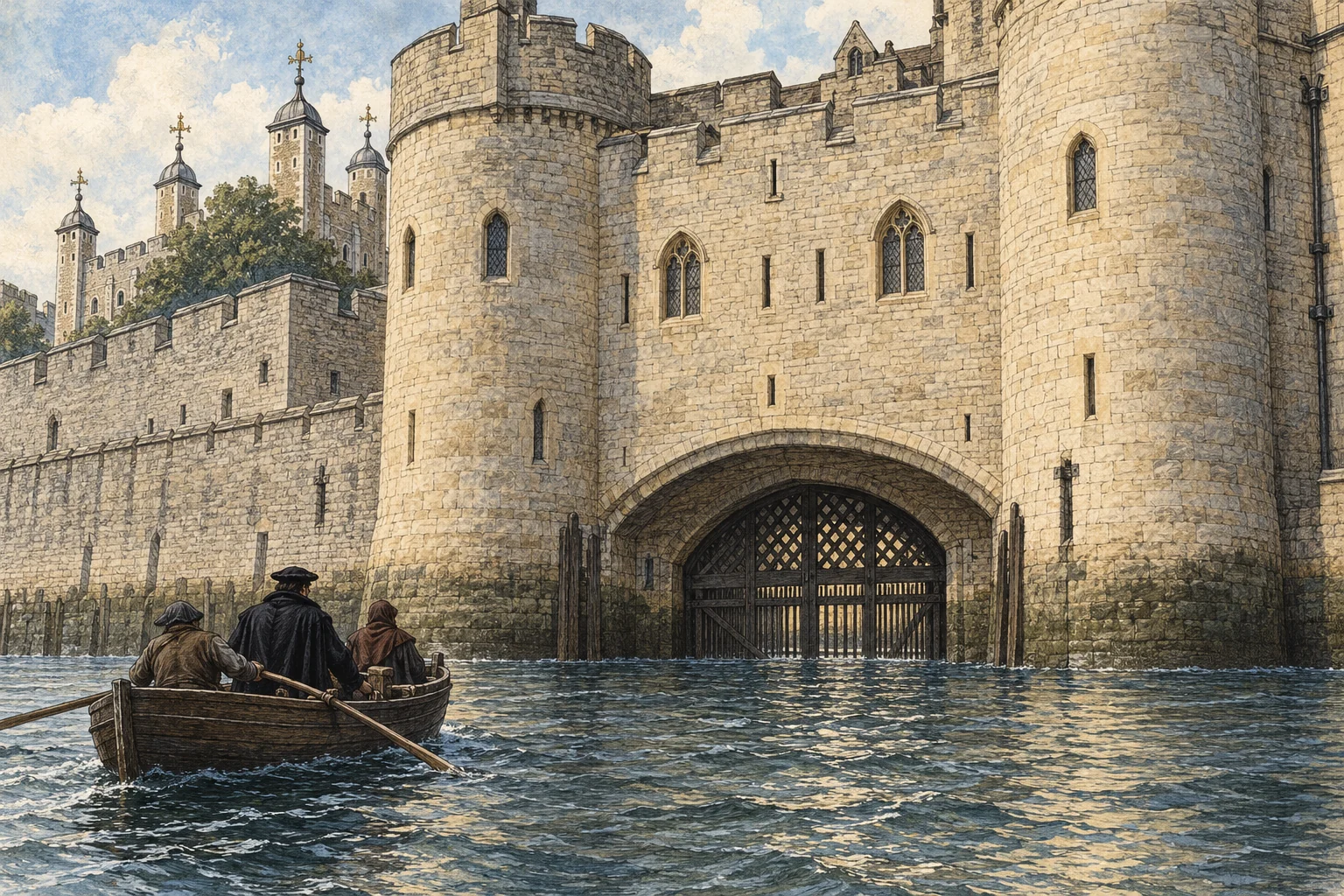
Imagine approaching the Tower of London by boat, with a broad stone arch ahead and the fortress rising above the river.
We know the entrance as Traitors’ Gate. Yet it began as part of a royal building project, and some of its most famous supposed passengers appear to have entered somewhere else.
THE SHORT ANSWER
Traitors’ Gate acquired its name through its association with prisoners accused of treason and other offences against the state, who could be brought to the Tower by water.
It was originally a medieval water entrance beneath St Thomas’s Tower, built for Edward I. Its sinister name reflects a later reputation rather than its original purpose.
There is an important distinction between explaining that reputation and proving every story attached to it. A prisoner arriving by boat did not necessarily pass through this particular arch.
WHAT WE KNOW
A royal entrance before a notorious one
Historic Royal Palaces dates St Thomas’s Tower to 1275–1279. Built for Edward I by the master mason John of Beverley, it combined an imposing riverside gatehouse with royal accommodation.
The water entrance beneath it belonged to this wider arrangement of palace and fortress. The rooms above included spaces associated with the king’s household.
That setting matters. The entrance was not conceived simply as a funnel through which condemned people would disappear.
Its original story concerns royal access, architecture and the relationship between the Tower and the Thames.
A name explained in print
By 1761, Robert and James Dodsley’s London and Its Environs Described referred to the entrance as commonly called Traitor’s Gate.
Their explanation was practical: state prisoners were customarily conveyed through it by water for greater privacy.
This is clear historical evidence for how the name was understood by that date. It does not establish when somebody first used it.
The same account also mentions prisoners admitted publicly through the main entrance. Even an eighteenth-century description therefore resists the idea that every important captive followed one compulsory route.
HOW IT BECAME A HABIT
Here, the enduring habit is a way of naming and remembering a place.
“Water gate” describes what an entrance does. “Traitors’ Gate” tells a story about the people associated with it.
Once that second name became familiar, it encouraged later generations to interpret the building through imprisonment. The royal accommodation above the arch became less memorable than the possibility of a guarded boat approaching below.
A place-name can act like a miniature history lesson. The difficulty is that it can also make a complicated history seem simpler than it was.
THE STORY EVERYONE TELLS
The familiar version assembles a procession of famous Tudor prisoners beneath the same gloomy arch.
Anne Boleyn approaches the Tower after her arrest. Princess Elizabeth follows during the reign of her half-sister Mary I. The gate becomes the threshold between courtly splendour and possible death.
These are powerful images because both women really were imprisoned at the Tower. The uncertainty concerns the entrance used.
In Anne’s case, Historic Royal Palaces states that she arrived by barge on 2 May 1536 at the private postern gate associated with the Byward Tower.
For Elizabeth’s imprisonment in March 1554, the same institution describes entry through Traitors’ Gate as legend and points instead to an account of her walking over a drawbridge.
The dramatic setting has gathered genuine prisoners into a shared arrival scene that the evidence does not securely support.
WHAT THE EVIDENCE ACTUALLY SAYS
The evidence label is WELL SUPPORTED, with limits.
The medieval gatehouse, its royal context and the water entrance are documented. So is the historical association between the entrance and state prisoners.
What remains less secure is a precise naming moment. The sources examined here do not establish who coined “Traitors’ Gate”, whether it began informally, or when it first became widely familiar. A dated appearance of a name would show that it was already being used, rather than necessarily revealing its invention.
Individual arrival claims need separate checking. A general connection with prisoners cannot prove that a particular person passed beneath the arch.
Even institutional summaries can disagree. Historic England’s Heritage Gateway record includes Anne Boleyn among prisoners associated with this entrance, whereas Historic Royal Palaces’ dedicated account identifies the private postern. For Anne’s route, the more specific account provides the stronger basis for this article.
Finally, “traitor” is part of the gate’s historical name, not a judgement we should automatically apply to everyone imprisoned at the Tower.
Accusation, conviction and historical guilt are different questions. The name compresses them into one alarming word.
WHY IT STUCK
The name gives the building an immediate emotional meaning.
An unfamiliar visitor needs little explanation to imagine the anxiety of approaching a fortress under guard. Stone, water and a dark opening provide a setting that storytelling can easily fill.
That helps explain why uncertain arrival stories remain persuasive. They seem to belong there.
But the gate becomes more interesting when its earlier identity returns to view: a royal entrance whose later associations largely eclipsed its beginnings.
The arch is real. Its reputation has a historical foundation. The queue of famous prisoners imagined beneath it needs considerably more care.
RELATED CURIOSITIES
Why Is a Time Limit Called a Deadline?
Why Is a Londoner Called a “Cockney” — and What Do Bow Bells Have to Do With It?
Why Did Church Bells Signal a Massacre in Sicily?
SOURCES & FURTHER READING
Historic Royal Palaces — Medieval Palace: St Thomas’s Tower and Edward I’s riverside gatehouse
https://www.hrp.org.uk/tower-of-london/whats-on/medieval-palace/
Historic England, Heritage Gateway — Traitors Gate, record 1106152
Useful for the building’s chronology and recorded function; its Anne Boleyn arrival claim differs from Historic Royal Palaces’ dedicated account.
Historic Royal Palaces — Anne Boleyn: arrest and arrival at the private postern
https://www.hrp.org.uk/tower-of-london/history-and-stories/anne-boleyn/
Historic Royal Palaces — The Tower of London as a prison: Elizabeth’s imprisonment and the gate tradition
https://www.hrp.org.uk/tower-of-london/history-and-stories/tower-of-london-prison/
The Grub Street Project, University of Saskatchewan — Traitors’ Gate
Includes the description from Robert and James Dodsley’s London and Its Environs Described (1761).