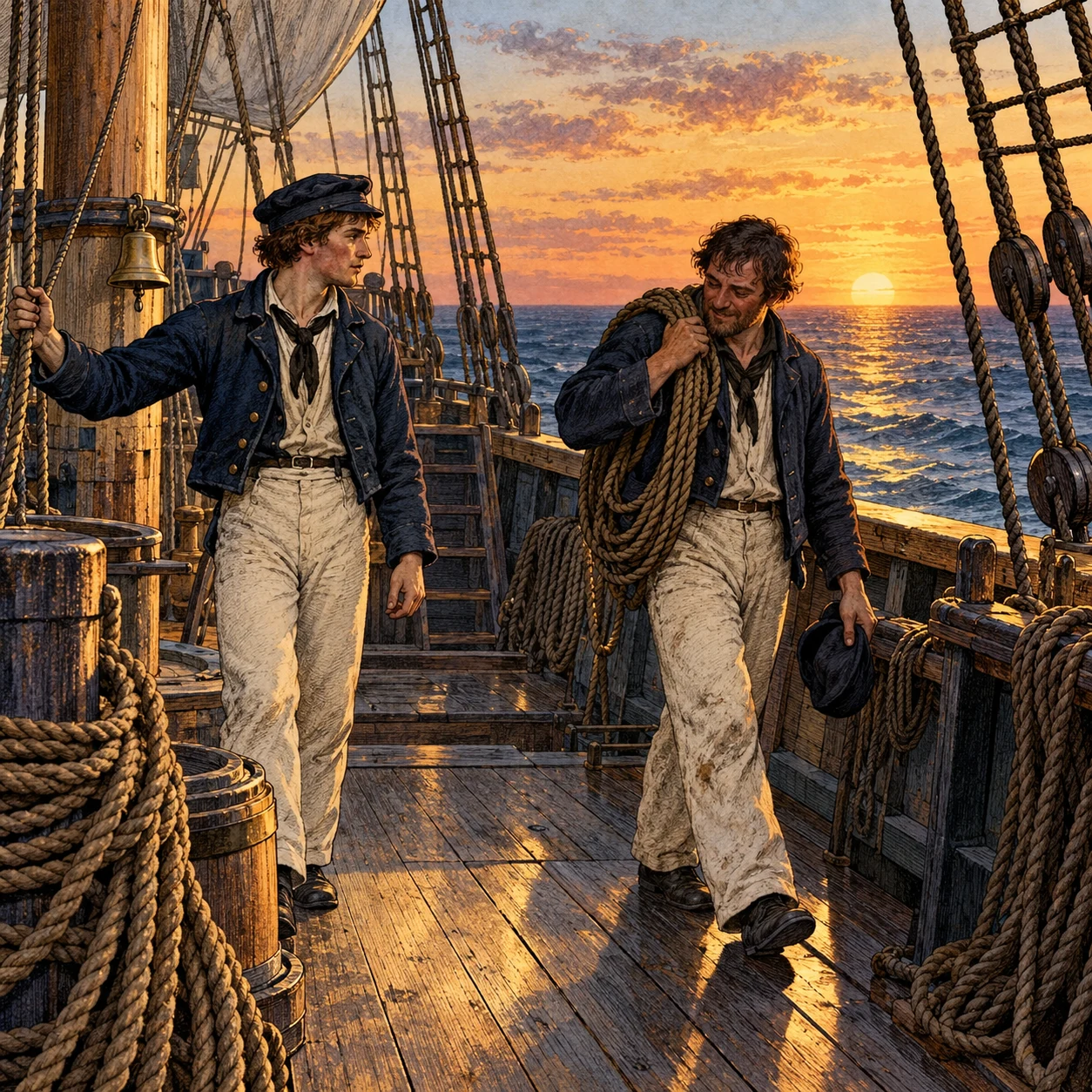
The first watch belonged to the night. The morning watch belonged to the morning. Most naval watch names were reassuringly straightforward.
Then came the dog watches: two short evening duties whose practical purpose is easier to explain than the animal in their name.
THE SHORT ANSWER
In the familiar traditional naval timetable, dog watches were the two-hour duties from 4 to 6 pm and from 6 to 8 pm. Splitting an ordinary four-hour period created seven watches in the day instead of six, changing how two alternating groups shared the following day’s duties.
The Oxford English Dictionary identifies the English word as modelled on a Dutch term. That gives the name a stronger linguistic explanation than the familiar claim that “dog watch” simply developed from “dodge watch”.
Why the earlier expression involved a dog is less certain. The timetable, the history of the word and the stories explaining the animal need to be considered separately.
WHAT WE KNOW
A particularly useful historical account appears in Admiral W. H. Smyth’s The Sailor’s Word-Book, published in 1867 and revised for the press by Vice-Admiral Sir Edward Belcher.
Its entry for “dog-watch” defines the two evening periods and explains their purpose: seven watches prevented the same sequence of duty hours from repeating throughout a voyage.
The logic is simple. Imagine two groups taking alternate watches. With six periods in a day, the first group returns to the first slot on the following day. With seven, the second group takes it instead.
This changed who received particular hours; it did not make everyone’s work disappear. The two short periods also mean that counting the number of watches alone does not tell us how many hours someone worked.
Smyth’s separate entry for “watch” records different ways of dividing crews, including three watches. The familiar two-group arrangement should therefore not be imposed on every navy, vessel or period.
HOW IT BECAME A HABIT
A ship needed people on duty while others rested. Once a crew worked within a repeated timetable, those periods needed recognisable names.
The traditional sequence was:
| Watch | Hours |
|---|---|
| First watch | 8 pm to midnight |
| Middle watch | midnight to 4 am |
| Morning watch | 4 to 8 am |
| Forenoon watch | 8 am to noon |
| Afternoon watch | noon to 4 pm |
| First dog watch | 4 to 6 pm |
| Last dog watch | 6 to 8 pm |
The USS Constitution Museum’s reconstruction of daily routine around the War of 1812 includes this pattern. Its evening periods sit between the afternoon and first watches, showing how the shortened duties fitted the whole day.
“Last dog watch” and “second dog watch” describe the same position in this familiar arrangement. The distinction is in the wording, not an extra shift.
THE STORY EVERYONE TELLS
One explanation makes the name sound almost inevitable: the shorter watches helped sailors dodge the same duty hours, so “dodge watch” gradually became “dog watch”.
A historical terminology guide published by the Naval History and Heritage Command repeats that derivation. It neatly connects the word with the arrangement’s purpose.
But a satisfying connection is not enough to demonstrate a word’s history. The Oxford English Dictionary’s identification of a Dutch model points to a different linguistic route.
There is also a much better joke. Smyth records Theodore Hook’s explanation that the watches were “cur-tailed”. A cur is a dog; the duties were curtailed, or shortened.
The pun was already worth preserving in a nineteenth-century nautical dictionary. That makes it evidence for an old joke, not evidence that the joke created the name.
WHAT THE EVIDENCE ACTUALLY SAYS
Our DISPUTED label concerns explanations of the name, rather than the existence or purpose of the watches.
The strongest distinction is between three questions.
What were they? The traditional two-hour evening duties are securely documented.
Why split the period? Historical nautical evidence explicitly explains the change to the daily rotation.
Why “dog”? The OED identifies a Dutch model for the English compound, but the animal’s original significance is harder to establish.
Anu Garg’s Wordsmith account discusses the Dutch hondenwacht and German Hundewache, suggesting associations with dogs being awake at night or with a dog’s short sleep. Those suggestions should remain possibilities, rather than eyewitness explanations from whoever coined the term.
Smyth separately defines “dog-sleep” as fitful naps taken under demanding conditions. That establishes the expression’s existence in nautical vocabulary; it does not prove that dog-sleep produced dog-watch.
Dating needs care too. Collins gives a late-seventeenth-century origin range, while Wordsmith reports documented use in 1657. Such differences are a reminder that a dictionary’s date reflects the evidence it uses, not a birth certificate for a word.
There is consequently no need to choose a charming canine story merely to complete the explanation. We can know how the watches worked without claiming to know precisely why the dog first entered the name.
WHY IT STUCK
The dog watches solved a recurring problem with an easily repeated adjustment: divide one period, alter the sequence, and change who receives the next night’s duties.
Their name also supplied sailors with something the more literal watch names lacked—a question worth asking, and several answers worth repeating.
The practical arrangement is well recorded. The dog has proved rather harder to pin down.
RELATED CURIOSITIES
Why Did Eight Bells Mark the End of a Sailor’s Watch?
Why Did Royal Navy Sailors Wear Bell-Bottom Trousers?
Why Is Whistling on a Ship Supposed to Bring Bad Luck?
SOURCES & FURTHER READING
W. H. Smyth, revised by Edward Belcher — The Sailor’s Word-Book (1867), entries “Dog-Watch”, “Watch” and “Dog-Sleep”. Historical definitions, rotation and the “cur-tailed” pun.
https://www.gutenberg.org/files/26000/26000-h/26000-h.htm
Oxford English Dictionary — “dogwatch, n.” The publicly indexed etymology identifies an English compound modelled on a Dutch lexical item. Full entry may require a subscription.
https://www.oed.com/dictionary/dogwatch_n
USS Constitution Museum — Daily Routine, Join the Crew. Historical watch timetable, including both evening dog watches.
https://jointhecrew.ussconstitutionmuseum.org/daily-routine/
Naval History and Heritage Command — Origin of Navy Terminology, “Dog Watch”. Records the “dodge watch” explanation, treated here as a claim to assess rather than an established derivation.
Collins English Dictionary — “dogwatch”. Definitions and a late-seventeenth-century dating range.
https://www.collinsdictionary.com/dictionary/english/dogwatch
Anu Garg, Wordsmith.org — “dogwatch”, A.Word.A.Day, 6 August 2024. Dutch and German parallels, possible canine associations and a reported 1657 attestation.