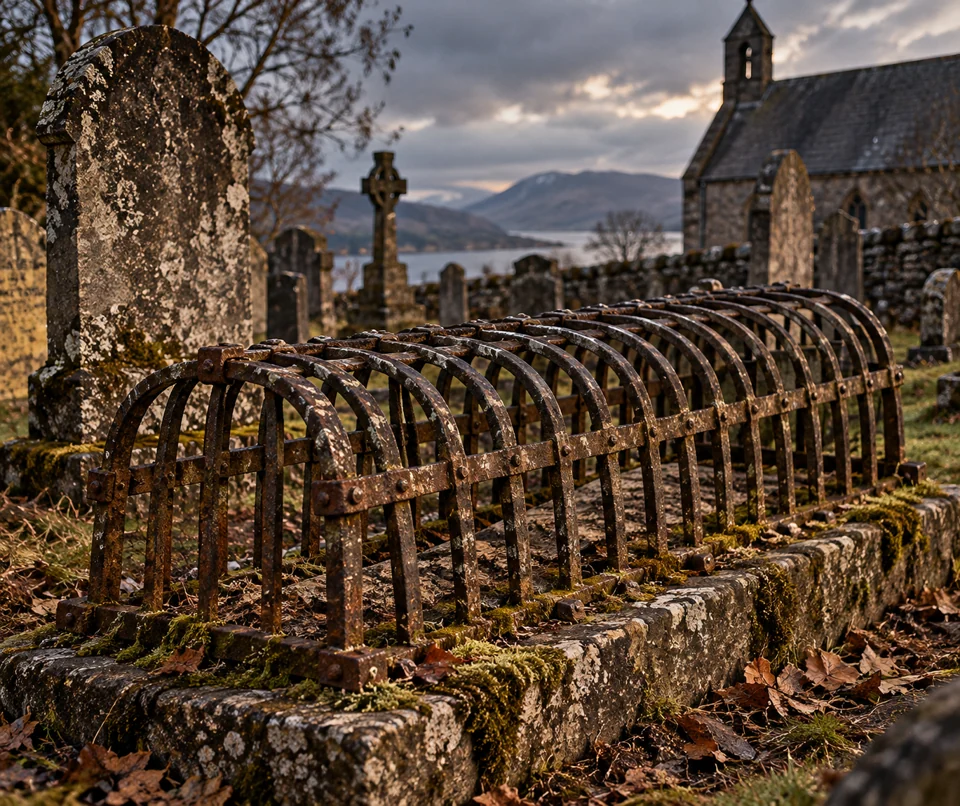
In certain old Scottish churchyards, an unsettling sight awaits the curious visitor. Heavy iron bars arch over graves, forming cages that appear designed to keep something securely underground.
At first glance, they resemble the sort of precautions one might expect in a Gothic horror story.
But these strange structures were not built to prevent the dead from rising.
They were designed to stop the living from stealing them.
The Short Answer
The iron cages were called mortsafes. They were used particularly in Scotland during the early nineteenth century to protect recently buried bodies from grave robbers known as resurrectionists.
Medical schools needed human bodies for anatomical teaching and dissection, but the legal supply was severely restricted.
Criminals discovered that freshly buried corpses could be stolen and sold to anatomists.
Mortsafes made the task of digging up a grave much more difficult, protecting the body until decomposition had made it unsuitable for the trade.
Why Were People Stealing Dead Bodies?
During the eighteenth and early nineteenth centuries, the study of human anatomy became increasingly important to medical education.
Students needed to understand the structures of the human body, and dissection was central to that training.
Yet British law provided only a limited legal supply of bodies, particularly those of executed criminals.
As medical schools expanded, demand exceeded supply.
This created an illegal market in human remains.
Body snatchers, sometimes called resurrection men or resurrectionists, entered burial grounds at night, opened recent graves and removed corpses.
The bodies could then be sold to anatomy teachers or their intermediaries.
For grieving families, the possibility that a loved one's body might be stolen after burial was horrifying.
How Did the Iron Cages Work?
Mortsafes appeared in several forms.
Some consisted of heavy iron frameworks placed over graves. Others enclosed coffins beneath the ground, sometimes combining ironwork with substantial stone slabs.
Their purpose was straightforward: make access to the body so difficult and time-consuming that grave robbing became impractical.
Some structures were extraordinarily heavy and required lifting equipment to position or remove them.
The protection was often temporary.
After several weeks, decomposition would generally have reduced the body's usefulness for anatomical dissection.
The mortsafe could then be removed and used to protect another newly buried person.
Historical records describe communities sharing or hiring these protective structures rather than commissioning an entirely new mortsafe for every burial.
Why Were They Particularly Common in Scotland?
Scotland became an important centre of medical education, especially in Edinburgh and Aberdeen.
Edinburgh's medical schools attracted students and teachers, increasing demand for bodies used in anatomical study.
The shortage of legally available cadavers helped sustain the illicit trade.
Churchyards near medical centres could therefore become targets for grave robbers.
Scottish communities responded with various protective measures, including heavy grave slabs, iron cages, locked burial vaults and organised graveyard watches.
Mortsafes became one of the most distinctive physical reminders of this period.
Did Families Really Guard Graves at Night?
Yes.
Where iron protection was unavailable or unaffordable, relatives and local communities sometimes organised watches over recently buried bodies.
Special watch-houses were constructed in some burial grounds to shelter those keeping guard.
Other precautions included reinforced coffins, heavy stones, secured vaults and measures intended to reveal whether a grave had been disturbed.
Some communities established associations to organise and finance protection.
These precautions reveal how seriously the threat of body snatching was regarded.
A funeral did not necessarily mean that a family could immediately stop worrying about the security of the grave.
What Did Burke and Hare Have to Do with It?
The notorious Edinburgh crimes of William Burke and William Hare in 1827 and 1828 exposed the disturbing commercial demand for human bodies.
The pair supplied corpses to the anatomist Dr Robert Knox.
But an important distinction is often overlooked.
Burke and Hare became notorious primarily for murdering people and selling their bodies, rather than simply stealing corpses from graves.
Their crimes demonstrated how the demand for anatomical subjects could encourage criminal activity beyond grave robbery.
Burke was executed in 1829. Hare escaped execution after giving evidence against him.
The scandal contributed to public anxiety about the trade in human remains.
What Happened to the Mortsafes?
The Anatomy Act of 1832 changed the legal framework governing the supply of bodies for dissection in Britain.
It allowed anatomical examination under regulated conditions and expanded access to bodies that had not been claimed for burial, subject to the Act's provisions.
The legislation did not immediately eliminate every abuse or controversy, but it helped undermine the commercial incentive for stealing bodies from graves.
As the nineteenth century progressed, mortsafes and organised graveyard watches became increasingly unnecessary.
Some iron structures were dismantled, reused or sold for scrap.
Others remained in churchyards, where they can still be seen today.
Surviving examples are associated with places including Greyfriars Kirkyard in Edinburgh and burial grounds elsewhere in Scotland.
Were the Cages Intended to Keep the Dead Inside?
No.
Although their appearance has encouraged supernatural interpretations, mortsafes were not designed to prevent vampires, ghosts or reanimated corpses from escaping.
Their documented purpose was to deter the theft of human remains.
The distinction matters because it separates a genuinely extraordinary historical practice from a later Gothic interpretation.
The real explanation is disturbing enough without introducing supernatural fears.
The Strange Part
There is something deeply unsettling about the idea that grieving families once needed to lock their loved ones beneath iron bars.
The cage was not a punishment, and the person inside was not considered dangerous.
It was an act of protection.
For a brief period in British history, the living sometimes had to defend the dead against other living people.
And the rusting ironwork left behind in old churchyards is a reminder that even the peace of the grave was not always guaranteed.
Evidence and Uncertainty
WELL SUPPORTED — mortsafes and their use against body snatching are historically documented.
Surviving mortsafes, contemporary records and historical investigations establish that these structures were used to protect graves against resurrectionists.
Their designs, ownership arrangements and periods of use varied.
Some were positioned above graves, while others protected coffins underground.
The association between mortsafes, the shortage of legally available anatomical subjects and the body-snatching trade is well documented.
The supernatural explanation sometimes attached to grave cages is not supported by the historical evidence for mortsafes.
Sources
1. Wellcome Collection — Beating the Bodysnatchers, Allison C. Meier, 14 June 2018. Historical account of mortsafes, grave robbery and the precautions taken by families.
https://wellcomecollection.org/stories/beating-the-bodysnatchers
2. National Museums Scotland — The Coffins Found on Arthur's Seat. Explains the shortage of anatomical subjects, Edinburgh's body-snatching trade and the use of locked iron mortsafes.
https://www.nms.ac.uk/discover-catalogue/the-coffins-found-on-arthurs-seat
3. Society of Antiquaries of Scotland — James Ritchie, An Account of the Watch-houses, Mortsafes, and Public Vaults in Aberdeenshire Churchyards, formerly used for the Protection of the Dead from the Resurrectionists (1912). Historical survey of surviving structures and their uses.
https://doi.org/10.9750/PSAS.046.285.326
4. Archaeology Scotland — Stories in Stone: Educator Notes. Discusses surviving mortsafes in Greyfriars Kirkyard and the historical context of body snatching.
5. The National Archives — Body Snatchers. Archival material concerning resurrectionists, the London Burkers and the Anatomy Act 1832.
https://www.nationalarchives.gov.uk/education/resources/body-snatchers/
6. West Highland Museum — The Sinister History of Mort Safes, 7 March 2021. Describes surviving mortsafe artefacts and methods of protecting graves.
https://www.westhighlandmuseum.org.uk/2021/03/07/the-sinister-history-of-mort-safes/