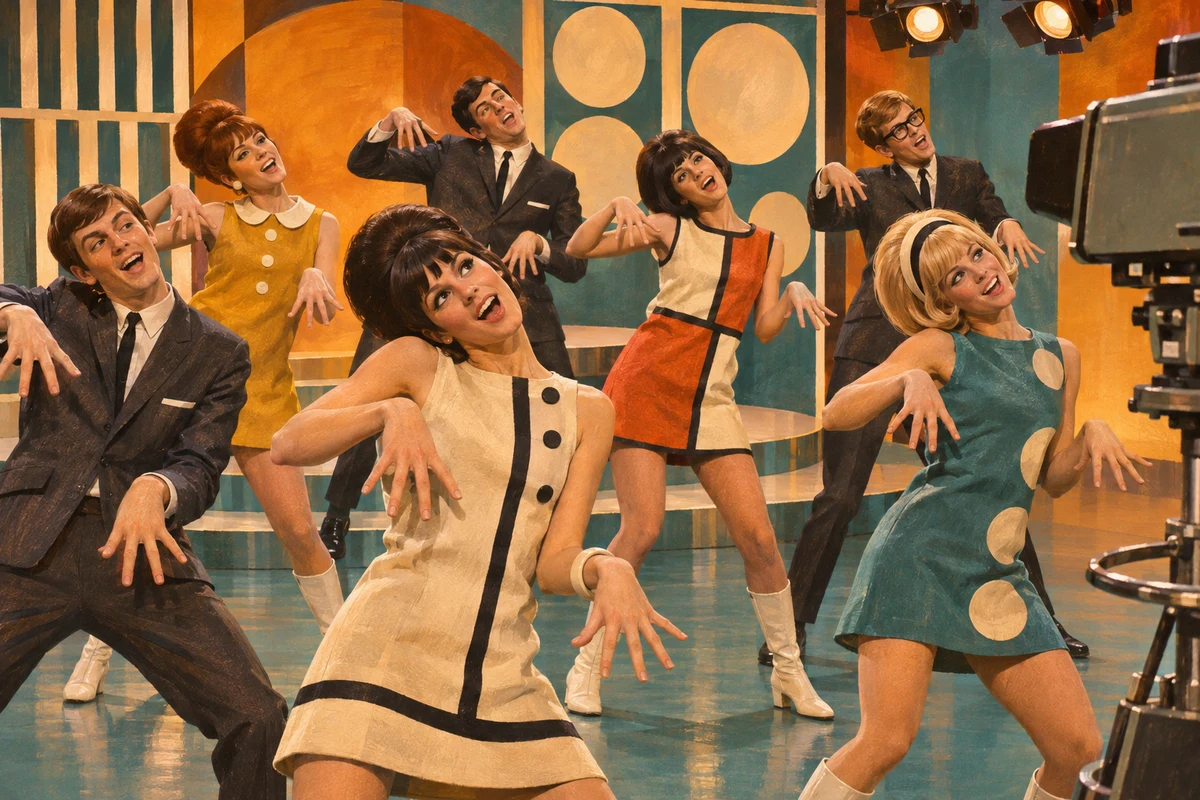
Long before Michael Jackson's Thriller, young people were appearing on television with their heads hanging sideways, their shoulders twitching and their bodies moving like marionettes with broken strings. What looks today like a zombie dance was part of a decade when popular music encouraged increasingly strange ways of moving.
But what were these dancers actually doing — and why did the 1960s produce so many extraordinary dance crazes?
The short answer
The 1960s saw an explosion of novelty dances, many of which abandoned traditional partnered steps in favour of independent, exaggerated movements. Dances such as the Shake, the Jerk and the Frug encouraged dancers to shake, twitch, gesture and improvise.
Television programmes helped spread these fashions, sometimes turning ordinary club movements into carefully staged performances.
The surviving clip that inspired this article shows dancers behaving remarkably like modern fictional zombies. But without identifying its original broadcast, we cannot say which named dance they were performing — or even whether it had a recognised name.
A dance floor full of the living dead
The starting point for this investigation is a short, unidentified clip described in the original draft: smartly dressed dancers, a monochrome studio setting and repeated, exaggerated head movements. The comparison with zombies is immediately appealing.
But a description is not a broadcast record. Without a programme credit, archive reference or securely identified original, even its apparent period remains provisional. Nor can we assume a coordinated television routine represents what ordinary people were doing in clubs.
The useful question is therefore broader: what documented dance culture could make such a performance seem at home in the 1960s?
When dancing stopped requiring a partner
Many prominent early twentieth-century social dances were organised around couples, although solo dancing and group traditions were already well established.
The foxtrot, waltz, jitterbug and jive all relied, to varying degrees, on coordination between partners.
The Twist helped make dancing independently a mass commercial phenomenon.
Popularised internationally by Chubby Checker's recording in 1960, the Twist helped transform mainstream social dancing. Partners could face one another without touching, swivelling their hips and moving independently.
Its roots, however, reached back into African American social dance traditions. The Twist did not suddenly appear from nowhere, and its international success was part of a longer history of Black musical innovation entering the commercial mainstream.
The commercial impact was enormous.
For this dance, there was no need for one person to lead another through a partnered sequence.
You could simply stand on the spot and move.
Once that idea became fashionable, there were remarkably few limits on what counted as dancing.
Why a familiar dance name is not enough
The Shake is an obvious name to encounter when researching 1960s dancing. Yet calling a movement a shake tells us little about the origin of a particular piece of footage.
Dance names travelled between places, performers and commercial demonstrations. An individual could adapt a fashionable movement; a choreographer could exaggerate it; a broadcaster could stage it as a comic routine.
A resemblance to the Shake, the Jerk or the Frug is a useful lead. It is not a reliable identification.
The Jerk, the Frug and the art of doing something strange
The Shake was only one member of a growing family of dances with memorable names.
The Jerk, associated with the Larks’ 1964 record of that name, involved sharply changing the position of the arms in time with the music. Contemporary dance instructions described movements alternating between softer positioning and sudden jerks.
The Frug concentrated on movements of the hips, torso and arms, often with relatively little travelling across the floor.
Other dances invited participants to imitate familiar actions or creatures.
There was the Swim, with gestures resembling swimming strokes, and the Hitch-Hiker, involving thumb gestures. The Pony, Monkey and Watusi were among the other fashionable names.
The Twist alone shows why television cannot be treated as the sole inventor. Hank Ballard and the Midnighters released the song in 1959, before Chubby Checker’s enormously successful 1960 version. The Library of Congress places that breakthrough within rhythm and blues history. Broadcasting amplified a culture that already existed.
Contemporary instruction books provide particularly useful evidence. The Library of Dance compares Dick Blake’s Discothèque Dances (1965) with The Hullabaloo Discothèque Dance Book (1966). These are useful records of how particular instructors explained fashionable movements, rather than proof that every dancer followed the same rules.
The important point is that exaggerated movement was no longer an accidental feature of dancing.
It had become a selling point.
Television turned dance crazes into spectacles
If a dance could be performed by a few young people in a nightclub, television could show it to millions.
In Britain, Ready Steady Go! became one of the defining pop programmes of the decade.
Launched on 9 August 1963, the ITV programme placed fashionable young people close to the musicians and encouraged an atmosphere resembling a crowded club.
The London Museum preserves photographs of the programme taken by Henry Grant in 1964.
Its historical account describes how producers selected audience members partly for their appearance and dancing ability. The programme also featured resident dancers who demonstrated new routines for viewers.
The result was more than a concert broadcast.
It was a weekly display of how young people were expected to look, dress and move.
Across the Atlantic, American programmes such as American Bandstand, Shindig! and Hullabaloo also helped turn popular dancing into a television spectacle.
For producers, the appeal was obvious.
A group of energetic dancers could make even a simple musical performance visually exciting.
And a strange-looking routine might be remembered long after the record had stopped playing.
Why did the movements become so exaggerated?
There was no single explanation.
Part of the answer lay in the music itself.
Electric guitars, powerful backbeats and increasingly prominent rhythm sections encouraged physical responses quite different from those associated with ballroom orchestras.
Another factor was the changing relationship between young people and authority.
The 1960s were a period when fashion, music and behaviour increasingly became ways of expressing generational identity.
A movement that looked absurd to parents could be wonderfully fashionable to teenagers.
Television intensified the effect. A dance had to communicate visually, often within a few seconds.
Large gestures, unusual poses and synchronised movements were easy to recognise on screen.
The more distinctive the routine, the more likely it was to stand out.
There is also a simpler explanation: people enjoyed being silly.
Not every strange 1960s dance was a political statement, a psychological experiment or a rejection of convention.
Sometimes it was simply fun to invent a movement that made your friends laugh.
The story everyone tells
A detached clip invites a wonderfully tidy explanation: people in the 1960s had a dance called the Zombie, and here it is.
That may make an effective caption. It is not established by the material available for this article.
“Zombie dance” here is a modern description of how the performers appear, not a verified contemporary title. There is no evidence before us that they intended to imitate the undead. Equally, without the original programme, we cannot rule out theatrical or comic intent.
The same caution applies to assumptions about drugs, hypnosis or a whole generation behaving irrationally. An unusual pose cannot establish any of those things.
What the evidence actually says
The evidence label is WELL SUPPORTED for the wider historical explanation: records, dance instructions and museum collections document an expanding market for named dances and television demonstrations.
The specific routine remains unidentified. This investigation has not established its original music, performers, country, broadcast date or contemporary dance name. The visual details reported in the starting draft should not be mistaken for independently authenticated archive information.
There is a further distinction between social dancing and performance. A television production may exaggerate a movement for entertainment, just as a dance manual may simplify it for teaching. Neither source automatically tells us how every club audience danced.
That leaves a smaller but more interesting conclusion. These movements belong beside a documented culture of novelty, imitation and individual expression; their resemblance to zombies cannot, on its own, tell us what they meant.
Why it stuck
Most people remember the 1960s through the Beatles, the Rolling Stones, miniskirts and psychedelic fashions.
But the decade also transformed the way ordinary people moved to music.
Dance became increasingly individual, expressive and improvisational.
Some crazes disappeared almost as quickly as they arrived. Others helped establish the freedom of movement that would become familiar in later discos and nightclubs.
The mysterious routine raises a useful question about that transformation.
To modern eyes, they seem to have wandered out of a horror film.
To their original audience, they may have looked like the height of fashion.
An original broadcast credit or an archive match could still change the story. Until then, the strangest detail deserves to remain a question.
RELATED CURIOSITIES
Was “Space Oddity” Really Written About the Moon Landing?
How Was the Doctor Who Theme Built from Tape and a Plucked String?
Why Did Radio Stations Ban a Record Without Any Words?
SOURCES & FURTHER READING
London Museum — Ready Steady Go!: The Swinging Sixties music show. Television context and Henry Grant’s 1964 photographs.
London Museum — Audience at filming of ‘Ready Steady Go’ television programme, 1964. A specific collection record for comparison; not an identification of the mystery clip.
Library of Congress — The 2012 National Recording Registry With a Twist. Hank Ballard, Chubby Checker and the commercial dance craze.
https://www.loc.gov/item/prn-13-044/
Library of Dance — The Jerk. Comparison of instructions from 1965 and 1966.
https://www.libraryofdance.org/dances/jerk/
Library of Dance — 1960s Discothèque Dances. Descriptions and references to Dick Blake’s 1965 manual.