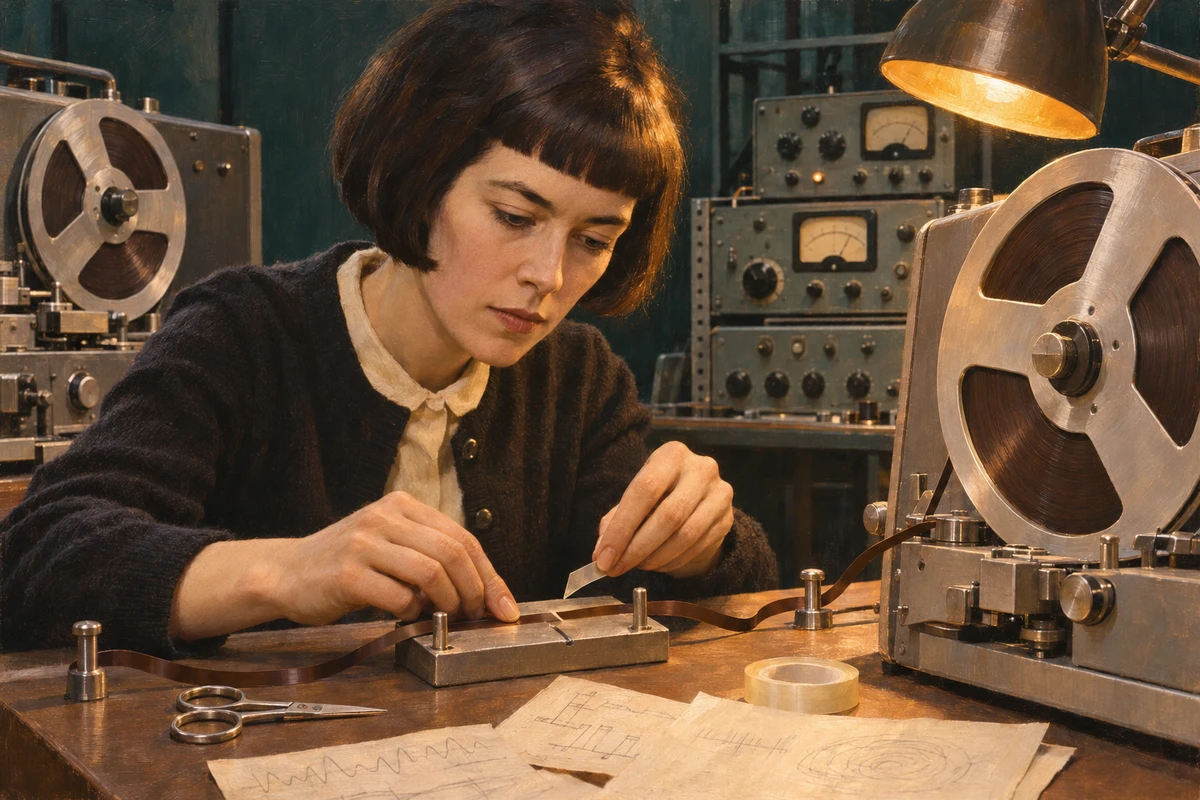
The sound of the future arrived through a very physical process: recording, measuring, cutting and joining magnetic tape.
In 1963, Delia Derbyshire helped give Doctor Who its extraordinary musical identity. Understanding how she made it also changes what it means to say that someone “wrote” a piece of music.
THE SHORT ANSWER
Ron Grainer composed the Doctor Who theme. Delia Derbyshire, working at the BBC Radiophonic Workshop, created its original electronic realisation: the particular sounds, textures and recorded construction that made the tune seem to come from another world.
The National Film and Sound Archive of Australia identifies white noise, a test-tone oscillator and a plucked string among the raw materials. Recorded sounds were manipulated and assembled on analogue tape. This was not a performance of the whole theme on a keyboard, and it was not a computer generating a finished arrangement.
WHAT WE KNOW
Derbyshire joined the Radiophonic Workshop in 1962. The unit supplied music and unusual sound for broadcasting, bringing musical decisions into close contact with engineering and experiment.
The University of Manchester’s archive catalogue identifies her 1963 work as an electronic realisation of Grainer’s theme. The description is important. It preserves the difference between the composition and the making of a particular recording without reducing the latter to a routine technical service.
A melody written on a page does not determine every sound through which an audience will encounter it. Instrument choice, articulation, texture and the relationship between layers can transform its character. In this case, the sounds themselves had to be constructed.
The now-familiar theme is evidence of a musical imagination at work in recorded material.
HOW A STRING BECAME SOMETHING ELSE
A plucked string begins as an ordinary acoustic event. Record it and the resulting sound becomes material that can be handled differently.
Changing tape speed alters pitch as well as duration. Short sections can be cut out and joined in a chosen order. Repetition can turn a fragment into a rhythmic pattern; reversing a recording changes the shape of its attack and decay.
These were among the Radiophonic Workshop’s methods, described by the Science Museum. Rather than asking one conventional instrument to play a line from beginning to end, a maker could organise recorded fragments into that line.
An oscillator supplied an electronic tone. Noise supplied a different kind of texture. The craft lay in selecting, shaping and combining such materials so that they became music rather than a demonstration of equipment.
The distinction is easy to underestimate now that a screen can make a sound look like a movable object. For Derbyshire, the material could actually be a length of tape. An edit involved joining physical surfaces, not dragging a cursor.
THE ARCHIVE HAS MORE THAN A FAMOUS NAME
There are useful records behind the story, not simply later admiration.
Manchester holds the Delia Derbyshire Papers, encompassing recordings and other material associated with her work. Its catalogue separately identifies the original Doctor Who construction tapes as held in the BBC’s Radiophonic Workshop archive.
Those collections should not be collapsed into one imaginary box labelled “the lost Doctor Who tapes”. Different holdings can answer different questions.
When Manchester announced work on its Derbyshire collection in 2008, it described 267 tapes donated by Workshop archivist Mark Ayres. The researchers also cautioned that unlabelled material required investigation and could not automatically all be attributed to her.
That is a useful antidote to the romantic discovery story in which every tape immediately reveals a forgotten masterpiece. Archives need patient identification, just as the music needed patient construction.
THE STORY EVERYONE TELLS
One version says Derbyshire composed the Doctor Who theme and did not receive the credit. Another describes her as someone who merely put another composer’s notes onto tape.
Neither gives an adequate account of the work.
Grainer’s authorship of the composition is established. So is Derbyshire’s creative role in producing its extraordinary recorded form. Giving her proper attention does not require removing his name.
There is a related temptation to describe the production as music made before synthesisers existed. Electronic instruments already had a history. The more precise point is that this recording was painstakingly constructed through the Workshop’s tape-based methods, rather than played as a complete piece on a modern synthesiser.
Old technology did not make the task simple. It made some of its musical choices unusually tangible.
WHAT THE EVIDENCE ACTUALLY SAYS
The label WELL SUPPORTED applies to the basic division of roles and to the use of manipulated recorded sound. The NFSA explicitly credits Grainer as composer and Derbyshire as musician and arranger.
Recognition nevertheless needs more than one category. In his research for British Art Studies, David Butler explains that Workshop staff commonly lacked individual screen or printed credits during much of the 1960s under BBC policy. He also notes contemporary press attention to Derbyshire’s contribution.
It would therefore be too sweeping to say that nobody knew she had made the recording. Absence from programme credits, absence from publicity and absence from the historical record are different things.
Nor should every unusual object associated with Derbyshire be inserted into the Doctor Who session. The Science Museum preserves a lampshade used as a sound source for “Blue Veils and Golden Sands” in 1967. It is a wonderful example of her practice, but it is not evidence that the same object produced the 1963 television theme.
A LARGER LIFE BEHIND THE THEME
The fame of Doctor Who can conceal the breadth of Derbyshire’s output. She worked across broadcasting and other artistic settings; her career does not fit neatly inside one set of television credits.
It also deserves a better ending than the familiar claim that she stopped creating when she left the BBC in 1973. Butler’s study uses archival material to document later collaborations and a more complicated continuation of her work.
The correction follows the same principle as the story of the theme. A memorable summary should be tested against what people actually made and what survives of the process.
WHY IT STUCK
The recording gave a television programme an audible identity: strange, insistent and immediately distinguishable from ordinary surroundings. Its interest lies not only in being an early electronic theme, but in how deliberately its sound was shaped.
A person hearing the finished result does not need to imagine scissors, tape or a test-tone generator. Yet those objects help explain why the result was a creative achievement rather than a lucky noise.
Grainer supplied a composition. Derbyshire transformed recorded material into a distinctive musical world. Remembering both makes the story richer, and gives the sound of the future its human hands back.
RELATED CURIOSITIES
Who Was the Woman Making Pianos in Beethoven’s Vienna?
Why Did a Sultan Own a Musical Tiger That Mauled a Soldier?
Who Was the Inventor Who Entered a Poisonous Tunnel to Save Strangers?
SOURCES & FURTHER READING
1. National Film and Sound Archive of Australia — “Doctor Who theme: Ron Grainer (composer) and Delia Derbyshire (musician and arranger)”. Credits and recorded raw materials. The archive notes that its presented version includes an opening sting absent from the original television broadcasts.
2. University of Manchester Library — “Delia Derbyshire Papers”. Collection description, 1963 realisation and the separate location of original Doctor Who construction tapes. The entry’s earlier BBC employment chronology should not be treated as more authoritative than specialised research.
3. Science Museum — “The Closure of the BBC Radiophonic Workshop”, 5 April 2012. Tape techniques, electronic sound and the theme’s production.
https://blog.sciencemuseum.org.uk/bbc-radiophonic-workshop/
4. Science Museum Group Collection — “BBC Radiophonic Workshop Items”. Surviving objects, including the lampshade associated with “Blue Veils and Golden Sands”.
https://collection.sciencemuseumgroup.org.uk/objects/co8355715/bbc-radiophonic-workshop-items
5. University of Manchester — “Lost tapes of Dr Who composer reveal hidden treasures”, 18 July 2008. Donation, tape count and attribution cautions. Its account of a complete post-BBC withdrawal is qualified by the later research below.
https://www.manchester.ac.uk/about/news/lost-tapes-of-dr-who-composer-reveal-hidden-treasures/
6. University of Manchester Research Explorer — “Lost Tapes of the Dr Who Composer”. Explicit clarification that Derbyshire realised Grainer’s composition rather than originating the theme’s composition herself.
https://research.manchester.ac.uk/en/clippings/lost-tapes-of-the-dr-who-composer/
7. David Butler — “Whatever Happened to Delia Derbyshire?: Delia Derbyshire, Visual Art, and the Myth of her Post-BBC Activity”, British Art Studies, issue 12, May 2019. Research on creative practice, credit, public recognition and later work.
https://britishartstudies.ac.uk/issues/12/whatever-happened-delia-derbyshire