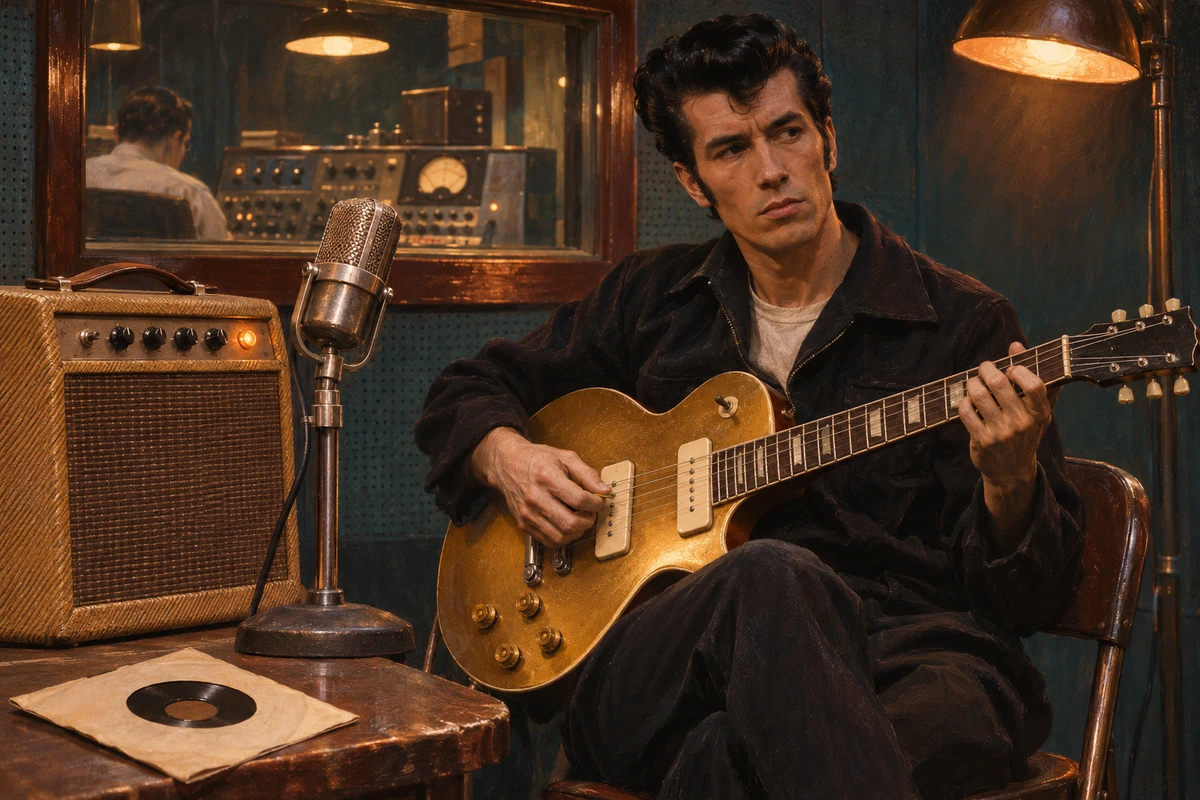
There were no obscene lyrics. There were no lyrics at all. Yet Link Wray’s “Rumble” acquired a reputation as a record too dangerous for the radio.
The 1958 instrumental exposes an unusual kind of musical anxiety: what happens when a guitar, a title and an audience’s imagination seem threatening enough on their own?
THE SHORT ANSWER
Some American radio stations refused to play “Rumble” because its title suggested street fighting and its ominous sound became associated with fears about teenage violence. The Library of Congress and museum histories describe that reaction.
This was not a nationwide legal prohibition. Nor does the evidence justify the frequently repeated claim that it was the only instrumental ever banned. The more secure story is strange enough: broadcasters could object to what a record appeared to imply, even when nobody sang a word.
WHAT WE KNOW
“Rumble”, credited to Link Wray and His Ray Men, appeared on the Cadence label in spring 1958. Its dark, spacious guitar sound gave an instrumental recording an unusually forceful personality.
Wray had not arrived from nowhere. Born Fred Lincoln Wray Jr. in Dunn, North Carolina, in 1929, he played western swing before becoming associated with the harder edge of rock ’n’ roll. His musical life crossed the categories that later histories sometimes present as separate worlds.
The North Carolina Department of Natural and Cultural Resources records that “Rumble” reached number 16 on Billboard’s chart. Whatever obstacles it encountered on air, it was a successful commercial release, rather than a suppressed recording that nobody could buy.
That distinction helps define the controversy. “Banned” here concerns broadcast decisions, not the disappearance of the record from shops, jukeboxes or listeners’ homes.
HOW A SOUND BECAME A WARNING
A record’s title tells listeners how to approach what they hear. “Rumble” supplied a particularly loaded instruction.
In the story recounted by Cary O’Dell for the Library of Congress, the tune was initially called “Oddball”. Its eventual name emerged from an association with gangs, fighting and West Side Story. O’Dell presents the naming anecdote as legend, rather than a fully documented exchange we can reconstruct word for word.
The new title nevertheless did useful imaginative work. A slow instrumental could become a confrontation without adding a singer, a threat or a narrative about an actual fight.
This is an interpretation of the record’s presentation, not a claim that every listener heard the same thing. A musician could hear a fascinating tone while a nervous broadcaster heard trouble.
A USEFUL GUITAR TO GET RIGHT
SFO Museum’s instrumental-rock exhibition makes a revealing distinction between Wray’s instruments.
It identifies the “Rumble” recording setup as a 1953 Gibson Les Paul played through a modified Premier amplifier. Its displayed Danelectro Guitarlin, with its distinctive long horns, belongs to a later part of his early recording career and appears on the cover of his first LP.
The comparison matters because a memorable photograph can quietly replace the history of a particular session. Wray’s best-known guitar image is not automatically evidence of the instrument used on every record.
The sound itself also deserves care. Distortion alters the signal; tremolo creates a repeated fluctuation in volume. Both belong to the familiar account of “Rumble”, but they are not interchangeable names for one effect.
THE STORY EVERYONE TELLS
The headline version is irresistible: the only instrumental banned for its lyrics.
It works as a joke because there are no lyrics. It becomes misleading when treated as an exact historical description or a demonstrated world record.
Another celebrated story explains the guitar tone through damaged speakers. In O’Dell’s essay, Wray recalls using a pen to make holes in the amplifier’s smaller speakers while trying to reproduce a live sound. Sonya Flowers’ later Registry essay recounts the episode with a pencil.
Those accounts give us a musician’s remembered solution and the way it was retold. They do not require us to identify the precise writing implement with confidence. Nor should an account of one influential recording become a claim that nobody had ever experimented with distorted guitar before it.
WHAT THE EVIDENCE ACTUALLY SAYS
The central explanation is WELL SUPPORTED: established institutional accounts connect refusals to broadcast the record with its suggestive title and anxieties about juvenile violence.
The wording varies. SFO Museum says some stations banned it; the Library of Congress essays use broader language and recount additional incidents. These are retrospective histories, not a complete surviving register of station instructions.
This article therefore does not attach a confident national total to the refusals, or claim that every station in a named city followed the same policy. A broadcaster declining a record, a presenter avoiding its title and a government outlawing its sale would be different events. They should not be bundled into one dramatic word.
The Rock & Roll Hall of Fame describes Wray’s power chords and raw distortion as a major musical influence. That supports his significance without requiring him to have single-handedly invented every ingredient of the sound.
WHY IT STUCK
Wray’s later recognition provides an extraordinary contrast with the controversy. “Rumble” belongs to the National Recording Registry’s 2008 selection, and Wray entered the Rock & Roll Hall of Fame’s Musical Influence category in 2023.
Something once described as a threat had become something institutions wanted remembered.
The change does not mean that the music itself grew polite. It shows how unfamiliar sounds can move from disturbance to inheritance. Later guitarists recognised expressive possibilities in the roughness that others had found objectionable.
The most revealing question is not whether a guitar really made teenagers violent. The accounts of the ban do not establish that it did. It is why adults could imagine a record carried dangerous intentions when its performers had not uttered a single sentence.
“Rumble” left the words out. Listeners supplied plenty of their own.
RELATED CURIOSITIES
Who Was the Woman Making Pianos in Beethoven’s Vienna?
Why Did a Sultan Own a Musical Tiger That Mauled a Soldier?
Why Did Maud Wagner Cover Her Body in Tattoos?
SOURCES & FURTHER READING
1. Library of Congress — Cary O’Dell, “Rumble—Link Wray (1958)”. Retrospective Registry essay, naming story, airplay controversy and Wray’s recollections.
https://www.loc.gov/static/programs/national-recording-preservation-board/documents/RUMBLE-FINAL.pdf
2. Library of Congress — Sonya Flowers, “Rumble—Link Wray (1958)”. Guest Registry essay, recording anecdotes and the record’s later reputation; individual anecdotes should be read as retrospective accounts.
3. SFO Museum — “Surf’s Up! Instrumental Rock ’n’ Roll”, Link Wray section. Guitar and amplifier details, the displayed Guitarlin and restrictions by some stations. Its absolute priority claim for recorded distortion is not adopted here.
https://www.sfomuseum.org/exhibitions/surfs-up-instrumental-rock/gallery
4. Rock & Roll Hall of Fame Library & Archives — “Link Wray”. Influence, archival resources and 2023 induction category.
https://library.rockhall.com/link_wray
5. North Carolina Department of Natural and Cultural Resources — “Link Wray of Dunn, Guitar Innovator, Renowned for ‘Rumble’”, 2 May 2016. Early career and chart performance.
https://www.dncr.nc.gov/blog/2016/05/02/link-wray-dunn-guitar-innovator-renowned-rumble
6. Library of Congress — Complete National Recording Registry Listing. “Rumble”: recording year 1958, Registry selection year 2008.