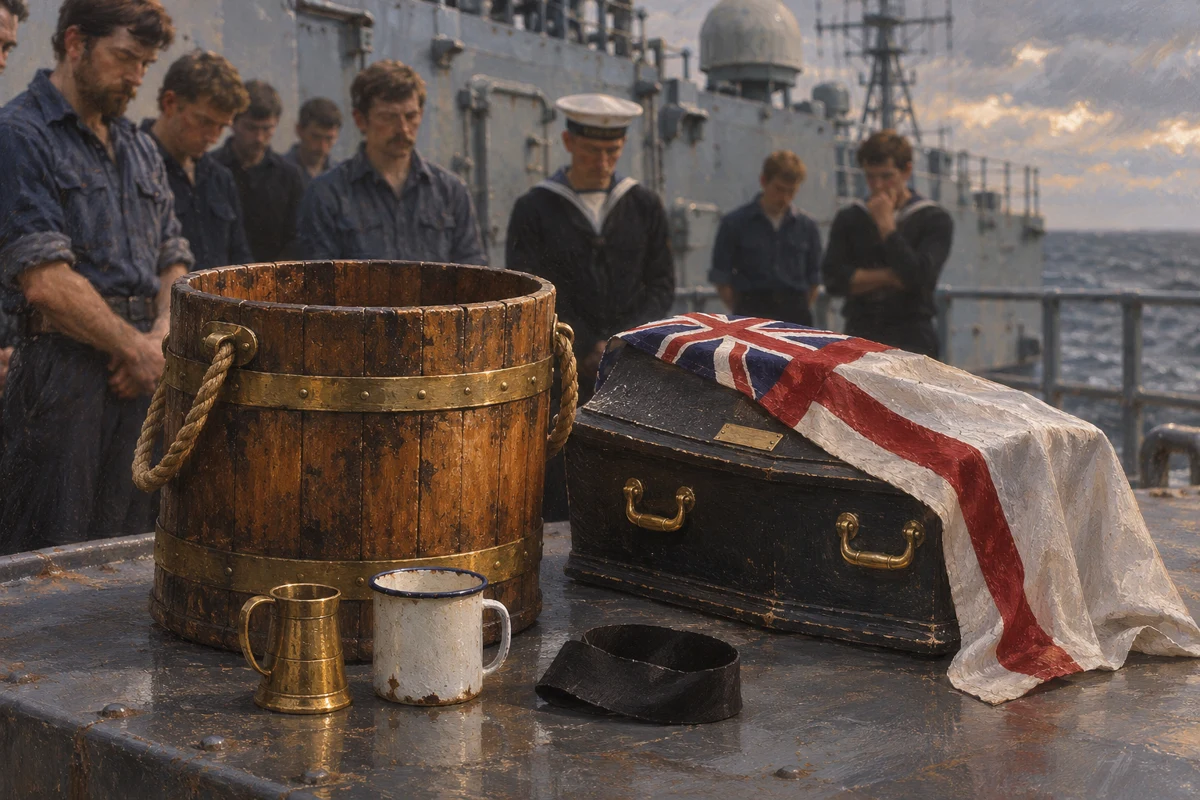
On 31 July 1970, some Royal Navy sailors put on black armbands and held mock funerals. The deceased had sustained a long relationship with the lower deck. It was also a drink.
Black Tot Day ended the Navy’s daily rum ration. Behind the theatrical mourning lay a serious argument about machinery, privilege and who got to decide when a naval tradition had outlived its usefulness.
THE SHORT ANSWER
Sailors staged funerals because their daily “tot” represented more than free rum. It was a familiar interruption to the working day, surrounded by routines and shared memories.
The Royal Navy’s last daily rum issue took place on 31 July 1970. Abolition took effect on 1 August. The Admiralty Board considered a regular issue of strong spirits incompatible with the precision demanded by modern naval equipment.
The ceremonies were real. So was the controversy. But the familiar picture of every British sailor receiving the same ration for 300 years compresses a much more changeable history.
WHAT WE KNOW
One particularly revealing witness is a small commemorative shield in the National Maritime Museum’s collection.
Its inscription identifies HMS Triumph and the last day of the rum issue: 31 July 1970. The design includes a coffin marked “TOT RIP”, draped with a White Ensign. Nearby sits a rum barrel carrying a blessing for the Queen.
This is a surviving object commemorating the farewell, rather than a modern illustration of what someone imagines happened. Its imagery turns an administrative decision into a death in the naval family.
Royal Museums Greenwich also records black armbands, symbolic burials at sea and mock funeral processions involving a coffin, drummers and a piper. These were ways some sailors marked the occasion, rather than a single ceremony performed identically throughout the fleet.
HOW IT BECAME A HABIT
The rum story usually begins with England’s capture of Jamaica in 1655. Caribbean availability helped rum enter naval provisioning, gradually displacing other spirits in that setting.
That date is a useful starting point, but not proof that every ship immediately adopted one universal daily rum ritual. Beer, wine and spirits belonged to a provisioning system shaped by supply and geography. A contemporary account published by the US Naval Institute in July 1970 distinguishes rum’s unofficial introduction in 1655 from its recognition as an official issue in 1731.
Another turning point came in 1740. Admiral Edward Vernon ordered his men’s rum mixed with water. Dilution was intended to address the harmful effects of drinking the allowance neat. The mixture became known as grog, associated with Vernon’s nickname, Old Grog.
The ration subsequently shrank. By its final period, the daily allowance was one-eighth of an imperial pint: approximately 71 millilitres of rum before dilution. Junior ratings normally received it mixed with water.
Measured quantities, supervision and the familiar call of “Up Spirits” made the issue a recognisable part of naval life. Something supplied by the institution became something sailors felt belonged to them.
THE STORY EVERYONE TELLS
The familiar version has an irresistible shape: sailors received rum for three centuries, modern officials took it away, and the Navy buried a beloved tradition.
There is truth in that outline. What it conceals is the disagreement over what the ration had become.
For its defenders, the tot represented comradeship and a distinctive naval privilege. For its critics, the same daily ritual put a substantial amount of alcohol into the middle of a working day.
Even the small word “tot” could be misleading. It sounded modest. The spirit it described was strong.
WHAT THE EVIDENCE ACTUALLY SAYS
The evidence label is WELL SUPPORTED, particularly for the ending. We have the government’s announcement, a parliamentary debate and surviving commemorative material.
On 17 December 1969, minister David Owen announced abolition on the Admiralty Board’s advice. The official statement compared the alcohol in the daily ration with slightly more than four measures of spirits. It stressed that lives depended on the reliable operation of complex machinery.
It also explicitly rejected economy as the motive. A capital payment of £2.7 million was promised to a new Sailors’ Fund for the benefit of ratings and Royal Marine other ranks.
The Commons debate of 28 January 1970 reveals resistance that a tidy anniversary summary can miss. MPs questioned the evidence, defended morale and challenged differences between the drinking privileges of officers and junior men. Owen defended abolition on medical and operational grounds.
That record documents a policy argument. It does not establish that every sailor welcomed the decision, or that every sailor opposed it.
Nor did everyone draw rum. Age restrictions and eligibility mattered, and a cash alternative existed. A universal daily handout to every person aboard is the wrong picture.
Finally, Black Tot Day did not make the Royal Navy entirely alcohol-free. The announcement included changes to purchased drinks and expressly retained the special ceremonial issue associated with “Splice the Main-brace”.
What ended was the routine daily entitlement.
WHY IT STUCK
The farewell survives because it gives an unusually clear date to a change that naval life had been approaching for years.
A drink associated with older conditions at sea had endured into an age of missiles and intricate electronic systems. Its defenders and opponents were arguing about how a modern service should work, but also about who owned its customs.
The mock coffin made that argument visible. An institution could abolish a ration. Sailors could still give it a send-off.
RELATED CURIOSITIES
Why Were the Navy’s Shortest Watches Called Dog Watches?
Why Did Eight Bells Mark the End of a Sailor’s Watch?
Why Did Royal Navy Sailors Wear Bell-Bottom Trousers?
SOURCES & FURTHER READING
UK Parliament, Hansard — Naval Ratings and Royal Marines (Rum Issue), 17 December 1969. The official abolition announcement.
UK Parliament, Hansard — Royal Navy (Rum Ration), 28 January 1970. The debate over efficiency, evidence, privilege and morale.
Royal Museums Greenwich — Black shield. HMS Triumph commemorative object.
https://www.rmg.co.uk/collections/objects/rmgc-object-63523
Royal Museums Greenwich — A rum deal: The origins of Nelson’s blood. Used for the final issue and farewell ceremonies; its Nelson story is explicitly presented as legend.
https://www.rmg.co.uk/stories/maritime-history/curatorial/rum-deal-origins-nelsons-blood
Royal Museums Greenwich — Admiral Edward Vernon, 1684–1757. Collection entry discussing the 1740 dilution order.
https://www.rmg.co.uk/collections/objects/rmgc-object-14541
Lawrence Phillips, US Naval Institute Proceedings — The Abolition of the Rum Ration, July 1970. A contemporary account of the ration and its abolition.
https://www.usni.org/magazines/proceedings/1970/july/abolition-rum-ration