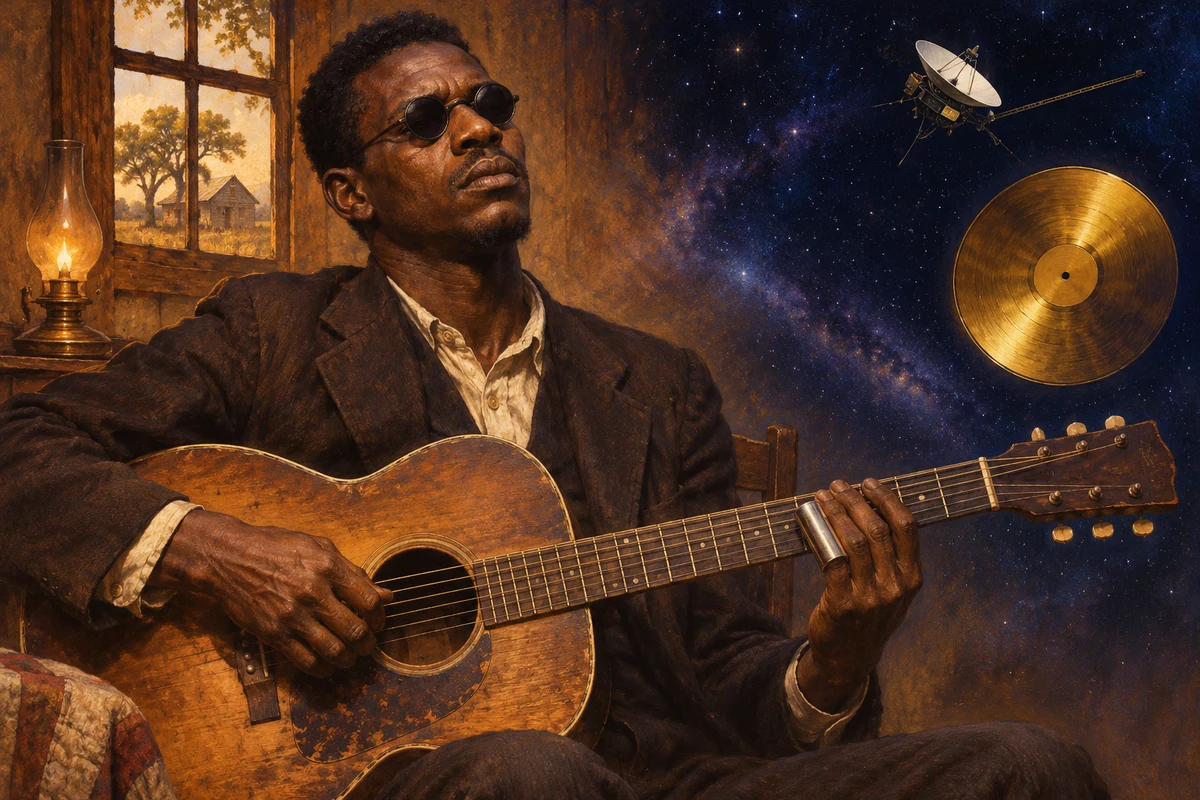
In 1927, Blind Willie Johnson recorded a piece of music without a single intelligible lyric. Fifty years later, it was chosen to help introduce humanity to any civilisation that might one day find a spacecraft from Earth.
The journey from a Texas recording session to the Voyager Golden Record is extraordinary enough. The sound itself is stranger still: a guitar, a human voice and something that seems to hover between a prayer and a cry.
THE SHORT ANSWER
Blind Willie Johnson’s “Dark Was the Night, Cold Was the Ground”, recorded for Columbia in 1927, was included on the Golden Records carried by Voyager 1 and Voyager 2 when they launched in 1977.
A committee chaired by Carl Sagan selected sounds, images and music intended to convey something of life on Earth. Johnson’s recording became one small part of that enormous introduction.
It was an unusual choice only if we expect a message to explain itself in words. Johnson’s performance offers something more immediate: the sound of a person expressing feeling.
WHAT WE KNOW
A recording made for listeners on Earth
Johnson recorded “Dark Was the Night, Cold Was the Ground” in Dallas on 3 December 1927. His instrument was an acoustic guitar, played with the sliding notes that became central to his musical identity.
Over it comes a voice without clearly articulated lyrics: humming, moaning and sustained phrases that seem to answer the instrument.
The effect can be unsettling. The guitar does not merely accompany a singer delivering a song. Voice and strings appear to exchange fragments of the same thought.
Johnson was a religious performer whose music drew on African American sacred traditions. Calling him a blues musician describes something important about his sound, but it can obscure the purpose of his singing. This was also the work of a street evangelist.
His title belongs to an older hymn tradition associated with Christ’s suffering. The recording is wordless, but it did not emerge from a world without words or religious meaning.
That distinction matters. A listener encountering it today might hear sorrow, solitude or consolation. Johnson’s musical world also contained worship, scripture and the shared language of church singing.
HOW IT BECAME A HABIT
From a commercial record to a planetary keepsake
In 1977, the two Voyager spacecraft began their missions carrying an unusual extra item: a phonograph record intended for a possible finder far beyond Earth.
The Golden Record project assembled a selection of images, natural sounds, spoken greetings and music. Its ambition was almost absurdly large. How could a finite object represent a planet?
One answer was variety.
Johnson’s performance sat within a collection that also included European classical music and musical traditions from many other parts of the world. It was neither a chart of the most commercially successful records nor a prize awarded to the best-known performers.
It was a collection of choices about what humanity might sound like.
NASA’s published track list identifies Johnson’s piece plainly. The link between the 1927 recording and the spacecraft is not a later internet embellishment. It is part of the mission’s documented cargo.
THE STORY EVERYONE TELLS
The man Earth overlooked, heard by the universe
The popular version often becomes a perfect miniature tragedy: an impoverished blind musician, ignored during his life, finally given an audience among the stars.
There is emotional truth in the contrast between Johnson’s circumstances and the remarkable destination of his music. But the neatness can conceal the person.
He was a working musician with a recording career, a religious repertoire and listeners. The surviving Columbia recordings are evidence of professional activity, not merely a lonely voice accidentally rescued from oblivion.
Other familiar details need more caution. A story that his stepmother blinded him with lye is widely repeated. The Handbook of Texas explicitly presents it as a legend. Accounts of his birth and family relationships also differ.
These uncertainties do not make his life unknowable. They mean that a vivid anecdote should not automatically be promoted into an established fact.
WHAT THE EVIDENCE ACTUALLY SAYS
A spacecraft is not a radio station
The central story earns a WELL SUPPORTED label: Johnson made the recording, and copies of it went aboard both Voyagers.
The phrase “his voice is singing through space”, however, needs a little translation.
The spacecraft do not continuously broadcast the Golden Record’s musical contents to the universe. The music is physically encoded on the discs. Someone would have to find a spacecraft and work out how to retrieve it.
The record travelled with instructions. NASA describes a protective jacket, a cartridge and a needle; diagrams on the cover explain playback and the reconstruction of images.
That makes the project more like a message in a bottle than an interstellar radio programme.
It also places a limit on an irresistible claim: we cannot know that an unfamiliar intelligence would recognise Johnson’s performance as sorrow, prayer or anything else. Even human listeners bring different experiences to it.
Its inclusion tells us what the selectors hoped to communicate. It does not establish what a hypothetical recipient would understand.
And the association with space came decades after Johnson’s performance. He was recording music within his own religious and commercial world, not composing an anthem for a future spacecraft.
WHY IT STUCK
An introduction without a speech
The story survives because the distance between its beginning and its destination is almost impossible to take in.
A recording session in 1927 became part of an attempt to describe Earth fifty years later. A voice shaped by one particular human life was offered as something that might speak beyond it.
Yet the most affecting part does not require an imagined alien audience.
We can listen now.
Before the spacecraft, before the gold-plated disc and before the grand ambition to represent humanity, there was a musician making a sound worth hearing.
The Voyager story gives us another reason to find him. The recording gives us a reason to stay.
RELATED CURIOSITIES
Was “Space Oddity” Really Written About the Moon Landing?
How Was the Doctor Who Theme Built from Tape and a Plucked String?
Why Did Radio Stations Ban a Record Without Any Words?
SOURCES & FURTHER READING
Library of Congress — Shane Ford, “Dark Was the Night, Cold Was the Ground”: National Recording Registry essay on Johnson and the 1927 recording.
NASA — Golden Record Sounds and Music: official list of the music carried aboard Voyager.
https://science.nasa.gov/mission/voyager/golden-record-contents/sounds/
NASA — Golden Record Contents: selection committee, contents and playback equipment.
https://science.nasa.gov/mission/voyager/golden-record-contents/
NASA — Golden Record Cover: explanation of the playback and image-decoding diagrams.
https://science.nasa.gov/mission/voyager/golden-record-cover/
Texas State Historical Association — “Johnson, ‘Blind Willie’”: biographical overview, including explicit qualifications around personal stories.
https://www.tshaonline.org/handbook/entries/johnson-blind-willie
Texas State University, Center for Texas Music History — The Ballad of “Blind” Willie Johnson: introduction to Shane Ford’s research and the problems in Johnson’s received biography.
https://www.txst.edu/ctmh/publications/hartman-series/blind-willie-johnson.html
The Traditional Ballad Index — “Dark Was the Night, Cold Was the Ground”: hymn background and discussion of the African American singing tradition.