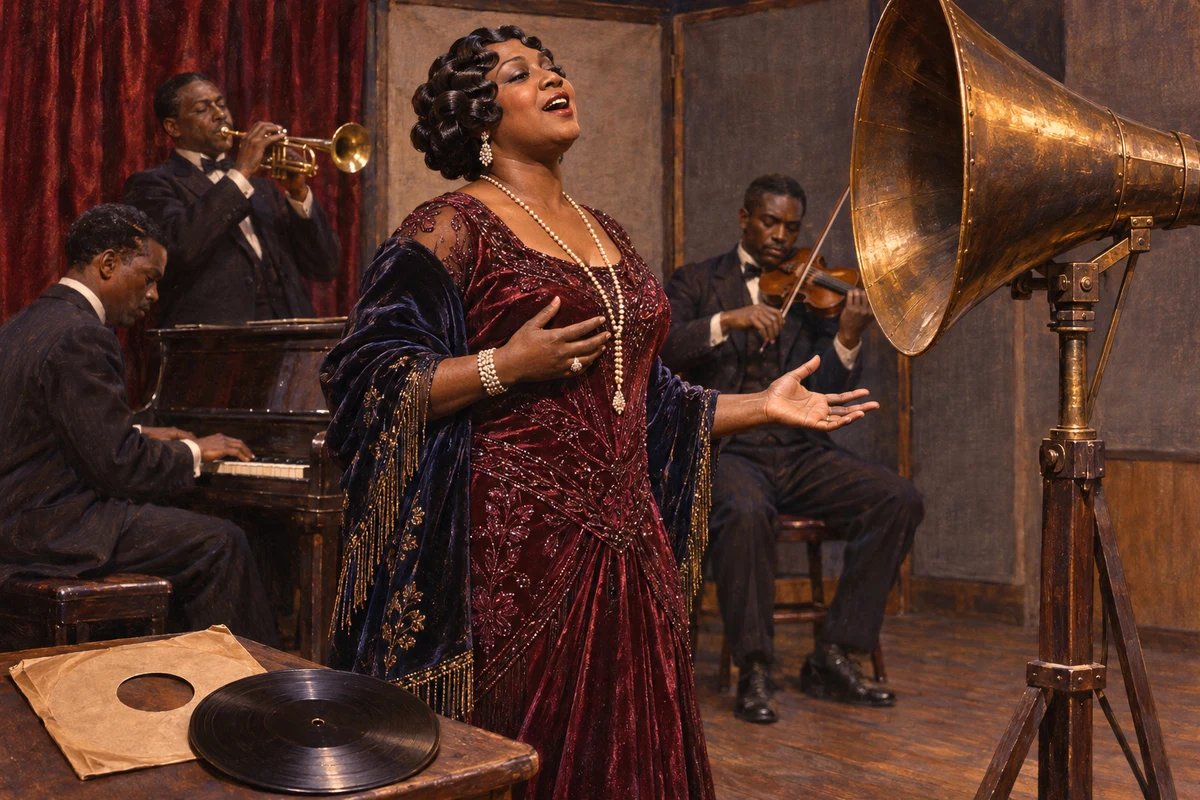
In 1920, Mamie Smith recorded “Crazy Blues” for a company that had been persuaded to take a chance on her. The result helped change whose voices the American record industry considered worth recording.
But the familiar story of the “first blues record” leaves out some of the most interesting evidence: an earlier session, a song with a theatrical past and a success that does not need an invented sales figure.
THE SHORT ANSWER
Mamie Smith’s recording of Perry Bradford’s “Crazy Blues” became a commercial breakthrough in 1920. Its success helped encourage record companies to record more Black performers and take Black record buyers more seriously.
It did not mark the invention of the blues, the first recording by a Black person or the first time a Black woman had made a commercial recording.
Its importance lies in the business it helped change: a performance by a Black female popular singer, backed by Black musicians, became a model that other companies wanted to follow.
WHAT WE KNOW
Before the famous session
Mamie Smith was already an experienced stage entertainer when she entered the recording business. She came from the world of touring performance, song, dance and vaudeville, rather than suddenly appearing as an unknown singer with one remarkable song.
Songwriter and promoter Perry Bradford was an important advocate. He wanted record companies to hear a commercial opportunity in Black popular performance.
The obstacles were not simply questions of musical taste. Racial prejudice shaped decisions about performers, audiences and the material companies were prepared to sell.
Bradford eventually found an opening with Fred Hager at Okeh.
Smith’s first Okeh session took place in February 1920. She recorded “That Thing Called Love” and “You Can’t Keep a Good Man Down”, issued together as Okeh 4113.
“Crazy Blues” came later.
That earlier record matters because it prevents the story from collapsing into a single miraculous afternoon. There had been persuasion, a first release and then another opportunity.
The famous August recording
The session for “Crazy Blues” is conventionally dated 10 August 1920. Discographical researcher Allan Sutton cautions that the surviving evidence does not justify treating every early Okeh session date as exact: the company’s recording files for the period have not survived.
“August 1920” is secure enough for the larger story.
Smith recorded with the musicians billed as her Jazz Hounds. The resulting record, Okeh 4169, paired “Crazy Blues” with “It’s Right Here for You”.
Copies survive in museum collections. The National Museum of American History catalogues a ten-inch shellac disc with that record number.
It is a useful object to keep in view. Behind the enormous claims made for this moment is something specific: a manufactured record that listeners could buy, take home and play.
HOW IT BECAME A HABIT
When a successful record becomes a business argument
The record’s success encouraged a wider rush to record Black women singing blues and related popular material.
Smith did not create the talent that followed. Singers such as Ma Rainey already had performing careers. What changed was the willingness of companies to seek out, promote and sell more of that music.
The University of Mississippi’s centenary exhibition places “Crazy Blues” at the beginning of the classic blues recording era, in which female performers occupied a central position.
That is a useful correction to a familiar picture of early blues history dominated by solitary men with guitars.
This was also the period in which the industry developed the category known as “race records”: a historical marketing term for recordings directed principally towards Black audiences.
The term described the way an industry organised and sold music. It was not a musical style, and the performers and their listeners were never as neatly bounded as a catalogue heading might suggest.
THE STORY EVERYONE TELLS
The first blues record—and the astonishing numbers
“Crazy Blues” is frequently introduced as the first blues recording.
That phrase is convenient, memorable and too broad.
Black performers had been recorded long before 1920. Songs advertised as blues, and recordings containing blues elements, also predated Smith’s breakthrough.
Even the music on “Crazy Blues” resists a tidy definition. It is a composed theatrical number combining blues passages with other song structures, not an unbroken sequence of twelve-bar verses.
Then there are the sales figures.
Accounts commonly report 75,000 copies in a month, sometimes followed by claims of a million or more. The numbers are repeated so confidently that they can seem as solid as the catalogue number on the label.
They are not.
WHAT THE EVIDENCE ACTUALLY SAYS
A strong case without a precise total
The broad conclusion is WELL SUPPORTED: “Crazy Blues” was a consequential commercial success that helped expand recording opportunities for Black popular performers.
Its exact sales are less secure.
Published accounts disagree even about the period attached to the familiar 75,000 figure. The University of Mississippi exhibition gives a month; the Library of Congress essay says the first two months.
Sutton’s examination goes further. He notes that Okeh’s sales records have disappeared and challenges the frequently recycled totals. Contemporary promotion, surviving copies and variations between pressings support substantial demand. They do not provide a dependable final count.
The sensible conclusion is not that the record’s success was imaginary. It is that historical importance and a precise audited sales figure are different claims.
The surviving sheet music provides a more revealing piece of evidence.
The Henry Ford holds a 1920 edition crediting Perry Bradford and showing Mamie Smith and her Jazz Hounds. Its cover directs buyers towards Okeh Record No. 4169.
Printed music and the record were promoting the same song across different forms of entertainment. This was an organised commercial release, not an unmediated fragment of folk music that happened to find its way into a studio.
There is also a caution about the audience.
The significance of Black buyers is central to this history, but it does not follow that the records were sold exclusively to them. Contemporary advertisements documented by Sutton show promotion towards white customers as well.
The breakthrough challenged an industry's assumptions. It did not instantly dissolve its prejudices.
WHY IT STUCK
The audience had been there all along
Mamie Smith’s story is often told as the discovery of a market.
That is a business description. From the listeners’ point of view, the people and their appetite for music did not suddenly come into existence in 1920.
The more revealing question is why the industry had been slow to serve them.
“Crazy Blues” supplied a persuasive commercial answer to prejudice: people bought the record, companies noticed and more recording opportunities followed.
Smith deserves to remain at the centre of that story. Bradford’s persistence and Okeh’s decisions mattered, but it was her performance that customers wanted to hear.
A century later, the shellac disc and the sheet music are still here. We do not need to award her every possible “first”, or repeat an uncertain million-selling claim, to recognise what she achieved.
She helped make an industry listen.
RELATED CURIOSITIES
How Was the Doctor Who Theme Built from Tape and a Plucked String?
Why Did Radio Stations Ban a Record Without Any Words?
Was “Space Oddity” Really Written About the Moon Landing?
SOURCES & FURTHER READING
Library of Congress — Ed Komara, “Crazy Blues—Mamie Smith (1920)”: National Recording Registry essay covering the song, recording sessions, musical form and industry impact.
https://www.loc.gov/static/programs/national-recording-preservation-board/documents/CrazyBlues.pdf
University of Mississippi — Greg Johnson, Crazy Blues at 100: Mamie Smith and the Beginning of the Classic Blues Era.
https://egrove.olemiss.edu/spe_exhibits/16/
Smithsonian National Museum of American History — “Crazy Blues; It’s Right Here for You”: catalogue entry for Okeh 4169, object 1996.0320.27357.
https://americanhistory.si.edu/collections/object/nmah_1387634
The Henry Ford — “Crazy Blues,” 1920: surviving sheet music, object 99.153.1, including the cross-promotion of the Okeh recording.
https://www.thehenryford.org/collections/explore/artifact/292325?AssetId=THF123860
Allan Sutton, Mainspring Press — The Facts Concerning Mamie Smith and “Crazy Blues”: examination of contemporary advertisements, trade reports, session dates and disputed sales claims.
https://mainspringpress.org/2026/08/05/the-facts-concerning-mamie-smith-and-crazy-blues/