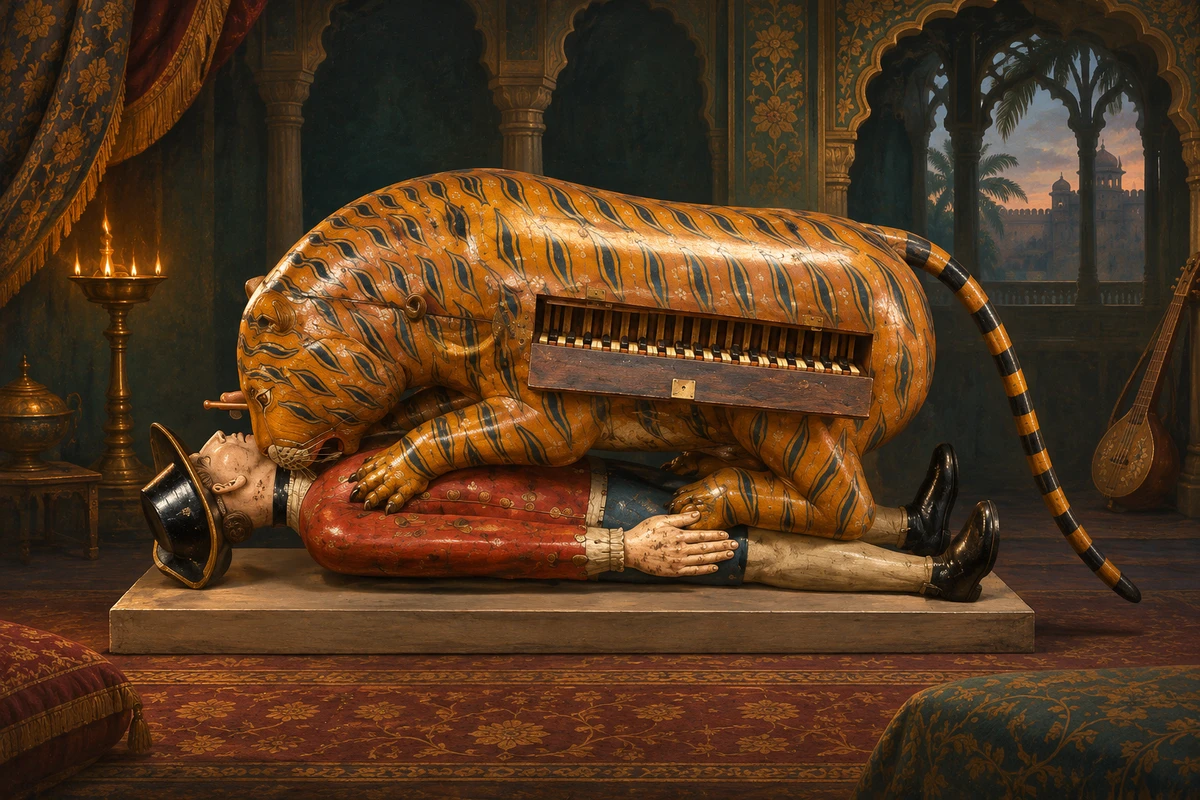
The tiger has a keyboard hidden in its ribs. Beneath its paws lies a European soldier, whose wooden arm can move as the mechanism imitates his dying cries.
Made for Tipu Sultan of Mysore, this extraordinary instrument tells a story about craftsmanship, political theatre and what happens when a ruler’s emblem becomes his enemy’s trophy.
THE SHORT ANSWER
Tipu’s Tiger was a mechanical organ made for the ruler of Mysore in southern India in the late eighteenth century. It combined a musical instrument with a moving scene of a tiger attacking a European.
The tiger was Tipu’s emblem, making the subject politically charged. The instrument’s survival establishes what it did; it does not tell us precisely how often Tipu played it, or prove every later story about why he commissioned it.
WHAT WE KNOW
The V&A identifies the painted wooden object as museum number 2545 (IS), dating it broadly to the 1780s or 1790s. Its maker is unknown. Giving it one confident birthday would make the evidence tidier than it really is.
A hinged opening in the tiger’s body reveals the organ. Operating the mechanism produces sounds intended to suggest the victim’s distress and makes his arm move. The apparent animal attack is therefore also a performance: a carved scene that acquires a voice.
Tipu ruled Mysore from 1782 until 1799. The East India Company was extending its territorial power, and his kingdom stood in its way. This was an instrument made in the setting of a dangerous political rivalry, rather than an eccentric ornament detached from events.
A TIGER WITH A POLITICAL JOB
The animal appeared across Tipu’s possessions, including weapons and royal furnishings. One useful comparison survives in the National Army Museum: his war turban, whose decoration incorporates stylised tiger stripes, with tiger heads on its metal guard.
Seen beside that helmet, the organ becomes less inexplicable. A repeated emblem could connect a ruler’s body, household and military equipment. The wooden tiger gives that emblem an unusually literal victory over a European opponent.
That interpretation fits its imagery and context. It should not be inflated into a claim that we know every private thought of the person who commissioned it.
HOW A PALACE INSTRUMENT BECAME A LONDON ATTRACTION
On 4 May 1799, British forces and their Indian allies captured Seringapatam, now Srirangapatna. Tipu was killed. The National Army Museum’s account describes the subsequent allocation and sale of royal property through the victors’ prize arrangements.
The tiger was taken from the palace and shipped to London, arriving in 1800. The V&A’s collection account places it in the palace music room before its removal. It became a popular exhibit at East India House, the Company’s headquarters, and eventually entered the institution later known as the Victoria and Albert Museum.
Its surroundings had changed, and so had the balance of power. An object showing a European’s defeat could now be displayed by the organisation that had defeated its owner.
THE STORY EVERYONE TELLS
A tempting explanation connects the machine to a real death. In December 1792, a son of General Sir Hector Munro was fatally attacked by a tiger on Saugor Island. British pottery groups depicting the incident survive, including examples at Brighton Museum and the National Army Museum.
The connection with Tipu’s instrument is presented with different degrees of confidence. The Army Museum says the incident inspired the machine; Brighton’s account describes the relationship as possible.
The distinction matters. A documented tiger attack and a similar surviving image do not, on their own, establish the commission’s exact inspiration. Without a decisive record linking them, the Munro story should remain a proposed connection rather than the article’s settled answer.
WHAT THE EVIDENCE ACTUALLY SAYS
The evidence label is WELL SUPPORTED for the instrument, its royal ownership and its removal after the conquest. Its exact inspiration and Tipu’s personal routine require more caution.
Early descriptions could be partisan. A British account reproduced in the V&A’s research on India Museum visitors portrayed the machine’s sounds as “infernal music” and claimed Tipu amused himself with it in the afternoons.
That is valuable evidence of how the object was described. It is not equivalent to an impartial diary of Tipu’s leisure hours. A victorious enemy had reasons to present the defeated ruler’s possessions as proof of his character.
Even the later history benefits from checking records. V&A archive research identifies files concerning damage to the tiger in September 1944 and repairs in 1953. The surviving object has a history of preservation as well as a history of conquest.
WHY IT STUCK
The tiger is memorable because its categories refuse to stay separate. It is sculpture, mechanism, instrument and political image. Its journey also demonstrates how taking possession of an object can change the story told around it.
The wooden soldier remains beneath the tiger. But the ruler who owned the scene lost his kingdom, and the instrument reached the capital of his adversary. That reversal is part of what makes this much more than a curious noise-making toy.
RELATED CURIOSITIES
Why Do Japanese Temples Ring Bells 108 Times on New Year’s Eve?
Why Did a Victorian Man Cover an Entire Room with 44,068 Postage Stamps?
Who Was the Inventor Who Entered a Poisonous Tunnel to Save Strangers?
SOURCES & FURTHER READING
1. Victoria and Albert Museum — “Tipu’s Tiger”: object identification, dating, mechanism and political symbolism.
https://www.vam.ac.uk/articles/tipus-tiger
2. Victoria and Albert Museum collection, via Google Arts & Culture — “Tippoo’s Tiger”: palace music room, journey to London and museum history.
https://artsandculture.google.com/asset/tippoo-s-tiger/AgHwQSVkLBM_-g
3. National Army Museum — “Tipu Sultan’s war turban”: tiger imagery, the 1799 siege and distribution of captured property.
https://www.nam.ac.uk/explore/tipu-sultans-war-turban
4. National Army Museum — “Figurine depicting Mr Hugh Munro being mauled by a Bengal tiger, December 1792”, accession 1961-11-32--1.
https://collection.nam.ac.uk/detail.php?acc=1961-11-32--1
5. Brighton Museums — “Munro and the Hungry Tiger”: the pottery tradition and a cautiously expressed possible connection with Tipu’s Tiger.
https://brightonmuseums.org.uk/discovery/history-stories/munro-and-the-hungry-tiger/
6. Arthur MacGregor / V&A — “Reconstructing the India Museum experience: some early personal visitor accounts”: historical descriptions and their interpretative context.
7. V&A Archives — “The India Museum Archive: cataloguing a colonial collection”: records of wartime damage and later repair.
https://www.vam.ac.uk/blog/museum-life/the-india-museum-archive-cataloguing-a-colonial-collection