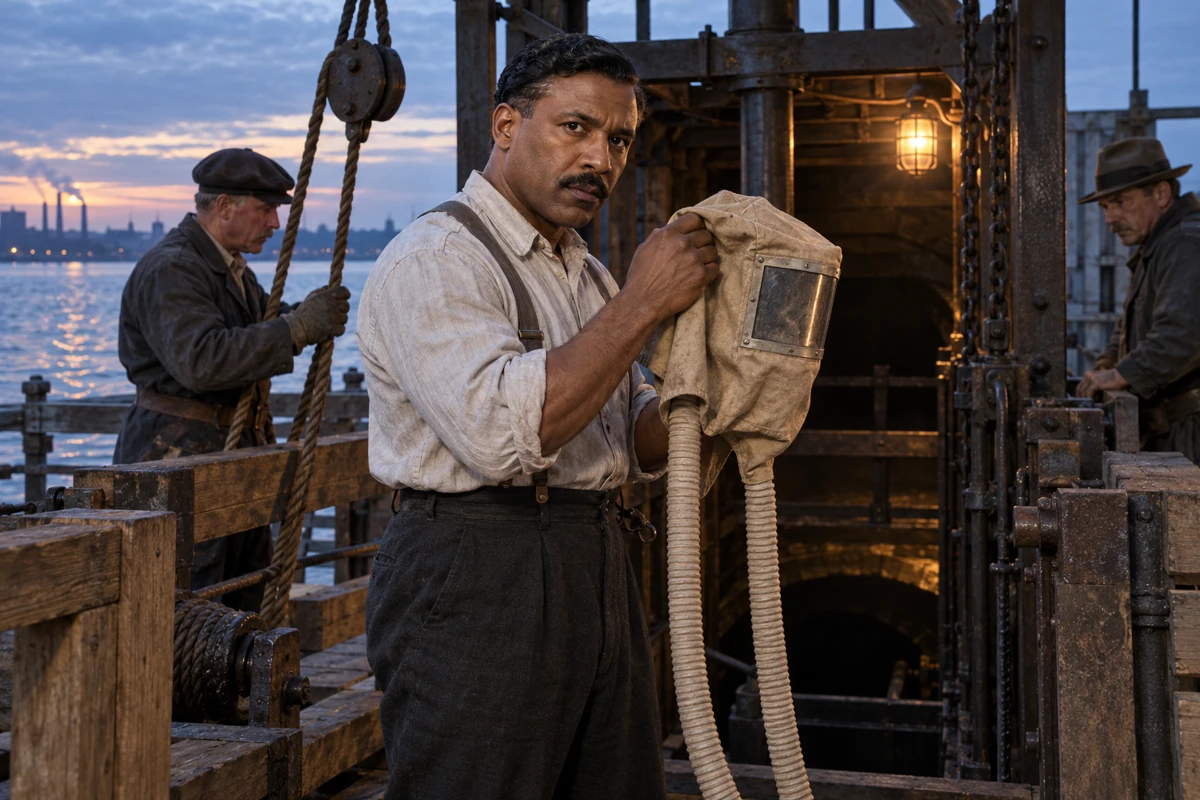
The men sent into the tunnel to save trapped workers had themselves become casualties. Now Cleveland needed someone who could enter the same dangerous air and return.
Garrett Morgan brought a breathing hood of his own invention. What followed made its value unmistakable, although recognition of the Black inventor proved much less straightforward.
THE SHORT ANSWER
Garrett Augustus Morgan was a Cleveland inventor and businessman who helped rescue men after a July 1916 explosion in a waterworks tunnel beneath Lake Erie.
He entered wearing his patented safety hood, accompanied by his brother Frank and other volunteers. The apparatus helped rescuers reach survivors and recover bodies. Morgan also patented a three-position traffic signal in 1923. Both inventions addressed a practical question: how could people be given a better chance of surviving an everyday danger?
WHAT WE KNOW
Born in Kentucky in 1877, Morgan moved to Cleveland in 1895. Work repairing sewing machines developed into businesses in machine repair, tailoring and hair-care products. He was an entrepreneur with practical mechanical experience, rather than a professional scientist working inside a university.
His breathing apparatus was already patented before the tunnel disaster. Applications filed in 1912 led to two US patents in 1914. Dates sometimes given as 1912 for the patent confuse application with grant.
The device covered the head and used tubes to draw air from a position away from the worst smoke. A wet absorbent lining helped check smoke and dust. It depended on finding more breathable surrounding air; it did not manufacture oxygen or make every poisonous atmosphere safe.
THE NIGHT THE RESCUERS NEEDED RESCUING
Cleveland was extending its water-intake system farther beneath Lake Erie to reach cleaner water. On the evening of 24 July 1916, an explosion struck the tunnel. Rescue attempts continued into 25 July.
Men entering to help were overcome by the dangerous atmosphere. Police contacted Morgan because his equipment offered another possibility.
Morgan and his brother brought safety hoods to the scene. With other volunteers, they descended into the tunnel and brought men out. Their work included rescuing survivors and recovering those who had died.
There is no need to imagine that Morgan acted alone. The achievement belongs within a rescue effort involving several people, undertaken after others had already lost their lives trying to help.
THE STORY EVERYONE TELLS
The familiar version is wonderfully compact: a Black inventor proves his gas mask in a dramatic rescue, then invents the traffic light.
Both halves need a little unpicking.
Calling the hood a gas mask can suggest modern equipment with capabilities it did not possess. Calling Morgan the inventor of the traffic light erases earlier signals and obscures what his own design actually improved.
His real achievements become more interesting when we look at their mechanisms rather than their slogans.
WHAT THE EVIDENCE ACTUALLY SAYS
The central story is WELL SUPPORTED, but even institutional accounts disagree over the numbers.
The US Patent and Trademark Office describes eight survivors being found by Morgan and fellow rescuers. Case Western Reserve University’s account records two men rescued and four bodies recovered by Morgan’s group. These figures should not be combined into a confident total or turned into a claim that Morgan personally saved everyone involved.
Recognition was also uneven. Morgan received honours, but racism affected publicity, sales and access to awards. White sales representatives helped market a device that some customers resisted buying from a Black inventor. His courage could be celebrated while his equal standing was still denied.
Nor was he entirely unknown in his lifetime. He ran businesses and participated in Cleveland’s Black civic life. “Forgotten” describes the gaps in later public memory better than it describes an absence of contemporary achievement.
WHAT HIS TRAFFIC SIGNAL ACTUALLY DID
US Patent 1,475,024, granted on 20 November 1923, describes a manually operated semaphore signal.
Its important feature was an interval when traffic stopped in every direction before another stream was allowed to proceed. Vehicles already in the intersection could clear it before waiting drivers moved.
This was not the invention of today’s red, amber and green electric traffic light. It was a particular improvement to traffic control, designed around the dangerous moment between stopping one movement and starting another.
WHY HIS STORY MATTERS
Morgan’s hood and signal confronted different hazards, but both made room for human vulnerability: a firefighter needed breathable air, and a driver needed time to clear a junction.
The tunnel rescue showed what invention could mean beyond a patent office. An idea became equipment, and equipment gave rescuers a chance to return.
Remembering Morgan accurately requires neither making him the sole hero nor awarding him inventions he did not claim. His documented work supplies more than enough reason to remember his name.
RELATED CURIOSITIES
How Did an Enslaved Man Sail a Confederate Ship to Freedom?
How Did a Woman Born Without Arms Become a Celebrated Royal Portrait Painter?
How Did a Woman Disguised as a Man Sail Around the World?
SOURCES & FURTHER READING
1. US Patent and Trademark Office — Of courage and caution. Morgan’s businesses, patents, rescue and unequal recognition.
2. Smithsonian, Lemelson Center — Diverse Voices: Inventor Garrett Morgan. Inventions, surviving images and racial barriers to sales.
https://invention.si.edu/invention-stories/diverse-voices-inventor-garrett-morgan
3. Case Western Reserve University, Encyclopedia of Cleveland History — Waterworks Tunnel Disasters. Chronology and an account distinguishing survivors from recovered bodies.
https://case.edu/ech/articles/w/waterworks-tunnel-disasters
4. Cleveland Water — Garrett Morgan and the History of Cleveland Water. The waterworks project and rescue of 24–25 July 1916.
https://www.clevelandwater.com/who-we-are/news/garrett-morgan-and-history-cleveland-water
5. Case Western Reserve University, Encyclopedia of Cleveland History — Morgan, Garrett A. Biographical and business context.
https://case.edu/ech/articles/m/morgan-garrett
6. Garrett A. Morgan — Breathing device, US Patent 1,113,675, granted 13 October 1914. Primary technical description.
https://patents.google.com/patent/US1113675A/en
7. Garrett A. Morgan — Traffic signal, US Patent 1,475,024, granted 20 November 1923. Primary evidence for the signal’s purpose and operation.