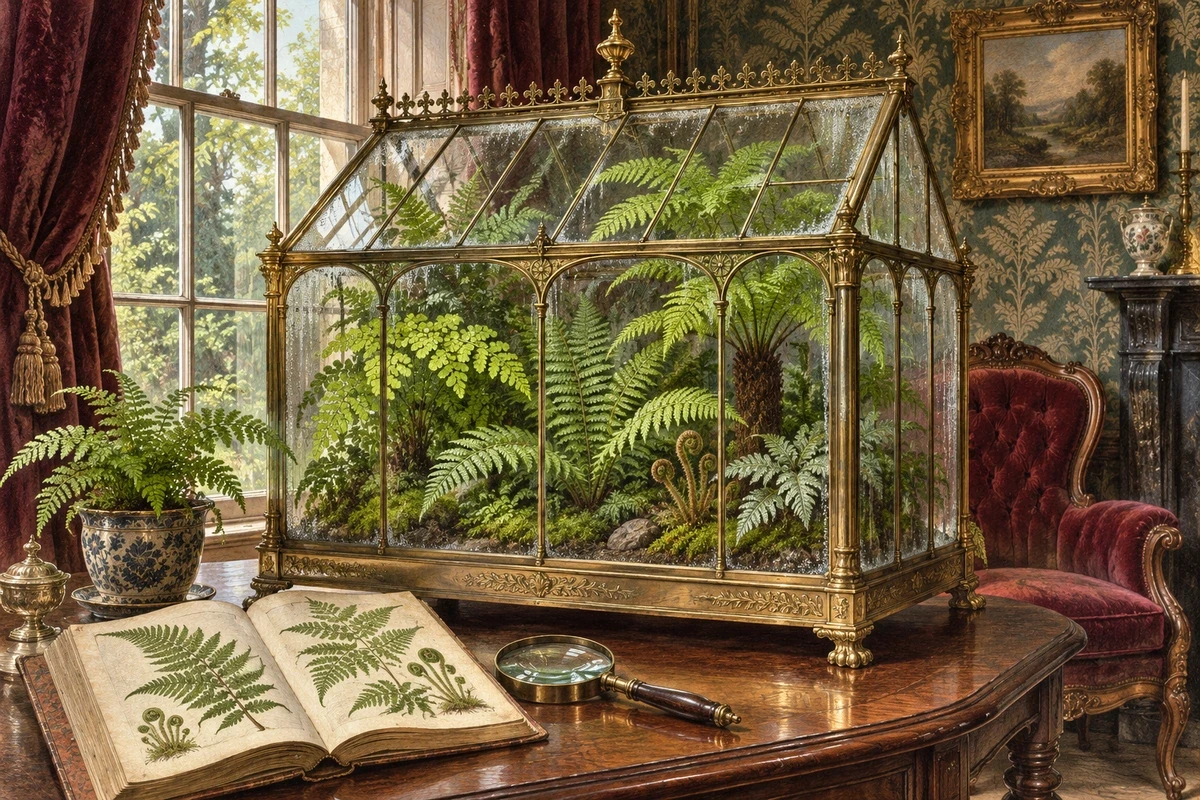
They hunted them on hillsides, displayed them beneath glass and put their curling fronds on household objects. Victorian fern fever turned an unassuming plant into a fashionable obsession — and some wild populations paid a heavy price.
THE SHORT ANSWER
Fern fever, or pteridomania, grew from a combination of natural-history enthusiasm, collecting, new gardening technology and a market eager to supply plants and equipment.
Ferns offered variety, intricate beauty and the pleasure of identifying and acquiring specimens. Glass growing cases made it easier to keep them in urban homes and transport living plants over long distances. Books, nurseries and fashionable displays helped the interest spread.
It was a substantial nineteenth-century craze, especially associated with the middle decades of the century. That does not mean every Victorian household owned an elaborate fernery.
WHAT WE KNOW
By 1855, the enthusiasm was conspicuous enough for the writer Charles Kingsley to give it a name: pteridomania, or fern madness.
The Royal Horticultural Society's collections preserve evidence of the trade and the advice that sustained it: illustrated growing manuals, nursery catalogues and designs for fern displays. Its examples include an 1887 catalogue from the fern nursery W. & J. Birkenhead.
The New York Botanical Garden places the craze's height between about 1850 and 1890 and identifies several forces behind it. These included improved propagation, expanding plant exploration, enthusiasm for natural history and the repeal of British glass excise duties in 1845, which helped make glass structures more affordable.
Books mattered too. George William Francis published An Analysis of the British Ferns and their Allies in 1837. Later guides helped readers identify plants, cultivate them and turn an interest into a collection.
The evidence describes a connected world of publishing, buying, growing and displaying. This was much more than a passing admiration for an attractive leaf.
HOW IT BECAME A HABIT
One crucial development began before Victoria became queen.
In 1829, the London doctor Nathaniel Bagshaw Ward noticed a fern growing in a glass container in which he had been observing an insect chrysalis. Plants that struggled in the surrounding city could survive within a sheltered, humid enclosure.
Ward experimented further and published On the Growth of Plants in Closely Glazed Cases in 1842. The resulting Wardian case protected plants and conserved moisture, making a miniature growing environment possible.
For a city household, the appeal was considerable. A fern case could bring delicate greenery indoors while protecting it from hostile conditions outside. Practical cases also transformed the movement of plants by sea, helping specimens survive journeys on which many had previously died.
The domestic and international stories were connected. Better transport brought more plants into commerce; more plants encouraged collecting; collecting created demand for cases, manuals and nursery stock.
Ornamental versions became pieces of furniture in their own right. A glass enclosure could turn a modest patch of greenery into a miniature landscape, something to examine, tend and show to visitors.
THE STORY EVERYONE TELLS
The cheerful version presents fern fever as an eccentric gardening fashion: a population suddenly enchanted by fronds.
There is truth in that. Fern forms spread into decorative design, appearing on objects far removed from a woodland floor. People could participate in the fashion through ornament as well as horticulture.
But the domestic picture can hide two larger realities. The movement of plants was entangled with imperial trade and the extraction of botanical resources. At home, collecting could also become destructive.
A fashionable interest in nature did not necessarily produce a careful attitude towards its survival.
WHAT THE EVIDENCE ACTUALLY SAYS
WELL SUPPORTED: Fern collecting became an organised and commercially supported enthusiasm. Surviving publications, nursery catalogues and growing equipment establish its substance.
WELL SUPPORTED: Wardian cases made cultivation and transport more reliable. They were an important enabling technology, rather than a complete explanation for the craze. Botanical curiosity, trade, publishing and the appeal of collecting all contributed.
The cases also need accurate description. They created sheltered microclimates, but historical models should not all be imagined as permanently airtight jars. Designs varied, and practical transport cases could include ventilation arrangements.
WELL SUPPORTED: Overcollecting seriously damaged particular wild populations. The Royal Botanic Garden Edinburgh records how commercial collecting and botanical excursions devastated oblong woodsia in the Moffat Hills. Its history includes an 1857 account in which collectors found five small tufts and removed four.
The detail is revealing. Leaving one plant behind could seem sufficient to people who did not share modern conservation expectations. Scientific interest itself could add pressure alongside commercial demand.
NatureScot likewise identifies Victorian overcollecting as a cause of the fern's decline. These records support a precise claim about particular plants and places; they do not justify saying that the Victorians nearly exterminated all British ferns.
INTERPRETATION: A fern case could convey taste, knowledge and access to plants from distant places. Scholarship has explored its connections with status and imperial culture. Those readings help explain the objects' wider significance, but individual owners need not all have understood their plants in the same way.
WHY IT STUCK
Fern fever offered several pleasures at once: an excursion outdoors, a puzzle of identification, a collection to enlarge and something beautiful to bring home.
It also made room for different levels of participation. A growing manual, a modest plant and an elaborate glass fernery did not require the same resources, even if all belonged to the same enthusiasm.
The fashion eventually lost its earlier intensity, but its appeal remains easy to recognise. A well-kept terrarium still offers the pleasure of a small green world beneath glass.
The less comfortable legacy matters too. Some plants are now the subjects of restoration work because earlier admirers were so determined to possess them.
Victorian fern fever shows how closely curiosity and consumption can grow together. Loving a plant was not always the same as leaving it alive where it belonged.
RELATED CURIOSITIES
Why Did a Victorian Man Cover an Entire Room with 44,068 Postage Stamps?
Why Did Victorian Families Decorate Their Homes with Poison?
Why Did People Keep a Dead Person’s Hair in Jewellery?
SOURCES & FURTHER READING
Royal Horticultural Society, Lindley Library — Pteridomania: The Victorian Obsession with Ferns; historical publications, catalogues and designs.
https://collections.rhs.org.uk/view/353182
New York Botanical Garden — Fern Fever; chronology and factors behind the craze.
https://sweetgum.nybg.org/science/the-hand-lens/explore/narratives-details/?irn=7001
Royal Botanic Gardens, Kew — The Wardian case: A history of plant transportation; Ward's discovery, publications and practical cases.
https://www.kew.org/read-and-watch/the-wardian-case-a-history-of-plant-transportation
Molly K. Eckel, The Courtauld — ‘A little world within a world’: The Wardian Case of Tropical Ferns in the Victorian Home; historical scholarship on domestic display and empire.
Royal Botanic Garden Edinburgh — Restoring a fern wiped out by collectors and botanists; oblong woodsia and historical collecting in the Moffat Hills.
https://stories.rbge.org.uk/archives/38600
NatureScot — Ferns; Victorian collecting and conservation.