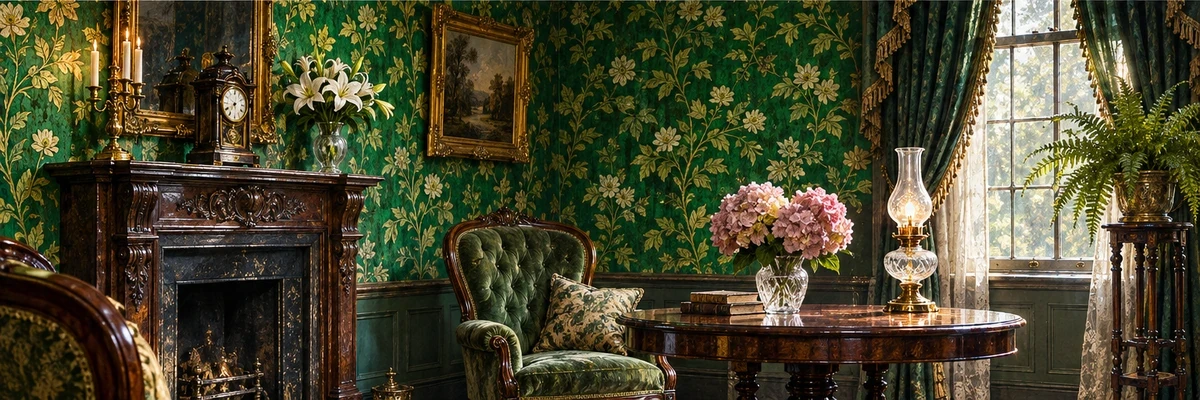
The extraordinary story of arsenic-green wallpaper, deadly Victorian fashions and the beautiful colour that concealed a dangerous secret.
Imagine entering an elegant Victorian drawing room.
The curtains are heavy, the furniture polished, and the walls covered in magnificent emerald-green wallpaper. Delicate leaves curl around exotic flowers. Every surface suggests prosperity, refinement and impeccable taste.
But hidden in those beautiful green patterns is something rather less desirable.
Arsenic.
During the nineteenth century, some of Britain's most fashionable homes were decorated with pigments containing a substance already notorious for its poisonous properties.
And the most remarkable part of the story is that the danger was not entirely unknown.
The Colour Everyone Wanted
For centuries, producing brilliant, durable green pigments had been a challenge.
Natural green colours could fade, darken or prove difficult to manufacture consistently.
Then, in the late eighteenth century, the Swedish chemist Carl Wilhelm Scheele developed a striking green pigment based on copper arsenite.
It became known as Scheele's Green.
The colour was vivid, attractive and relatively inexpensive to produce.
A later copper-arsenic pigment, commonly called Emerald Green or Paris Green, offered another brilliant shade.
These pigments were soon employed in a remarkable range of manufactured goods.
Wallpaper, paint, textiles and decorative objects could all benefit from the fashionable new greens.
By the Victorian period, the colours had become particularly desirable in domestic interiors.
For homeowners hoping to create a stylish drawing room or bedroom, richly patterned green wallpaper offered a fashionable transformation.
Unfortunately, the pigments responsible for the colour could also introduce a toxic substance into the home.
A Poison Hiding in Plain Sight
Arsenic was hardly an unfamiliar substance in nineteenth-century Britain.
It appeared in industrial processes, medicines, agricultural preparations and household products.
Its poisonous properties were also well recognised.
Yet arsenic compounds continued to be used in manufactured goods, including decorative pigments.
Part of the problem was that the dangers of different forms of exposure were not always fully understood.
A substance might be recognised as dangerous when swallowed without everyone appreciating the possible consequences of living alongside it for months or years.
In wallpaper, arsenic-containing pigments could become a concern when coloured particles were released into household dust.
Damaged, deteriorating or disturbed wallpaper could create opportunities for exposure.
Victorian doctors and chemists also debated whether damp wallpaper might release poisonous vapours.
The precise mechanisms and levels of exposure were difficult to establish with the scientific methods available at the time.
Nevertheless, the concern was serious enough to attract medical investigations, newspaper coverage and public debate.
The fashionable green wall had acquired a sinister reputation.
When the Bedroom Became a Suspect
One of the most troubling aspects of the controversy concerned bedrooms.
Victorian households sometimes reported unexplained illnesses that appeared to persist indoors.
Symptoms attributed to arsenical wallpaper included headaches, nausea, irritated eyes and respiratory complaints.
Such symptoms could have many causes, making individual cases difficult to diagnose with certainty.
But medical investigators increasingly questioned whether poisonous pigments in domestic decorations might be contributing to ill health.
The bedroom was an especially troubling location.
People spent long periods sleeping in enclosed rooms, often with limited ventilation.
If harmful particles were present, prolonged exposure was a legitimate concern.
Not every green bedroom was dangerous, and not every unexplained illness could be blamed on wallpaper.
But the possibility that fashionable decoration might be making occupants sick was disturbing enough to change public attitudes.
A room designed for comfort could become a source of anxiety.
The Poison Was Not Confined to the Walls
Wallpaper was only one part of the story.
Arsenic-based greens also appeared in fashionable clothing and accessories.
Bright green dresses, artificial flowers and decorative fabrics could contain poisonous pigments.
The people producing these goods sometimes faced particularly hazardous conditions.
Workers handling pigments or assembling artificial flowers could be exposed repeatedly to coloured dust.
For women employed in poorly ventilated workshops, the risks were especially concerning.
The same brilliant green that made a dress or bonnet desirable could place its maker in contact with toxic materials.
The problem revealed a darker side of Victorian consumer culture.
Beautiful manufactured goods often depended upon processes that exposed workers to substances the purchasers rarely considered.
The danger was not simply a matter of wealthy families making questionable decorating choices.
It extended into factories, workshops and the lives of people whose labour supplied fashionable society.
William Morris and the Poisonous Wallpaper Controversy
One of the most intriguing names associated with Victorian wallpaper is William Morris.
The celebrated designer helped transform British decorative arts through his intricate patterns inspired by nature.
His wallpapers featured leaves, flowers, branches and richly layered botanical designs.
Morris also had a family connection to the arsenic industry.
His father had been involved with the Devon Great Consols mining enterprise, and Morris himself held an interest in the company, which became an important producer of arsenic.
This connection has attracted considerable historical attention.
It would, however, be misleading to claim that every Morris wallpaper was poisonous or that he deliberately set out to harm his customers.
The wider history of Morris & Co. wallpaper production, pigments and changing manufacturing practices is more complicated.
What makes the connection fascinating is the contradiction.
A designer celebrated for bringing the beauty of nature into Victorian homes was also connected to an industry supplying a substance associated with poisonous domestic decoration.
It is a striking illustration of how art, industry and public health intersected in the nineteenth century.
The Growing Campaign Against Arsenic
By the later nineteenth century, concern about arsenical pigments had become increasingly difficult for manufacturers to ignore.
Doctors, chemists and reformers raised questions about the safety of coloured household goods.
Newspapers reported suspected poisonings, while scientific investigations examined the composition of wallpapers and fabrics.
Consumers began demanding safer alternatives.
Some manufacturers responded by advertising products made without arsenic.
In 1879, the wallpaper firm Jeffrey & Co. commissioned chemical examinations of its products as part of efforts to address public concern.
The company subsequently marketed hygienic wallpapers designed to reassure customers about their safety.
The idea of an arsenic-free wallpaper became a selling point.
A substance that had helped make certain colours fashionable was now becoming something manufacturers wanted to advertise as absent.
It was a remarkable reversal.
The same customers who had once admired brilliant green pigments were increasingly encouraged to ask what those colours contained.
Did Poisonous Wallpaper Really Kill People?
This is the question that requires the greatest care.
Arsenic is genuinely toxic, and surviving historical wallpapers have been scientifically confirmed to contain arsenic-based pigments.
Contemporary medical authorities also documented concerns about illness and poisoning associated with these materials.
But proving that a particular person's death resulted from a particular wallpaper is much more difficult.
Victorian reports sometimes lacked the clinical evidence that modern investigators would require.
Symptoms attributed to arsenic exposure could resemble those caused by infections, poor ventilation or other environmental hazards.
The presence of arsenic in wallpaper establishes a potential source of exposure, not necessarily the cause of every illness reported in the building.
The most defensible conclusion is that arsenical wallpapers represented a genuine historical health hazard, while individual dramatic stories should be assessed on their own evidence.
The science is real.
Not every frightening anecdote is equally reliable.
The Napoleon Wallpaper Legend
Perhaps the most famous story associated with poisonous green wallpaper concerns Napoleon Bonaparte.
Napoleon died in exile on the island of Saint Helena in 1821.
Later speculation suggested that arsenic-containing wallpaper in his residence might have contributed to his death.
The story became popular because it combined a mysterious death, a famous historical figure and a seemingly invisible poison.
Arsenic-containing wallpaper was indeed present at Longwood House.
But that does not establish that wallpaper poisoning killed Napoleon.
Modern historical and medical assessments generally favour stomach cancer as the explanation for his death.
The wallpaper theory remains a fascinating example of how a genuine material hazard can become attached to a much larger historical mystery.
The Evidence Still Exists
The remarkable thing about this story is that the evidence has not disappeared.
Museums and historic buildings preserve examples of nineteenth-century wallpapers containing arsenical pigments.
Modern conservation scientists can examine these objects using analytical techniques that identify chemical elements within the coloured surfaces.
Research by Historic England and English Heritage has demonstrated the presence of arsenic in surviving green wallpapers.
The Victoria and Albert Museum also preserves historical examples and documents the nineteenth-century concern surrounding their manufacture and use.
These objects are beautiful, fragile and scientifically important.
They provide physical evidence of a time when fashionable decoration and industrial chemistry developed faster than society's understanding of their consequences.
A piece of patterned paper can tell a surprisingly unsettling story.
The Strange Truth
The Victorians did not deliberately decorate their homes with poison because they enjoyed danger.
They wanted beautiful rooms.
They wanted vivid colours, elegant patterns and fashionable surroundings.
Industrial chemistry offered them remarkable new possibilities, often before the full health implications had been investigated.
The result was one of the strangest contradictions of Victorian domestic life.
A family could spend considerable money making its home more attractive while unknowingly introducing a hazardous substance into the very walls.
The beautiful emerald wallpaper was not simply a symbol of wealth and taste.
In some homes, it was also a reminder that progress could carry unexpected consequences.
And more than a century later, those magnificent green patterns still survive in museums.
Too beautiful to forget.
Too poisonous to handle carelessly.