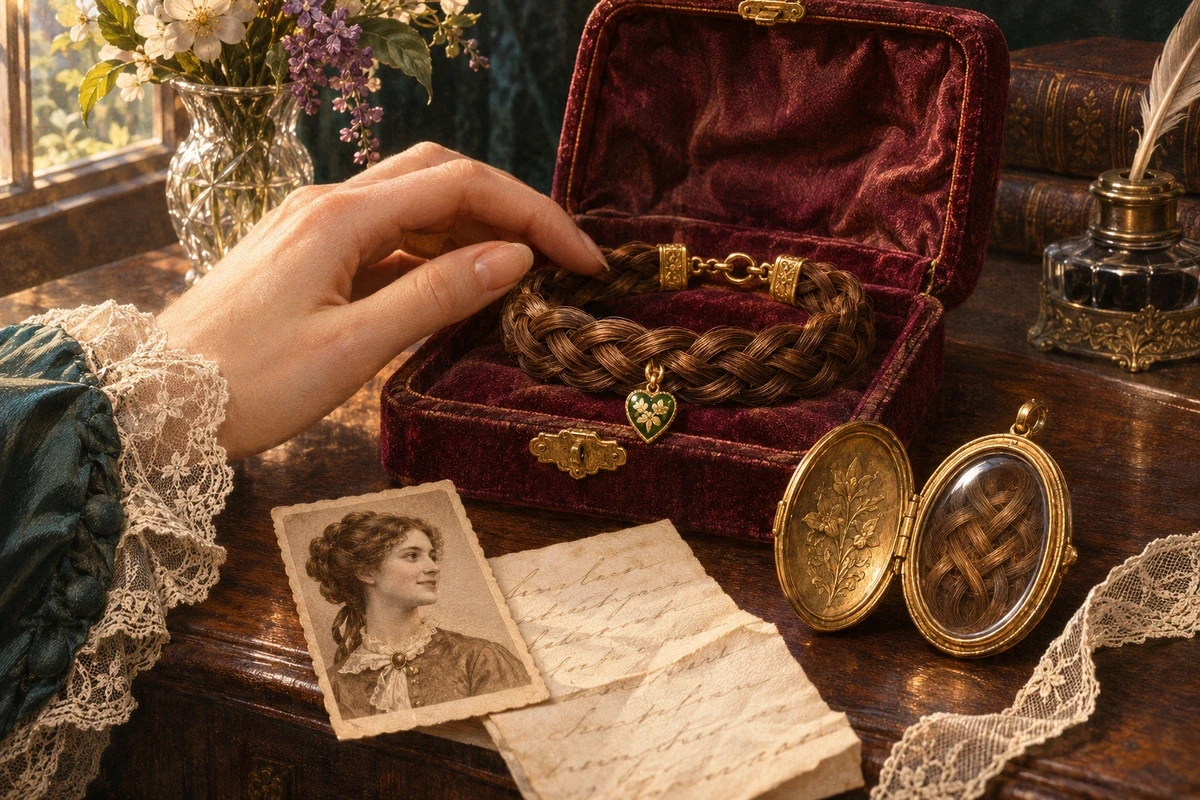
A bracelet made from your mother's hair. A locket containing your sweetheart's. To Victorian eyes, these could be gifts of affection rather than reminders of death. The surprising history of hairwork reveals how people carried a little of someone they loved wherever they went.
THE SHORT ANSWER
Victorians exchanged hair jewellery because hair provided a lasting, intensely personal connection with another person. It could be plaited beneath glass, worked into a bracelet or combined with a miniature portrait.
Some pieces commemorated the dead. Others celebrated friendship, family ties, courtship or marriage while the people involved were very much alive. Treating every surviving hair bracelet as a mourning object misses a warmer and sometimes rather romantic part of its history.
WHAT WE KNOW
A particularly revealing example belonged to Florence Nightingale.
The Florence Nightingale Museum preserves a bracelet given to her by her cousin Louis Shore Nightingale. It incorporates hair from her father, mother, sister and cousin, with a green enamel heart pendant and a serpent's-head clasp decorated with pearls. The museum records that she wore it beneath her sleeve during her time in the Crimea.
This was a portable family keepsake, rather than a collection of relics from deceased relatives. Its significance lay in the living relationships it represented.
Royal jewellery provides another example. The Royal Collection holds a woven-hair bracelet, dated around 1858, incorporating a photographic portrait of the Crown Prince and Princess of Prussia after their wedding at Windsor. The collection interprets it as probably celebrating the marriage. That qualification matters: the wedding association is an informed interpretation, rather than a surviving statement of the giver's intention.
Together, these objects make it difficult to sustain the idea that hairwork belonged exclusively to funerals.
HOW IT BECAME A HABIT
Hair had several advantages as a sentimental material. It was recognisably part of a particular person, could be cut without lasting injury and was small enough to send or wear. Carefully kept, it could endure long after a letter had faded or a relationship had been interrupted by distance.
The broader custom was older than the Victorian period. The Gibbes Museum of Art preserves eighteenth-century portrait miniatures incorporating hairwork, including a miniature worn with an elaborately braided hair bracelet. A painted likeness and an actual piece of the sitter could become parts of the same intimate object.
Nineteenth-century makers developed this combination of sentiment and skilled workmanship in many forms. Hair could be displayed behind glass or become the principal material of a wearable ornament. The Victoria and Albert Museum holds a bracelet dated 1830–1850 made from plaited human hair with a gold clasp and shell cameo.
Such work belonged both to the home and to the marketplace. Instructional publications taught readers how to make hair ornaments, while professional makers offered more elaborate commissions. Halford and Young's 1864 pattern book advertised a substantial range of possible designs.
A lock of hair was personal. Turning it into something handsome made that personal connection suitable for everyday dress.
THE STORY EVERYONE TELLS
The familiar account begins with a grieving widow, a black dress and a dead husband's hair.
There is nothing invented about mourning jewellery. Some surviving pieces explicitly record a death, and Queen Victoria's long mourning for Prince Albert helped make the association memorable.
But that is only one part of the story. Couples could exchange hair before marriage. Friends could give locks to one another. A parent could preserve a child's hair without the child having died.
The same material could mark absence, affection or bereavement. Its meaning depended on the relationship and the occasion.
WHAT THE EVIDENCE ACTUALLY SAYS
WELL SUPPORTED: Hairwork was made and exchanged between living people. Museum collections and the histories attached to particular objects establish that this was more than a modern attempt to make a macabre custom seem charming.
WELL SUPPORTED: It was also a commercial and domestic craft. The Smithsonian's discussion of nineteenth-century pattern books describes both professionally produced ornaments and instructions for making sentimental gifts at home.
UNCERTAIN WITHOUT CONTEXT: The purpose of an unidentified piece. Hair alone cannot tell us whether an ornament marked a death, a marriage or a friendship. An inscription, date, portrait or documented ownership can make the distinction clearer.
The attraction also created a practical problem. If someone sent precious family hair to a professional maker, how could they know it had been used? Historical accounts of the trade record worries about substitution with other hair. The concern exposes what mattered most: an elegant bracelet made from a stranger's hair could lose the very quality that made the gift valuable.
We should therefore resist reading every object through its appearance alone. A dark plait under glass may look mournful to us while having represented an entirely living attachment to its original owner.
WHY IT STUCK
Hairwork joined an ordinary material to an extraordinary amount of feeling.
Gold could be bought by anyone who could afford it. The hair of a particular parent, friend or lover could not be replaced in quite the same way.
That helps explain why an object that now seems peculiar once made emotional sense. The wearer was carrying a connection, shaped by someone else's hands into something that could remain close to the skin.
The surviving bracelet may be behind museum glass today. When it was first given, the person whose hair it contained might have been standing in the same room.
RELATED CURIOSITIES
Why Did People Keep a Dead Person’s Hair in Jewellery?
Why Did Victorians Photograph Their Dead?
Why Did a Victorian Man Cover an Entire Room with 44,068 Postage Stamps?
SOURCES & FURTHER READING
Florence Nightingale Museum — Victorian Hair Jewellery; documented family keepsakes and hairwork in the museum's collection.
https://www.florence-nightingale.co.uk/victorian-hair-jewellery/
Royal Collection Trust — Hair bracelet with photograph, circa 1858, RCIN 52516; a probable marriage keepsake.
https://albert.rct.uk/explore/themes/photographic-technologies/hair-bracelet-with-photograph
Smithsonian Libraries and Archives — Fashion for Hair – A creepiness I like; pattern books and sentimental exchanges.
https://blog.library.si.edu/blog/2014/06/25/fashion-for-hair-a-creepiness-i-like/
Smithsonian Institution — Hair art, cross; domestic craft, personal tokens and commercial production.
https://www.si.edu/object/hair-art-cross%3Ahac_1983.014
Gibbes Museum of Art — Tokens of Affection; hairwork incorporated into portrait miniatures.
https://www.gibbesmuseum.org/miniatures/about/tokens-of-affection/
Victoria and Albert Museum — Bracelet, 1830–1850, museum number M.64-1951; plaited hair with a gold clasp and cameo.