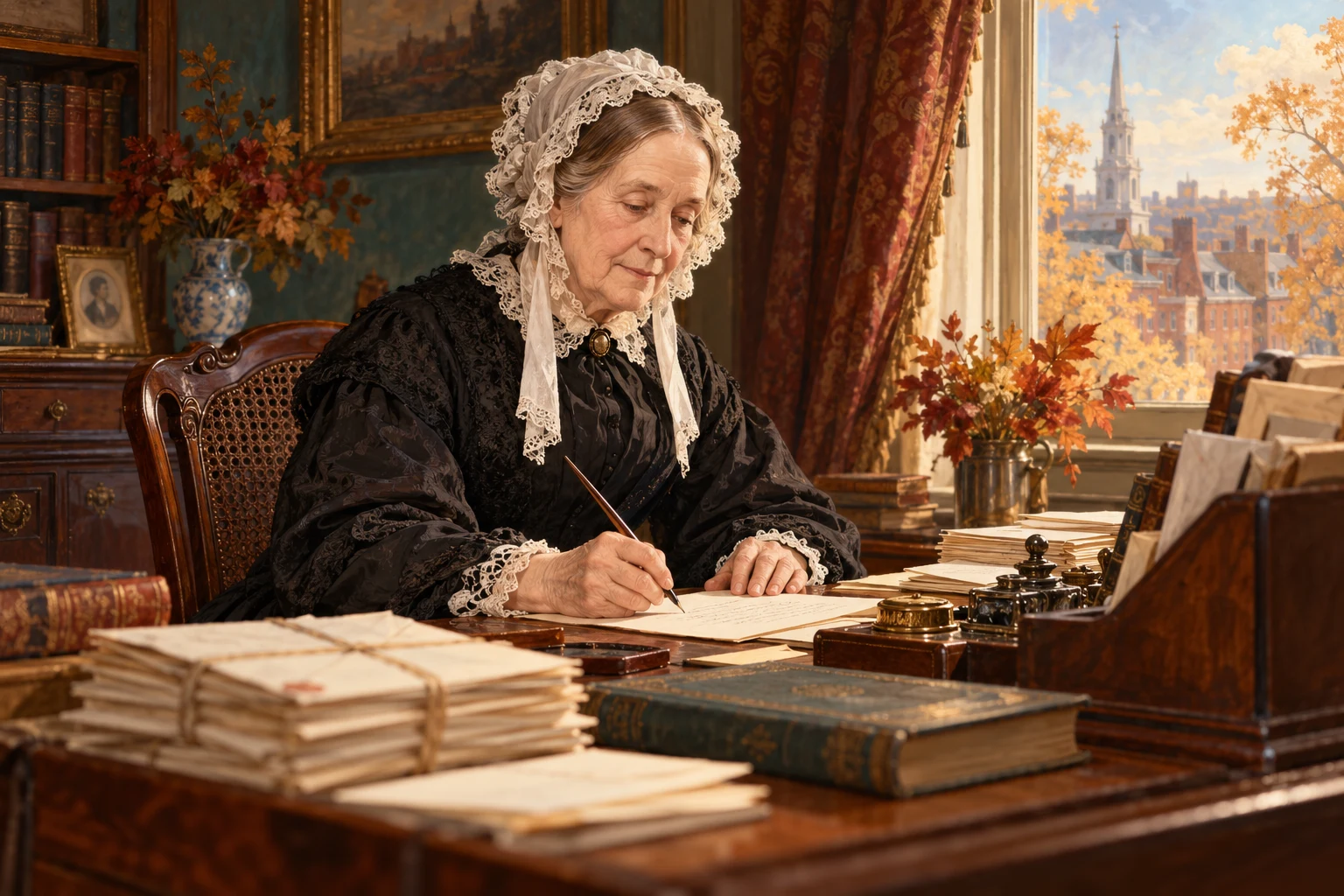
The woman associated with one of the world’s best-known nursery rhymes had another ambition: getting Americans to celebrate Thanksgiving together.
For Sarah Josepha Hale, a shared holiday promised more than a good dinner. It offered a small annual rehearsal for being one nation.
THE SHORT ANSWER
Hale campaigned for a national Thanksgiving because she believed a common day of gratitude, worship and family gathering could strengthen American unity.
Thanksgiving observances already existed. What she wanted was a shared annual date, supported by national recognition.
Her long campaign helped build support for that idea. On 28 September 1863, she appealed directly to Abraham Lincoln. Five days later, he issued the proclamation associated with the beginning of America’s continuing annual national Thanksgiving tradition.
WHAT WE KNOW
Hale was considerably more than a nursery-rhyme writer.
As the influential editor of Godey’s Lady’s Book, she could bring ideas about education, domestic life and national culture into households across America.
“Mary’s Lamb”, familiar today as “Mary Had a Little Lamb”, appeared in her 1830 collection Poems for Our Children. Later rival claims complicated its authorship story, but its publication under Hale’s name is documented.
Her sustained Thanksgiving lobbying was under way by the 1840s. Through editorials and correspondence, she urged public figures to support a common celebration.
Her clearest surviving appeal is the letter she sent Lincoln in September 1863.
HOW IT BECAME A HABIT
Hale’s proposal joined two forms of influence: the household and the government.
A magazine could encourage readers to value a celebration. Governors and presidents could give it a place on the calendar.
She wanted the last Thursday in November observed together, rather than Thanksgiving depending on separate appointments.
The idea was particularly pointed during the Civil War. A common festival offered an image of national belonging while the country was violently divided.
A shared meal could not end the fighting. Hale nevertheless believed a shared observance could help sustain the idea of a Union.
THE STORY EVERYONE TELLS
The familiar version is wonderfully tidy: the woman who wrote “Mary Had a Little Lamb” kept asking for Thanksgiving until Lincoln finally agreed.
There is a solid historical core here. Hale really campaigned, and Lincoln really issued his proclamation shortly after her letter.
But the compressed version can make Thanksgiving sound like her invention, with one determined correspondent creating a holiday almost overnight.
The actual achievement was more specific, and arguably more interesting: helping make an existing practice into a dependable national institution.
WHAT THE EVIDENCE ACTUALLY SAYS
Our evidence label is WELL SUPPORTED.
Hale’s letter establishes her goal and persistence. It does not reveal every consideration behind Lincoln’s decision, so “helped persuade” is more defensible than “single-handedly persuaded”.
Lincoln issued the proclamation on 3 October 1863. Secretary of State William H. Seward drafted it.
It invited observance on the last Thursday of November and combined gratitude with concern for those suffering in the war, including widows, orphans and mourners. It also called for the restoration of peace and union.
National thanksgiving proclamations were not new: George Washington had issued one in 1789. The importance of 1863 lies in the annual tradition that followed.
Nor did Lincoln establish today’s date permanently in law. The modern fourth Thursday in November was fixed by legislation signed by Franklin D. Roosevelt on 26 December 1941. In some years, the fourth Thursday and the last Thursday are different dates.
WHY IT STUCK
A recurring celebration becomes easier to sustain when people can plan around it.
A common date helps turn individual intentions into shared expectations: families arrange visits, communities prepare gatherings, and the next generation learns that this is what happens every year.
Hale recognised that a national habit needed both affection and a calendar.
Her contribution was to keep asking until the two came together.
RELATED CURIOSITIES
Why Did Americans Believe Benjamin Franklin Wanted a Turkey as Their National Bird?
Why Do People Break a Turkey’s Wishbone to Make a Wish?
Why Do We Make New Year’s Resolutions?
SOURCES & FURTHER READING
1. Library of Congress — Sarah J. Hale to Abraham Lincoln, 28 September 1863; transcript of her appeal.
https://www.loc.gov/resource/mal.2669900/?sp=1&st=text
2. National Park Service, Lincoln Home National Historic Site — Lincoln and Thanksgiving.
https://www.nps.gov/liho/learn/historyculture/lincoln-and-thanksgiving.htm
3. Archived White House — Transcript of Abraham Lincoln’s Thanksgiving Proclamation, 3 October 1863.
4. National Archives — Congress Establishes Thanksgiving; earlier proclamations and the legislation fixing the fourth Thursday.
https://www.archives.gov/legislative/features/thanksgiving
5. Smithsonian Libraries — Mary Had a Little Lamb; publication of “Mary’s Lamb” in 1830.
https://blog.library.si.edu/blog/2010/09/01/mary-had-a-little-lamb/
6. Smithsonian Magazine — Five Fascinating Details About the Media Mogul Who May Have Written ‘Mary Had a Little Lamb’; Hale’s editorial influence and the authorship dispute.