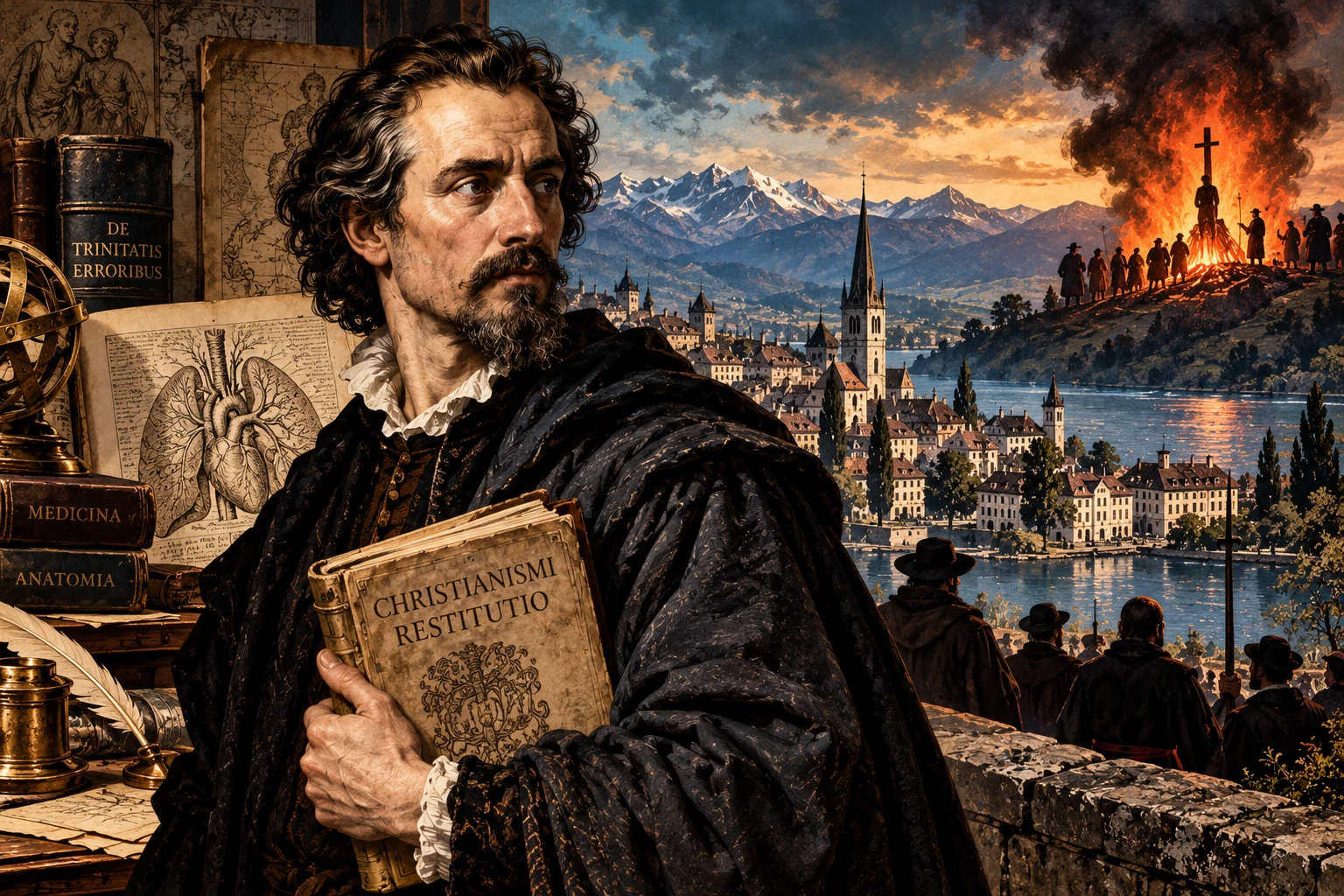
In October 1553, a Spanish physician was led to a hill overlooking Geneva and burned alive. His crime was not murder, treason or rebellion. It was refusing to accept the religious beliefs of the men who governed the city.
On 27 October 1553, a prisoner was taken from Geneva to the nearby hill of Champel.
His name was Michael Servetus.
He was a Spanish physician, scholar and theologian who had spent much of his adult life studying medicine, religion and the workings of the human body.
He had written controversial books, challenged powerful religious figures and developed ideas about the movement of blood through the lungs.
Yet none of these achievements could save him.
Servetus was condemned to die because he refused to accept the established Christian doctrine of the Trinity.
Perhaps the strangest part of his story is where his execution took place.
Geneva was one of the great centres of the Protestant Reformation, a movement that had challenged the religious authority of the Roman Catholic Church.
Its leaders had rejected the right of Rome to dictate religious truth.
Yet when Servetus questioned their own interpretation of Christianity, they condemned him to the flames.
How had a movement born from religious reform become responsible for one of the most notorious executions for heresy in European history?
A Spanish Scholar Who Asked Dangerous Questions
Michael Servetus was born in the kingdom of Aragon, in what is now Spain, around 1509–1511.
He was an unusually ambitious scholar whose interests ranged from theology and languages to geography and medicine.
As a young man, he studied at Toulouse in France, where he became increasingly absorbed in religious questions.
The sixteenth century was a dangerous time to question Christianity's established teachings.
The Protestant Reformation had fractured Western Christendom, but disagreement was not confined to the division between Catholics and Protestants.
There were fierce arguments among the reformers themselves.
Servetus became convinced that the traditional doctrine of the Trinity — the belief that God exists as Father, Son and Holy Spirit — was not supported by his interpretation of the Bible.
In 1531, he published De Trinitatis Erroribus, or On the Errors of the Trinity.
The book caused outrage.
Catholic and Protestant authorities alike regarded his teachings as dangerously heretical.
Servetus soon discovered that questioning the established beliefs of one church did not necessarily make him welcome in another.
The Doctor Who Understood the Blood
Servetus was not simply a religious controversialist.
He also studied medicine and established himself as a practising physician in France.
For years, he lived under the name Michel de Villeneuve, working in relative security while continuing his theological investigations.
His medical interests produced one of the most remarkable aspects of his legacy.
In his 1553 book Christianismi Restitutio, Servetus described blood passing from the right side of the heart through the lungs before reaching the left side.
This was an important early European account of pulmonary circulation.
It challenged aspects of the medical understanding inherited from antiquity.
Servetus was not the first person in history to describe pulmonary circulation, and he did not establish the complete circulation of blood through the body. The medieval physician Ibn al-Nafis had described pulmonary circulation centuries earlier, while William Harvey would later demonstrate systemic circulation.
Nevertheless, Servetus's description was an extraordinary achievement.
Even more strangely, he included it in a book about Christianity.
For Servetus, understanding the human body and understanding divine creation were closely connected.
Unfortunately, the theological arguments surrounding his medical observations would soon make the book extraordinarily dangerous to possess.
The Book That Brought the Inquisition
In 1553, Servetus arranged for the secret printing of Christianismi Restitutio, meaning The Restoration of Christianity.
The work renewed his attack on established doctrines and included material from his increasingly hostile correspondence with the Protestant reformer John Calvin.
Calvin was one of the most influential religious figures in Geneva.
The two men had exchanged arguments for years.
Neither showed much willingness to compromise.
When Servetus's book appeared, information identifying him reached the Catholic authorities in Vienne, France.
The precise extent of Calvin's responsibility for the French investigation has been debated by historians, although documents connected to the correspondence between the two men played a part in exposing Servetus.
Servetus was arrested and interrogated.
But before the authorities could carry out their judgment, he escaped.
For a time, the fugitive physician disappeared.
He intended to leave France, possibly hoping to establish himself in Italy.
Then he made an extraordinary decision.
He travelled through Geneva.
Why Did He Enter the City of His Enemy?
By the summer of 1553, Geneva was closely associated with Calvin's religious reforms.
Servetus knew Calvin opposed his teachings.
Yet he entered the city in July and remained there for several weeks.
Why?
Historians have never established a completely satisfactory explanation.
Perhaps Geneva was simply part of his intended route. Perhaps he underestimated the danger. Some historians have suggested he had other reasons for visiting the city.
Whatever his intentions, the decision proved fatal.
On 13 August 1553, Servetus was arrested after being recognised in Geneva.
He was imprisoned and brought before the city's authorities.
The charges concerned his religious beliefs, particularly his rejection of the Trinity and his opposition to infant baptism.
His trial became a confrontation between a fiercely independent thinker and a religious establishment determined to defend its doctrines.
The Reformer Who Would Not Tolerate Reform
John Calvin had himself belonged to a movement that challenged centuries of Catholic religious authority.
The Protestant Reformation insisted upon the importance of Scripture and criticised teachings and practices that reformers believed lacked biblical justification.
Yet this did not mean its leaders supported freedom of religion in the modern sense.
Many reformers believed that religious error threatened not only individuals but the moral and spiritual welfare of entire communities.
Heresy could therefore be treated as a public danger.
Calvin regarded Servetus's teachings as profoundly dangerous.
He participated in the prosecution and supported the death penalty, although he favoured execution by the sword rather than burning.
The final decision belonged to Geneva's governing council, not Calvin alone.
The council consulted other Swiss Protestant authorities before reaching its judgment.
On 26 October 1553, Servetus was sentenced to death.
The following day, he was taken to Champel.
The man who had challenged the religious authorities of Catholic Europe was about to be executed by Protestant authorities.
The Flames of Champel
The hill of Champel lay outside Geneva, with views towards the surrounding countryside and mountains.
On 27 October, Servetus was brought to the place of execution.
The Protestant pastor Guillaume Farel accompanied him and continued attempting to persuade him to abandon his beliefs.
Servetus refused.
According to historical accounts, his final prayer appealed to Jesus as the Son of the eternal God.
The wording mattered.
It reflected the theological distinction at the heart of the dispute: Servetus would not accept the formulation demanded by his opponents.
He was tied to the stake and burned.
Some historical accounts describe a copy of his condemned book being fastened beside him.
His death was a particularly brutal demonstration of the consequences of religious disagreement in sixteenth-century Europe.
A physician who had explored the workings of the human body had been destroyed because of his interpretation of Christian doctrine.
Did Everyone Approve?
It would be misleading to imagine that sixteenth-century Europe universally recognised the execution as an outrage.
Religious persecution was widespread across confessional boundaries.
Catholic and Protestant authorities alike punished beliefs they regarded as heretical.
Many prominent contemporaries supported the Geneva authorities.
But not everyone agreed.
One of the most important critics was Sebastian Castellio, a scholar who had previously worked with Calvin.
Castellio challenged the idea that religious disagreement justified killing.
In the controversy that followed Servetus's execution, he argued that putting a person to death did not establish the truth of a religious doctrine.
His writings became an important contribution to the developing European debate over freedom of conscience and religious toleration.
Servetus's death therefore helped provoke a question that would outlive both him and Calvin:
Should religious authorities have the power to punish people merely for what they believe?
The Strange Legacy of Michael Servetus
Servetus was not a simple modern hero transplanted into the sixteenth century.
He could be combative, uncompromising and insulting towards his opponents.
His theological positions were complex, and his own views should not automatically be equated with contemporary ideas about religious freedom.
But none of this changes the central injustice of his execution.
He was condemned for religious beliefs and arguments rather than for committing an act of violence.
The historical irony remains striking.
A city associated with the struggle against one form of religious authority became the scene of a notorious act of religious repression.
And the man whose medical writings helped advance knowledge of pulmonary circulation became far more famous for the manner of his death.
Today, Servetus is remembered not only as a physician and theologian but as a figure in the long and often painful history of freedom of conscience.
His story is a reminder that challenging an established authority does not necessarily make someone tolerant of dissent.
Sometimes those who fight hardest for the right to question others are unwilling to extend that same right to their opponents.
And that may be the most disturbing lesson of all.
The Strange by Habit Takeaway
Michael Servetus was burned alive in Geneva on 27 October 1553 for religious heresy. His execution became one of the Reformation's most notorious contradictions: a movement that challenged the authority of Rome had demonstrated how fiercely it could defend its own religious orthodoxy.
The episode also helped inspire an important debate about whether anyone should be punished with death for holding the wrong beliefs.
Sources & Further Reading
Calvin University, Meeter Center — The Controversy of Michael Servetus’ Execution: chronology and historical context.
Dictionary of Unitarian & Universalist Biography — Michael Servetus: life, trial and subsequent debates over toleration.
https://www.uudb.org/servetus-michael-2000/
National Library of Medicine — The discovery of pulmonary circulation: from Imhotep to William Harvey.