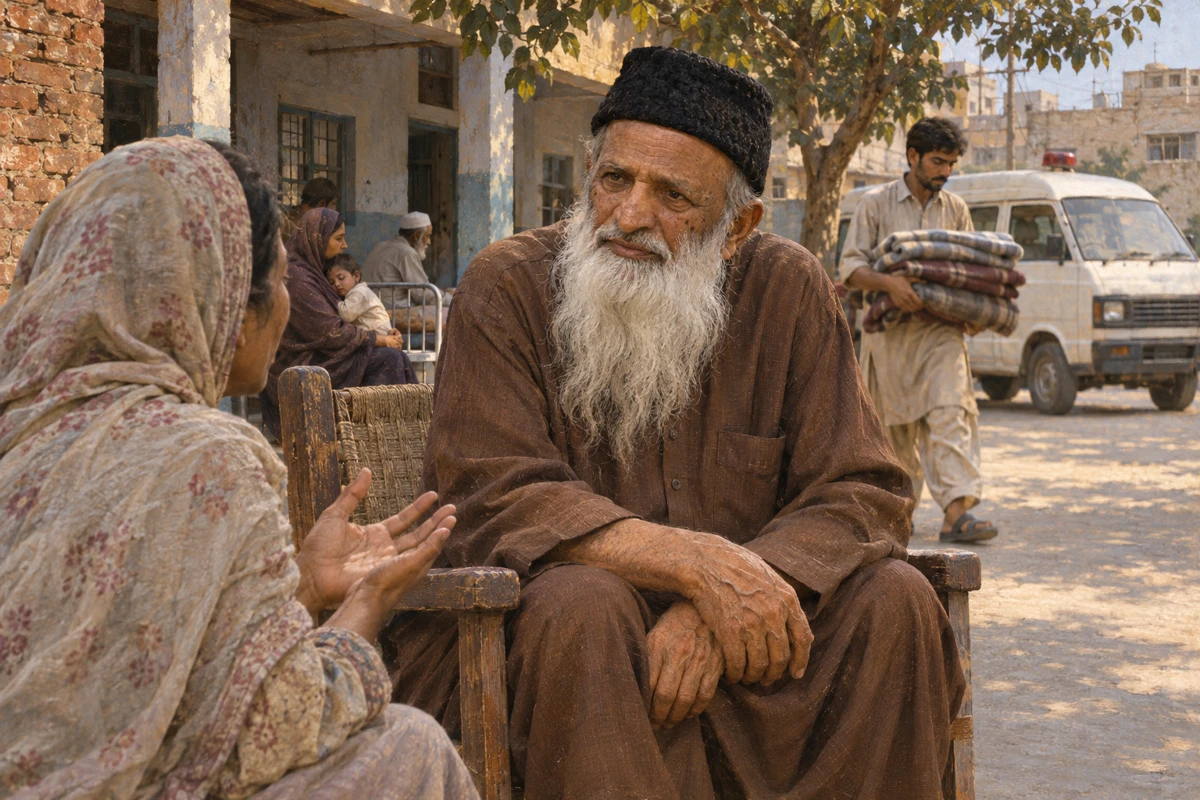
Abdul Sattar Edhi lived in simple clothes, avoided personal luxury and devoted his life to helping people who had nowhere else to turn. Starting with modest resources in Karachi, he and his wife Bilquis built an extraordinary network of ambulances, shelters, clinics and charitable services. Their achievement began with a simple conviction: nobody should be abandoned because they are poor, sick or unwanted.
The man who gave almost everything away
In Karachi, Pakistan, a man wearing a plain shalwar kameez could often be seen working among the poor, the sick and the homeless.
He did not look like the founder of a vast humanitarian organisation. He wore inexpensive clothes, lived modestly and had little interest in wealth or personal status.
Yet the organisation associated with his name operated ambulances across Pakistan, sheltered vulnerable children, cared for elderly people and provided assistance to those who could not afford it.
His name was Abdul Sattar Edhi.
To millions of Pakistanis, he became a symbol of compassion. But the most remarkable part of his story is not simply the scale of the organisation he built. It is the contrast between the life he chose for himself and the enormous effort he devoted to helping others.
Edhi wanted very little. For the people he served, he wanted everything that human dignity required.
A childhood shaped by suffering
Abdul Sattar Edhi was born in 1928 in Bantva, in what was then British India. His family later moved to Karachi following the partition of India in 1947.
But his understanding of suffering began long before he established a charitable organisation. When Edhi was a boy, his mother became seriously ill. She experienced paralysis and later developed severe mental health difficulties.
Young Abdul Sattar helped care for her. He washed her, fed her and assisted with everyday tasks. The experience exposed him to the vulnerability of someone who could no longer manage independently. It also taught him that caring for another person could require enormous patience.
His mother's illness became one of the defining influences of his life. In later accounts, Edhi described the importance of helping those who were unable to help themselves. It was a lesson he would eventually apply on an extraordinary scale.
A small dispensary in a crowded city
After moving to Karachi, Edhi encountered a city struggling with poverty, migration and inadequate public services. The partition of British India had displaced millions of people. Many arrived in Pakistan with few possessions and uncertain prospects.
Karachi was growing rapidly. Its charitable and medical services could not meet every need.
Edhi became involved in welfare work and began raising money to assist people who lacked medical care. In the early 1950s, he established a small charitable dispensary in Karachi's Mithadar district.
It was a modest beginning. There were no wealthy corporate sponsors behind the project. Edhi relied heavily on public donations. He approached ordinary people and asked them to contribute what they could.
His appeal was direct. The money was not for him. It was for people in greater need.
Over time, those small contributions helped create something much larger.
The ambulance that changed everything
One of Edhi's most important achievements was the development of an emergency ambulance service.
In many parts of Pakistan, reliable emergency transport was limited or unavailable. People injured in road accidents, suffering medical emergencies or requiring urgent hospital care could struggle to find help.
Edhi recognised that a vehicle capable of reaching patients quickly could save lives. His organisation began providing ambulance services and gradually expanded its fleet.
The work was not limited to wealthy neighbourhoods or people able to pay. The ambulances served people from different backgrounds, religions and communities.
They also transported the bodies of people who had died without family members able to arrange their burial. This was an important part of Edhi's philosophy. He believed that human dignity should not end at death. Even people who had been abandoned or forgotten deserved respectful treatment.
Over the decades, the ambulance network became one of the Edhi Foundation's most recognisable achievements.
Guinness World Records has recognised Abdul Sattar Edhi in connection with the world's largest volunteer ambulance organisation. The published record describes a fleet of hundreds of vehicles, although the figures reflect the period in which they were recorded. Later reports have cited larger totals as the organisation expanded.
The precise numbers changed. The underlying principle did not. Emergency assistance should be available to people because they needed it, not because they could afford it.
The woman who helped build the organisation
The story of the Edhi Foundation cannot be told properly without Bilquis Edhi.
Bilquis was a nurse who became Abdul Sattar Edhi's wife and lifelong partner in humanitarian work. They married in 1965. Together, they expanded the organisation's services for women, children and vulnerable families.
Bilquis played a particularly important role in maternal healthcare, nursing, adoption services and the care of abandoned infants. She became a major humanitarian figure in her own right.
The couple's work complemented each other. Abdul Sattar became especially associated with ambulances, emergency assistance and the organisation's public identity. Bilquis helped develop essential services for women and children.
Their partnership demonstrated that effective humanitarian work requires more than a charismatic founder. It requires skilled people, practical systems and sustained commitment.
The Edhi Foundation became an institution because thousands of people contributed their labour, expertise and donations.
The cradles that offered abandoned babies a chance
Among the organisation's most moving initiatives were its baby cradles. These were placed outside selected Edhi centres so that parents unable or unwilling to care for a newborn could leave the child in a place where staff could provide assistance.
The initiative was intended to prevent infant abandonment in dangerous circumstances. The organisation arranged care for babies and, where appropriate, adoption through its established procedures.
The programme reflected a difficult social reality. Some parents faced poverty, stigma, family pressure or circumstances that made caring for a child seem impossible. Edhi and his colleagues sought to provide an alternative to abandonment in unsafe places.
The programme was not without controversy. Questions about adoption, child protection and the circumstances in which babies were surrendered remained important.
But its central purpose was humanitarian. A child should not die because adults could not find a safe way to seek help.
Bilquis Edhi's role in caring for these children became one of the most significant aspects of the organisation's work.
A home for people nobody wanted
The Edhi Foundation expanded beyond emergency medical services. It established shelters, welfare centres, rehabilitation facilities and homes for vulnerable people.
Its services included assistance for elderly people without family support, people with disabilities, homeless individuals and children requiring care. In a society where poverty could leave people without access to basic services, these institutions filled important gaps.
The organisation also provided food, medical assistance and disaster relief.
Edhi's approach was notable for its emphasis on helping people without discrimination. The foundation served people regardless of religion, ethnicity or social status.
That principle was especially significant in a country where religious and social divisions could be deeply contentious.
Edhi's response was practical. A person in need of an ambulance did not have to pass a test of belief. A hungry person did not need to belong to the right community. A child requiring shelter did not have to prove that their parents were respectable.
Need itself was sufficient reason to help.
Why did he refuse to become wealthy?
As the Edhi Foundation grew, Abdul Sattar Edhi became increasingly well known. He received national and international recognition. His organisation attracted substantial donations.
Yet he continued to live with remarkable personal simplicity. Accounts describe him wearing inexpensive clothing, avoiding luxury and keeping his personal requirements modest.
This was not merely a public image. It reflected his belief that resources should be directed towards people who needed assistance.
Edhi understood that public trust was essential to a donation-funded organisation. People needed to believe that their contributions would be used for charitable work. His personal lifestyle reinforced that message.
He did not ask ordinary people to make sacrifices while visibly enriching himself. He attempted to demonstrate the same restraint that he encouraged in others.
His simplicity became one of the most memorable features of his public identity. But it should not obscure the complexity of what he built.
The foundation required administration, transport systems, medical staff, volunteers, buildings and fundraising. Its success depended on organisation as well as generosity.
Edhi's achievement was combining a simple moral philosophy with a practical institution capable of delivering assistance.
The awards that could not change him
Abdul Sattar Edhi received numerous honours during his lifetime.
In 1986, he and Bilquis Edhi received the Ramon Magsaysay Award for Public Service. The award recognised their contribution to humanitarian welfare.
In 2000, Edhi received the International Balzan Prize for Humanity, Peace and Fraternity Among Peoples.
These honours brought international attention to his work. But Edhi remained closely associated with the everyday operations of his organisation. He continued to speak about poverty, suffering and the importance of helping others.
The awards recognised what he had accomplished. They did not become the purpose of his life.
For Edhi, the people who arrived at his centres in need of help remained more important than ceremonial recognition.
The organisation that became larger than one man
By the later decades of Edhi's life, the foundation had developed into one of Pakistan's most extensive charitable welfare networks.
Its activities included emergency medical transport, shelters, healthcare, burial services and disaster assistance. The organisation also responded to emergencies beyond Pakistan. Its reputation became closely associated with rapid practical assistance.
But the size of the foundation creates a challenge for historians and journalists. Different sources report different numbers of ambulances, centres, patients and people helped.
Some figures describe particular years. Others are cumulative estimates. The numbers cannot always be compared directly.
For example, a record describing several hundred ambulances at one point in the organisation's history does not necessarily contradict later reports of a much larger fleet. The organisation expanded over time.
The safest historical conclusion is not that one precise number defines Edhi's achievement. It is that he helped build a large, durable and nationally significant humanitarian network from extremely modest beginnings.
The final act of generosity
Abdul Sattar Edhi died in Karachi on 8 July 2016. He was eighty-eight years old.
His death prompted an extraordinary public response. Pakistan honoured him with a state funeral, an exceptional recognition for a civilian humanitarian. Large numbers of people mourned a man whose organisation had touched lives across the country.
Even at the end of his life, Edhi's concern for others remained evident. He had expressed a wish to donate his organs after death.
Because of his age and medical condition, only his corneas were suitable for donation. They were donated to restore sight to people in need.
It was a final act consistent with the principles that had guided his life. A man who had spent decades helping others continued to give after death.
The legacy of Bilquis and Abdul Sattar Edhi
Bilquis Edhi continued her humanitarian work after her husband's death. She remained closely associated with the foundation's services for women and children. She died in April 2022.
Together, the couple left behind an organisation that continued to provide assistance long after its founders were gone.
That is perhaps the clearest measure of their achievement. A charitable act can help someone for a day. An effective humanitarian institution can continue helping people for generations.
The Edhis did not simply distribute money or provide occasional assistance. They helped create systems through which compassion could become a continuing public service.
Their legacy is therefore both personal and institutional. It is found in the lives of people they helped directly. And it is found in the ambulances, shelters and welfare centres that continue their work.
The man who understood what wealth was for
Abdul Sattar Edhi's life presents an unusual contrast.
He became associated with one of Pakistan's largest charitable organisations while maintaining an extraordinarily modest personal lifestyle. He helped provide vehicles, buildings and medical services worth far more than anything he wanted for himself.
He received international honours but remained known for simple clothing and direct humanitarian work.
His story is not about a man who became wealthy and then decided to give some of his fortune away. It is about someone who made helping others the central purpose of his life. And who persuaded thousands of ordinary people to join him.
There is an important lesson in that achievement. Compassion is often described as a feeling. Edhi demonstrated that it could also become an organised, practical and enduring form of public service.
An ambulance arriving at an accident. A safe place for an abandoned child. A shelter for someone with nowhere to sleep. A dignified burial for a person whose family could not be found.
These were not abstract expressions of kindness. They were concrete acts that changed people's lives.
Abdul Sattar Edhi owned little, wanted little and spent his life building something extraordinary for people who had even less.
His greatest legacy was not the size of his organisation. It was the belief that nobody should be considered too poor, too forgotten or too unwanted to deserve help.
---
What the evidence tells us
WELL SUPPORTED: Abdul Sattar Edhi founded the humanitarian organisation that became the Edhi Foundation, which developed extensive ambulance, medical and welfare services across Pakistan.
WELL SUPPORTED: Bilquis Edhi played a major role in expanding services for women, children and abandoned infants. The organisation's achievements were collaborative.
WELL SUPPORTED: Edhi lived modestly and received major humanitarian honours, including the Ramon Magsaysay Award and Balzan Prize.
WELL SUPPORTED: He died in July 2016 and received a state funeral. His corneas were donated after his death.
REQUIRES QUALIFICATION: Claims about the precise number of ambulances, welfare centres, children rescued or patients treated. Figures vary by source and reporting date.
COMMON OVERSIMPLIFICATION: Edhi single-handedly built and operated the entire welfare network. The foundation depended on Bilquis Edhi, staff, volunteers and public donors.
Historical sources and further reading
1. Edhi Foundation — Official Website: https://www.edhi.org/
2. Guinness World Records — Largest Volunteer Ambulance Organisation: https://www.guinnessworldrecords.com/world-records/72849-largest-volunteer-ambulance-organisation
3. International Balzan Foundation — Abdul Sattar Edhi: https://www.balzan.org/en/prizewinners/abdul-sattar-edhi
4. Ramon Magsaysay Award Foundation — Abdul Sattar and Bilquis Edhi, 1986 Public Service Award.
5. BBC News — Abdul Sattar Edhi: Pakistan's 'Father Teresa' Dies Aged 88, July 2016.
6. Reuters — Obituary and coverage of Abdul Sattar Edhi's state funeral, July 2016.
7. Associated Press — Reporting on Bilquis Edhi's humanitarian work and death, April 2022.
Last checked: 5 November 2026.