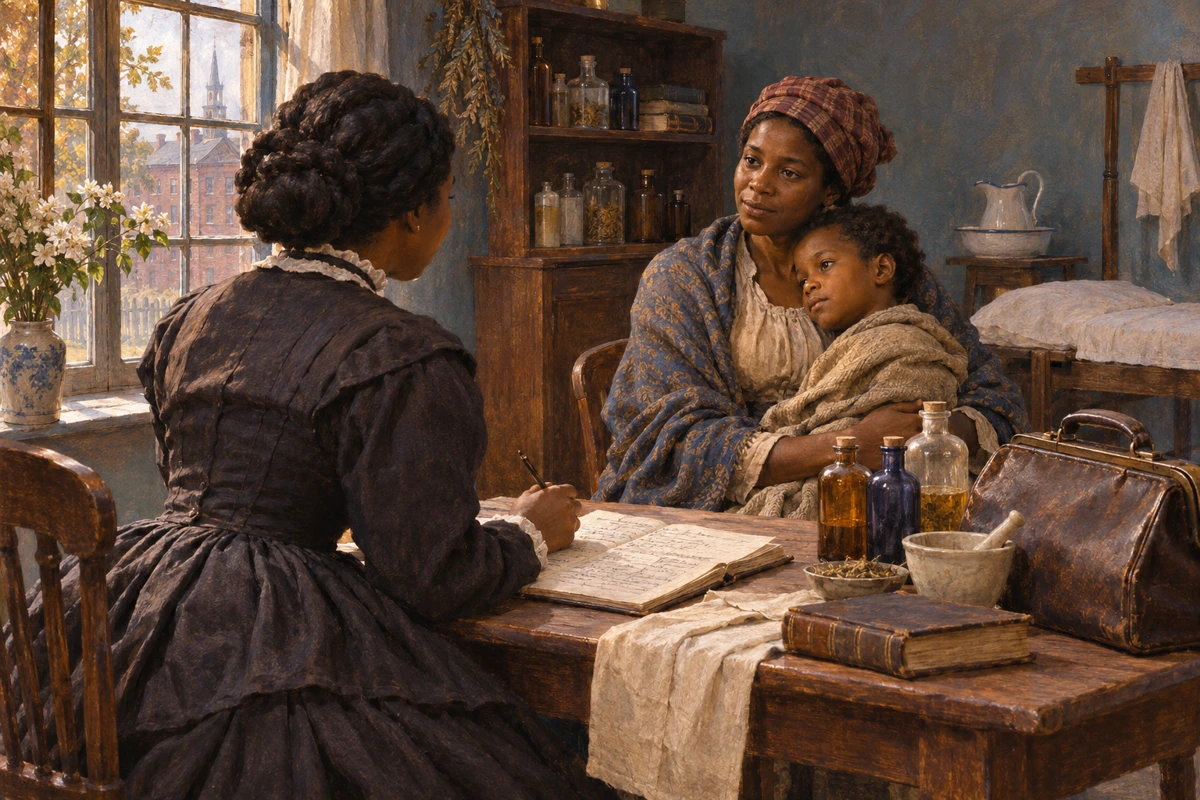
In 1864, Rebecca Lee Crumpler became the first Black woman in the United States to earn a medical degree. She went on to care for formerly enslaved families in the devastated American South and publish a medical book at a time when women, particularly Black women, were routinely excluded from the profession.
The doctor who was never supposed to exist
In 1864, a woman graduated from a medical college in Boston.
Her name was Rebecca Lee. She was thirty-three years old, Black, and entering a profession overwhelmingly controlled by white men.
Her qualification was extraordinary. At a time when women were routinely discouraged from studying medicine, and African Americans faced profound discrimination in education and employment, she had achieved something no Black American woman was previously known to have accomplished.
She had earned a medical degree.
Today, she is remembered as Dr Rebecca Lee Crumpler. But her remarkable story is not simply about becoming the first. It is about what she chose to do with the opportunity.
Rather than pursue only a comfortable medical career, she travelled to the American South after the Civil War to care for people who had been enslaved. And when her working life was drawing to a close, she wrote a book to share the knowledge she had gained.
The book survives. It allows us to hear the voice of a pioneering physician whose personal history might otherwise have been almost entirely forgotten.
The aunt who inspired a future doctor
Rebecca Davis was born in Delaware on 8 February 1831. She spent much of her childhood in Pennsylvania, where she was raised by an aunt who cared for sick neighbours.
The aunt's work made a lasting impression. In the introduction to her 1883 medical book, Crumpler recalled that she had developed an early desire to relieve suffering because she had witnessed this practical kindness.
It was an unusual beginning for a medical career. She did not come from a family of wealthy physicians. She did not grow up surrounded by university laboratories or prestigious hospitals.
Instead, she learned that medical care could begin with an ordinary person helping someone in need. That lesson shaped her entire professional life.
By 1852, Rebecca had moved to Charlestown, Massachusetts, where she began working as a nurse. She spent approximately eight years nursing under the supervision of physicians.
Formal nursing education was still developing in the United States, so much of her training came through direct experience. She observed illness, assisted patients and learned how medical treatment worked in practice.
Her abilities impressed the doctors with whom she worked. They encouraged her to pursue medical training. It was an extraordinary opportunity.
Entering a profession that excluded women
In 1860, Rebecca entered the New England Female Medical College in Boston. The institution was unusual because it admitted women to medical education at a time when most American medical schools did not.
Even there, her position was exceptional. She was a Black woman studying medicine in a society that imposed restrictions on both women and African Americans.
The American Civil War began the following year. While the country was torn apart by conflict over slavery and the future of the Union, Rebecca continued her medical studies.
The training was demanding. Students needed to understand anatomy, physiology, disease and treatment. They also faced the limitations of nineteenth-century medicine, when many effective modern treatments had not yet been developed.
Nevertheless, Rebecca persisted. In 1864, she graduated with a medical degree. She became the first Black woman in the United States known to have earned an MD.
It was an achievement of enormous historical significance. But Rebecca did not treat it as the conclusion of her ambitions. For her, becoming a doctor was a means of helping people.
A country emerging from slavery
The American Civil War ended in 1865. Slavery had been abolished, but freedom did not immediately bring security or equality.
Millions of formerly enslaved people faced poverty, displacement, hunger and illness. Many had little access to doctors or hospitals.
The federal government established the Freedmen's Bureau to provide assistance during the difficult transition from slavery to freedom. Its responsibilities included supporting education, employment, food distribution and medical care.
The need was immense. In Richmond, Virginia, the former Confederate capital, war damage and economic upheaval had left communities struggling.
Rebecca Lee Crumpler saw an opportunity to put her medical training to work where it was desperately needed. She travelled to Richmond with her husband, Arthur Crumpler.
There, she began treating formerly enslaved people and other patients who could not easily obtain medical assistance.
The doctor who treated people who could not pay
Crumpler worked with the Freedmen's Bureau and charitable organisations. Her patients included women, children and families living in poverty.
Many had experienced years of deprivation. Some suffered from illnesses made worse by inadequate housing, poor nutrition and limited access to medical care.
Crumpler was particularly interested in the health of women and children. In her later writing, she described Richmond as a place where she could carry out meaningful humanitarian work while learning more about the diseases affecting vulnerable families.
During the final months of 1866, she gained access to large numbers of patients in Richmond's Black community.
The work was physically and emotionally demanding. It also exposed her to prejudice. Black physicians faced hostility from people who refused to accept their professional authority. Women doctors encountered additional discrimination.
Crumpler had to practise medicine in a society where many people believed she had no right to be a physician at all.
Yet she continued. Her patients needed medical care. That mattered more than the approval of those who questioned her place in the profession.
A medical practice built on compassion
After her work in Richmond, Crumpler returned to Boston. She settled in the Beacon Hill neighbourhood, which had a substantial Black community.
There, she continued practising medicine. Her work included visiting patients and treating children in her own home.
She did not restrict her services to people who could afford conventional medical fees. In her book, she explained that payment was not always her principal consideration.
This was a continuation of the philosophy she had learned as a child. Her aunt had helped sick neighbours because they needed assistance. Crumpler had become a physician partly so she could do the same thing with greater medical knowledge.
The circumstances had changed. The principle had not.
The extraordinary book she left behind
In 1883, Rebecca Lee Crumpler published A Book of Medical Discourses: In Two Parts.
It was an unusual achievement. Very few Black American women had entered the medical profession. Fewer still had published substantial medical writing.
Crumpler's book drew upon the notes she had kept during years of clinical work. The first part concentrated on illnesses affecting infants and young children. The second discussed conditions affecting women and young people.
Her subjects included childhood digestive illnesses, nursing, pregnancy and the practical care of families.
Some treatments reflected the limitations of nineteenth-century medical knowledge and would not be appropriate today. But the book remains an important historical document.
It demonstrates that Crumpler was not simply a symbolic pioneer. She was an experienced practitioner who had developed professional knowledge and wanted to make it useful to others.
The book also preserved details of her life that might otherwise have disappeared. Its introduction contains her own account of her early nursing experience, medical education and work in Richmond.
In an era when Black women's achievements were frequently omitted from institutional records, this was especially significant. Crumpler had ensured that at least part of her story survived in her own words.
Why are there no photographs of her?
One of the strangest aspects of Rebecca Lee Crumpler's story concerns her appearance. Despite her extraordinary achievements, no authenticated photograph of her is known to survive.
Images sometimes circulated online as portraits of Crumpler have been misidentified. Some actually depict other pioneering Black women, including physicians who lived during the same period.
This creates an important problem for historians. A famous person's image can become so widely repeated that people assume it must be authentic. But repetition is not evidence.
The United States National Library of Medicine and the National Park Service acknowledge that no verified photograph of Crumpler is known.
Her surviving book, institutional records and historical documents are therefore especially valuable. They tell us what she did, even though we cannot confidently say what she looked like.
For Strange by Habit, that distinction matters. A historical illustration can represent her world, but it should never be presented as an authentic portrait.
The doctor whose grave had no headstone
Rebecca Lee Crumpler died in Boston on 9 March 1895. She was sixty-four years old. She was buried in Fairview Cemetery.
For more than a century, her grave remained without a headstone. It was a striking omission for a woman who had achieved such an important milestone in American medical history.
Her name survived in historical records, but her burial place offered little indication of her extraordinary life.
In 2020, efforts by local supporters and historians helped secure a memorial headstone. More than 125 years after her death, her resting place finally received the recognition it deserved.
The memorial did not change what Crumpler had accomplished. It changed how visibly those accomplishments were remembered.
More than a medical first
It is tempting to summarise Rebecca Lee Crumpler's life in a single sentence. She was America's first Black woman physician.
That is true, but it is incomplete.
She was also a nurse who spent years learning through practical experience. A student who persisted through exclusion and prejudice. A doctor who travelled to a devastated city to care for formerly enslaved families. A practitioner who treated people regardless of their ability to pay. And an author who preserved her medical knowledge for future readers.
Her life demonstrates that historical progress is not always achieved through dramatic speeches or public campaigns.
Sometimes it happens in a classroom where someone has been told they do not belong. Sometimes it happens in a clinic where a patient is finally treated with dignity. And sometimes it happens when a person decides that knowledge is most valuable when it is used to help others.
Rebecca Lee Crumpler's greatest achievement may not have been that she became a doctor when the world made it difficult. It may have been that, once she had earned that title, she devoted it to people who needed her most.
She broke a barrier to enter medicine — and then spent her career opening the door to care for others.
---
What the evidence tells us
WELL SUPPORTED: Rebecca Lee Crumpler graduated from the New England Female Medical College in 1864, becoming the first Black woman in the United States known to have earned an MD.
WELL SUPPORTED: She worked with the Freedmen's Bureau and charitable organisations in Richmond, treating formerly enslaved people and impoverished families.
WELL SUPPORTED: Her A Book of Medical Discourses was published in 1883 and survives as an important primary source.
WELL SUPPORTED: Her grave remained unmarked for more than a century, with a memorial headstone arranged in 2020.
IMPORTANT QUALIFICATION: No authenticated photograph of Crumpler is known to survive. Images claiming to show her should not be accepted without reliable provenance.
COMMON MISCONCEPTION: Crumpler founded a hospital specifically for formerly enslaved people. The stronger historical record documents her medical practice and work with existing welfare organisations, not the establishment of her own hospital.
Historical sources and further reading
1. US National Library of Medicine — Rebecca Lee Crumpler: https://www.nlm.nih.gov/exhibition/changing-the-face-of-medicine/physicians/biography_rebecca_crumpler.html?id=item-77
2. US National Park Service — Dr Rebecca Lee Crumpler: https://www.nps.gov/people/dr-rebecca-lee-crumpler.htm
3. Rebecca Lee Crumpler, A Book of Medical Discourses: In Two Parts (1883), available through the US National Library of Medicine and Internet Archive.
4. National Women's History Museum — Rebecca Lee Crumpler.
5. Boston University — Trailblazing BU Alum Gets a Gravestone 125 Years after Her Death (2020).
6. New England Journal of Medicine — To Mitigate the Afflictions of the Human Race: The Legacy of Dr Rebecca Crumpler (2021).
Last checked: 5 November 2026.