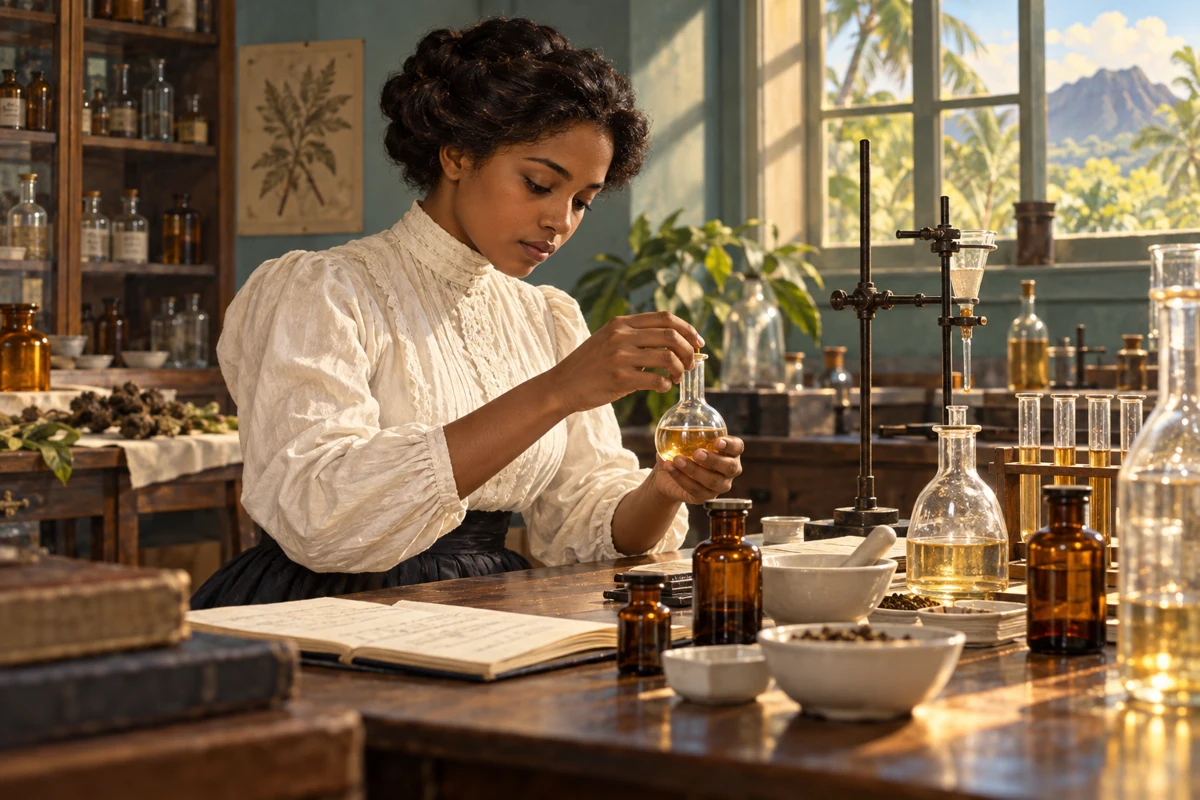
Alice Ball helped turn a difficult medicinal oil into an injectable treatment at just 23. After she died, the work continued, but her name slipped out of the story.
One doctor put her contribution into print. It would take decades more for that acknowledgement to become lasting public recognition.
THE SHORT ANSWER
Alice Augusta Ball developed a method for preparing injectable derivatives of chaulmoogra oil, an important early treatment for Hansen’s disease, commonly called leprosy. She died in 1916, aged 24, before publishing her findings herself.
Arthur Lyman Dean, president of the College of Hawai‘i, continued the research and published without acknowledging her crucial contribution. The treatment became associated with his name. Harry T. Hollmann credited Ball in 1922, but that published correction did not secure her a prominent place in scientific memory.
WHAT WE KNOW
Born in Seattle on 24 July 1892, Ball studied pharmaceutical chemistry and pharmacy at the University of Washington before moving to the College of Hawai‘i.
In 1915 she became the college’s first woman and first Black graduate to earn a master’s degree. Her thesis examined the chemical constituents of kava root. She also taught chemistry.
That experience in plant chemistry helped bring her to the attention of Hollmann, a physician working with people with Hansen’s disease in Honolulu. He asked her to investigate chaulmoogra oil.
The oil already had a long history in Asian medicine. Ball did not discover it, and she was not the only researcher investigating its possibilities. Her achievement was solving a practical chemical problem that stood between a promising substance and a more usable treatment.
FROM AN OIL TO AN INJECTION
Raw chaulmoogra oil was troublesome medicine. Swallowing it could cause nausea; injections could be painful and poorly absorbed.
Ball developed a way to prepare ethyl esters from the oil’s fatty acids. These derivatives were more suitable for injection and absorption than the original oil.
The distinction sounds technical until one considers what a diagnosis could mean. In Hawai‘i, compulsory segregation separated people from their families and communities. Kalaupapa, on Moloka‘i, became the most enduring symbol of that policy.
A treatment that improved someone’s condition could therefore affect much more than symptoms. It could offer a possible route out of enforced isolation.
THE STORY EVERYONE TELLS
The familiar version is stark: a brilliant young woman discovered a cure, a senior man stole it, and nobody remembered her for nearly a century.
The injustice is real, but that summary needs care.
Ball developed a treatment rather than a dependable cure. Chaulmoogra preparations remained important until sulfone drugs emerged in the 1940s, but improvement did not guarantee permanent freedom from the disease.
Nor was her name completely absent from the record. The strongest evidence for her achievement survived because a colleague wrote it down.
WHAT THE EVIDENCE ACTUALLY SAYS
The central account is WELL SUPPORTED.
In his 1922 paper, The Fatty Acids of Chaulmoogra Oil in the Treatment of Leprosy and Other Diseases, Hollmann identified Ball as the chemist who solved the preparation problem. He described her method and challenged the value of Dean’s more elaborate processing.
That is more substantial than a later tribute. It is testimony from the doctor who had asked her to undertake the research.
Dean’s continuation of the work should not be confused with authorship of Ball’s original contribution. Equally, the surviving record does not let us reconstruct every private conversation or motive. We can establish the missing acknowledgement without inventing a confession.
Race and sex also belong in this history. A young Black woman worked in a profession whose authority largely rested with white men. Those inequalities help explain her vulnerability to being overlooked; they do not give us a complete documentary explanation for every later omission.
Ball died on 31 December 1916. Accounts connect her illness with laboratory exposure, while other records mention tuberculosis. The cause remains uncertain. A dramatic story of a fatal laboratory accident should not be stated as settled fact.
HOW HER NAME RETURNED
Hollmann’s paper preserved a trail that later researchers could follow. Scholars, campaigners and university staff helped bring Ball’s work back into public view.
A commemorative plaque was dedicated at the University of Hawai‘i at Mānoa in 2000. The university awarded her its Medal of Distinction posthumously in 2007.
Recognition has continued. On 26 February 2026, the American Chemical Society dedicated a National Historic Chemical Landmark honouring the Ball Method in Honolulu.
These honours came far too late for Ball to receive them. They nevertheless changed the name attached to an achievement that had outlived its discoverer.
WHY HER STORY MATTERS
A scientific result can survive while the person responsible disappears from its retelling. Publication, institutional prestige and repeated attribution all help decide whose name travels with an idea.
Ball’s story also shows the value of a precise correction. Hollmann could not give her back the career she lost, but his paper left evidence against which later accounts could be checked.
The treatment was superseded. The need to credit the chemist who made it possible has not expired.
RELATED CURIOSITIES
How Did a Woman Disguised as a Man Sail Around the World?
How Did an Enslaved Man Sail a Confederate Ship to Freedom?
How Did a Woman Born Without Arms Become a Celebrated Royal Portrait Painter?
SOURCES & FURTHER READING
1. Harry T. Hollmann — The Fatty Acids of Chaulmoogra Oil in the Treatment of Leprosy and Other Diseases (1922). Contemporary paper; repository record and scan.
https://zenodo.org/records/1496183
2. American Chemical Society — Alice Augusta Ball: A trailblazing chemist created a viable treatment for leprosy. National Historic Chemical Landmark history.
https://www.acs.org/education/whatischemistry/landmarks/alice-ball.html
3. University of Hawai‘i — Alice Ball: 1st African-American woman chemist, UH alumna celebrated (2024).
https://www.hawaii.edu/news/2024/02/29/alice-ball-celebrated-2024/
4. University of Hawai‘i Board of Regents — Alice Augusta Ball, Medal of Distinction (2007).
https://hawaii.edu/offices/bor/distinction.php?person=ball
5. British Pharmacological Society — Alice Ball: The Chemist Who Revolutionised Leprosy Treatment and Changed Pharmacological History.