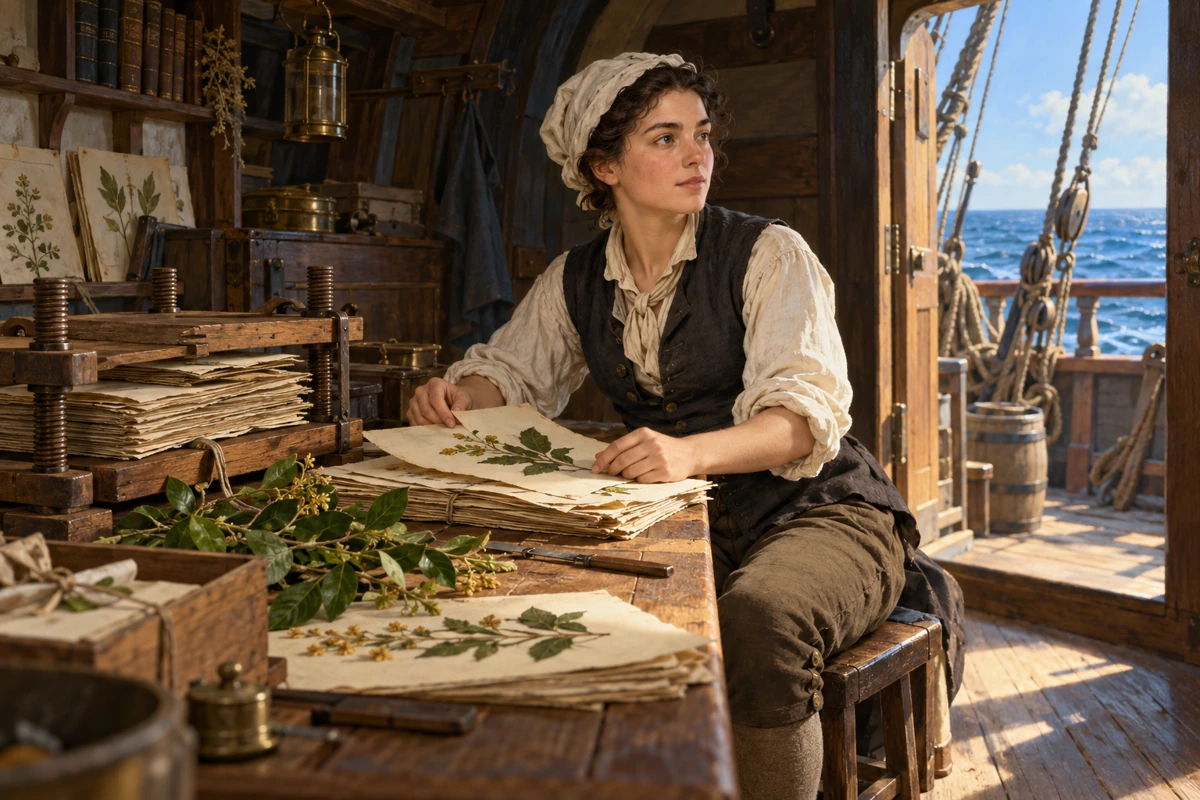
In 1767, a French expedition sailed with a botanical assistant known as Jean. The assistant carried equipment, collected plants and helped preserve the material of a scientific voyage.
Jean was Jeanne Baret. She became the first woman known to circumnavigate the globe, although the familiar story of her disguise is much tidier than the surviving evidence.
THE SHORT ANSWER
Jeanne Baret joined the expedition led by Louis-Antoine de Bougainville aboard the Étoile, presenting herself as a man because French naval regulations excluded women. She travelled as the servant and assistant of the naturalist Philibert Commerson, with whom she already had a personal and working relationship.
She did not complete the circuit with Bougainville. Baret and Commerson stayed in Mauritius; she returned to France several years later, probably around 1775, completing the journey. The achievement is secure. Exactly how her identity became public is considerably less certain.
WHAT WE KNOW
Baret was born in 1740 at La Comelle in Burgundy, into a family of modest means. Before the voyage she worked in Commerson's household. He was a naturalist with scientific connections; she occupied a much less privileged position in the society that supported his work.
Bougainville's expedition began in 1766, but the Étoile, carrying Commerson and Baret, left France in 1767. That distinction explains why different starting years appear in accounts of her journey.
Commerson was allowed a personal servant. Baret took that place in male clothing, commonly appearing in the story as Jean rather than Jeanne. She was an assistant travelling under a disguise, rather than a hidden passenger who emerged from the cargo hold.
The voyage took her across the Atlantic to South America, through the Strait of Magellan and into the Pacific. The expedition reached Tahiti in April 1768 and later crossed towards the Indian Ocean.
Its scientific work depended on demanding physical labour. Plants had to be gathered, carried and preserved before heat, damp and decay destroyed them. Commerson's poor health sometimes restricted his fieldwork, increasing the importance of Baret's assistance. She helped create collections that entered the French National Herbarium.
This was exploration undertaken within a European imperial project. A specimen unfamiliar to French botanists was not necessarily unfamiliar to the people who lived where it grew.
A WOMAN'S PLACE ABOARD SHIP
The disguise answered a practical problem: Baret could not openly take this place aboard a French naval vessel as a woman.
It did not remove the risks of living among the crew. Bougainville's account records that suspicions had circulated before he questioned her in May 1768. The familiar idea that nobody noticed anything for more than a year is therefore misleading, even within his own version.
The distinction matters. Concealing an identity, having others suspect it and being officially acknowledged are different stages. Later retellings often compress them into one dramatic revelation.
THE STORY EVERYONE TELLS
In the best-known account, Baret went ashore in Tahiti and local people immediately recognised her as a woman. A disguise that had apparently deceived French sailors fell apart almost at once.
This version comes from Bougainville and has an obvious narrative appeal. It supplies a single turning point, a picturesque setting and a moment of astonishment.
But other expedition accounts complicate the sequence and describe threatening incidents involving the crew. Historians disagree about how to reconcile these accounts, including the evidence used to argue that Baret suffered sexual assault.
That possibility should neither be suppressed nor converted into a confidently reconstructed scene. Baret left no known personal account of the voyage to settle these questions.
WHAT THE EVIDENCE ACTUALLY SAYS
WELL SUPPORTED applies to the central achievement, rather than every incident attached to it.
Her presence on the expedition, male disguise, work alongside Commerson and eventual circumnavigation are well established. Her botanical contribution was substantial enough to deserve serious attention, although allocating individual specimens between the two collaborators is difficult.
Her earlier training is less clear. The appealing picture of Baret as an experienced country herbalist who taught Commerson about plants is an interpretation advanced by biographers, not an established description of her education.
Bougainville's Tahitian revelation should be identified as his account. Competing testimony and later reconstructions prevent us from treating it as an uncontested record of precisely what happened.
The bougainvillea also requires care. It is often presented as Baret's great discovery, but a confident claim that she alone found it goes beyond what can securely be assigned to her. Collecting a plant, recording it and formally publishing its scientific name were separate activities.
Her achievement does not depend on resolving those uncertainties in the most flattering direction.
THE JOURNEY AFTER THE EXPEDITION
Baret and Commerson remained on Mauritius when the expedition continued towards France. Commerson died there in 1773.
Baret ran a drinking establishment on the island and married the French soldier Jean Dubernat in May 1774. She subsequently returned to France, completing her circuit of the world. The exact arrival date is uncertain; around 1775 is a cautious way to give it.
Nor did she vanish entirely without recognition. She received a royal pension in 1785. Her later life included property and financial security, complicating the assumption that every overlooked pioneer must have died destitute. She died in 1807.
WHY HER STORY SURVIVED
The disguise makes Baret memorable, but it can also overshadow the work that put her aboard the ship.
In 2012, botanists named Solanum baretiae in her honour. The name recognises a participant whose contribution was much less visible than those of the expedition's celebrated men.
Her story survives partly because it exposes how a voyage becomes history: some people write the journals, some receive the official appointments, and others do essential work that later readers must recover from the margins.
Jeanne Baret travelled around the world. We can recognise that extraordinary achievement without pretending that we can see every part of the journey through her eyes.
RELATED CURIOSITIES
How Did a Woman Born Without Arms Become a Celebrated Royal Portrait Painter?
How Did an Enslaved Man Sail a Confederate Ship to Freedom?
Why Did Maud Wagner Cover Her Body in Tattoos?
SOURCES & FURTHER READING
1. Library of Congress — Jeanne Baret, French Women & Feminists in History. A useful comparison of differing biographical interpretations and the limits of the surviving evidence.
https://guides.loc.gov/feminism-french-women-history/famous/famous/jeanne-baret
2. Western Australian Museum — Journeys of Enlightenment: Jeanne Baret. Includes an extract from Bougainville's journal of May 1768.
https://museum.wa.gov.au/exhibitions/journeys/The_Explorers/Jeanne_Baret.html
3. Nicole Crestey — L'affaire Jeanne Barret (2011), pp. 327–343. Scholarly discussion of the voyage, naval restrictions and documentary records.
https://www.persee.fr/doc/ecoge_1952-2568_2011_ant_5_1_1476
4. Eric J. Tepe, Glynis Ridley and Lynn Bohs — A new species of Solanum named for Jeanne Baret, an overlooked contributor to the history of botany, PhytoKeys 8 (2012), pp. 37–47.
https://pmc.ncbi.nlm.nih.gov/articles/PMC3254248/
5. Sandra Knapp — Celebrating Women's History Month: Jeanne Baret, the Man who was a Woman, Biodiversity Heritage Library (2013). Botanical context and discussion of the voyage accounts; some chronology differs from other sources.
6. Guinness World Records — First circumnavigation (female). Gives her return as around 1775.
https://www.guinnessworldrecords.com/world-records/420434-first-circumnavigation-by-a-woman