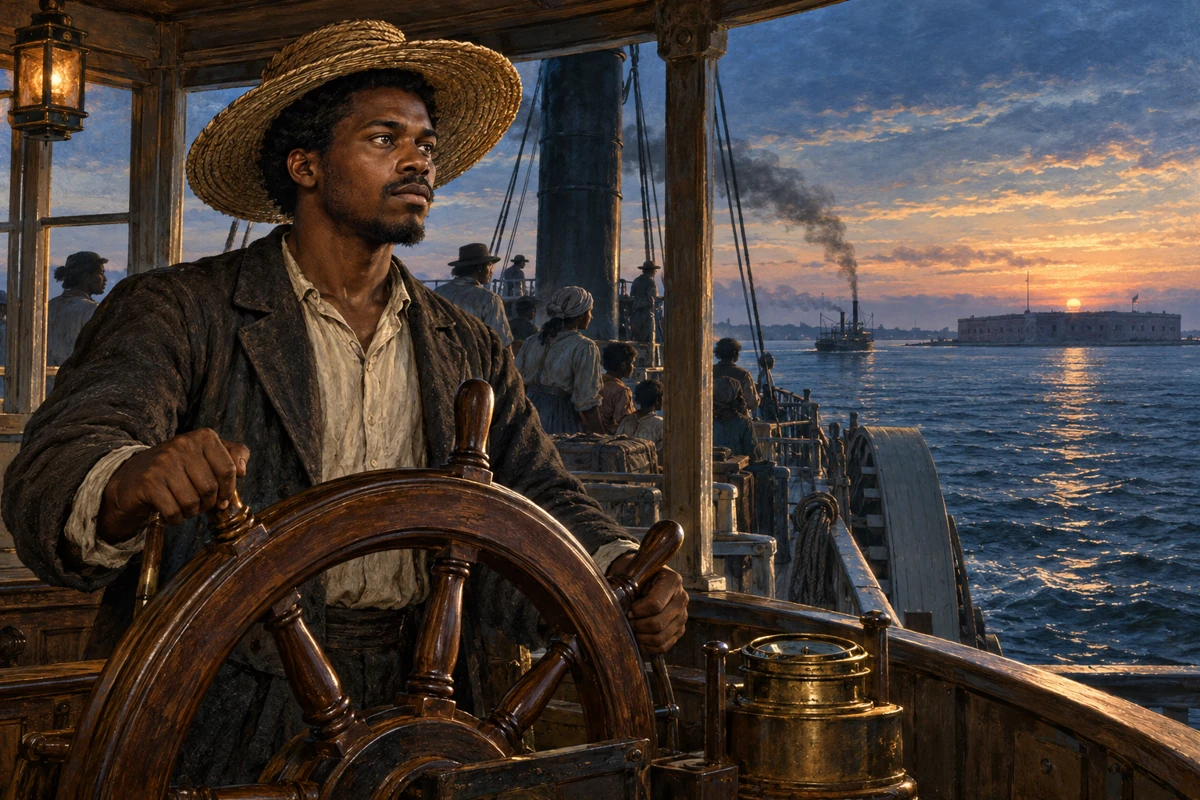
Before dawn, a Confederate transport steamed past the guns guarding Charleston harbour. Its movements appeared familiar, its signals correct.
At the helm was Robert Smalls, an enslaved man taking his family and fellow freedom seekers out of the Confederacy. Getting past the forts was only the first danger. Ahead lay Union warships with reasons to fire on an approaching Confederate vessel.
THE SHORT ANSWER
On 13 May 1862, Smalls and his fellow enslaved crew members took control of the Planter while its white officers were ashore. They collected waiting family members, passed Confederate defences using the expected signals, then raised a white flag and surrendered the vessel to the Union blockade.
Smalls’s knowledge made the escape possible. He knew the waterways, the ship’s routines and the signals that could make an extraordinary departure look ordinary.
WHAT WE KNOW
Born enslaved in Beaufort, South Carolina, in 1839, Smalls was sent to Charleston as a boy and hired out for work. Waterfront employment gave him extensive maritime experience, although he remained legally enslaved.
By the Civil War he was working aboard the Planter, a sidewheel steamer used by the Confederate army to transport troops, equipment and messages around Charleston’s defences.
This was skilled work. The harbour contained channels, shoals and heavily armed fortifications. Moving safely through it required local knowledge. The men denied control of their own lives nevertheless performed work on which the Confederate system depended.
On the night of 12 May 1862, the white officers went ashore, leaving the enslaved crew aboard. In the early hours of 13 May, Smalls and his companions put their plan into action.
THE NIGHT THEY LEFT
The Planter stopped to collect family members before heading towards the harbour entrance. Smalls’s wife Hannah was among those escaping.
He wore a captain’s hat to help disguise his identity and gave the familiar signals as the steamer passed Confederate positions. Fort Sumter was a particularly dangerous obstacle: a suspicious sentry could have brought the escape to an abrupt end.
The ship passed without being stopped.
Beyond the forts, another problem appeared. The Union blockade existed to intercept Confederate shipping. An approaching vessel could be mistaken for an attack.
The freedom seekers raised a white flag. The Planter reached the USS Onward and was handed over to the United States Navy, together with its weapons and cargo. Naval history records sixteen people reaching freedom aboard it.
THE STORY EVERYONE TELLS
The most memorable version concentrates on Smalls’s disguise: an enslaved man puts on the captain’s hat, imitates his behaviour and sails straight past the enemy.
The hat belongs in the story. It should not become its entire explanation.
A disguise could help a distant observer see what he expected to see. It could not navigate a channel, operate an engine or supply the correct signal. Nor could Smalls have brought families to safety without the participation of other people risking their lives.
The escape worked through preparation, practical expertise and collective action.
WHAT THE EVIDENCE ACTUALLY SAYS
The central event is WELL SUPPORTED. This is not a maritime legend built around a mysterious ship: the Planter entered Union service, and Smalls became a publicly recognised figure during the war.
Some details deserve more care. Institutional accounts do not all give identical passenger totals or timings. Sixteen is the figure used by the US Navy’s modern ship history and the National Park Service’s dedicated account, but precision about every person’s movements is harder to establish.
The Planter is also often called a Confederate warship. More precisely, it was an armed transport serving Confederate forces. Its importance lay in its useful cargo, its working role and the knowledge Smalls brought with it.
The broad outline needs no invented conversations or perfectly timed last-second cannon shots to make it remarkable.
FROM THE WHEELHOUSE TO CONGRESS
Smalls continued serving the Union as a pilot and later commanded the Planter. His escape became the beginning of a public career.
Using prize money from the capture, he bought the Beaufort property where he and his mother had been enslaved. During Reconstruction he advocated education and entered South Carolina politics.
Elected to the United States House of Representatives in 1874, he began congressional service in 1875. He eventually served parts of five terms, with interruptions, through 1887.
His political life involved practical work for his coastal constituents and resistance to the intimidation of Black voters. The struggle for freedom had moved from the harbour into elections, public institutions and the defence of citizenship.
WHY HIS STORY MATTERS
Smalls’s life exposes a contradiction at the heart of slavery: people treated as property possessed the judgement and expertise that those claiming ownership relied upon.
His escape made that contradiction visible. His political career carried it further. A man once compelled to serve the Confederacy became a representative in the national legislature.
The night aboard the Planter deserves remembering. So does everything he tried to build after reaching shore.
RELATED CURIOSITIES
How Did a Woman Born Without Arms Become a Celebrated Royal Portrait Painter?
Why Did a Mysterious Woman's Photograph Survive 150 Years Beneath the Sea?
Why Did Maud Wagner Cover Her Body in Tattoos?
SOURCES & FURTHER READING
1. Naval History and Heritage Command — Planter I (Side-wheel Steamer).
https://www.history.navy.mil/research/histories/ship-histories/danfs/p/planter-i.html
2. National Park Service — The Planter.
https://www.nps.gov/articles/000/the-planter.htm
3. National Park Service — Robert Smalls.
https://www.nps.gov/people/robert-smalls.htm
4. US House of Representatives, History, Art & Archives — SMALLS, Robert.
https://history.house.gov/People/Detail/21764
5. National Archives, Pieces of History — Facial Hair Friday: Robert Smalls.
https://prologue.blogs.archives.gov/2022/02/04/facial-hair-friday-robert-smalls/
6. National Park Service — The “Planter”: A Strike for Freedom.
https://www.nps.gov/reer/learn/historyculture/the-planter-a-strike-for-freedom.htm