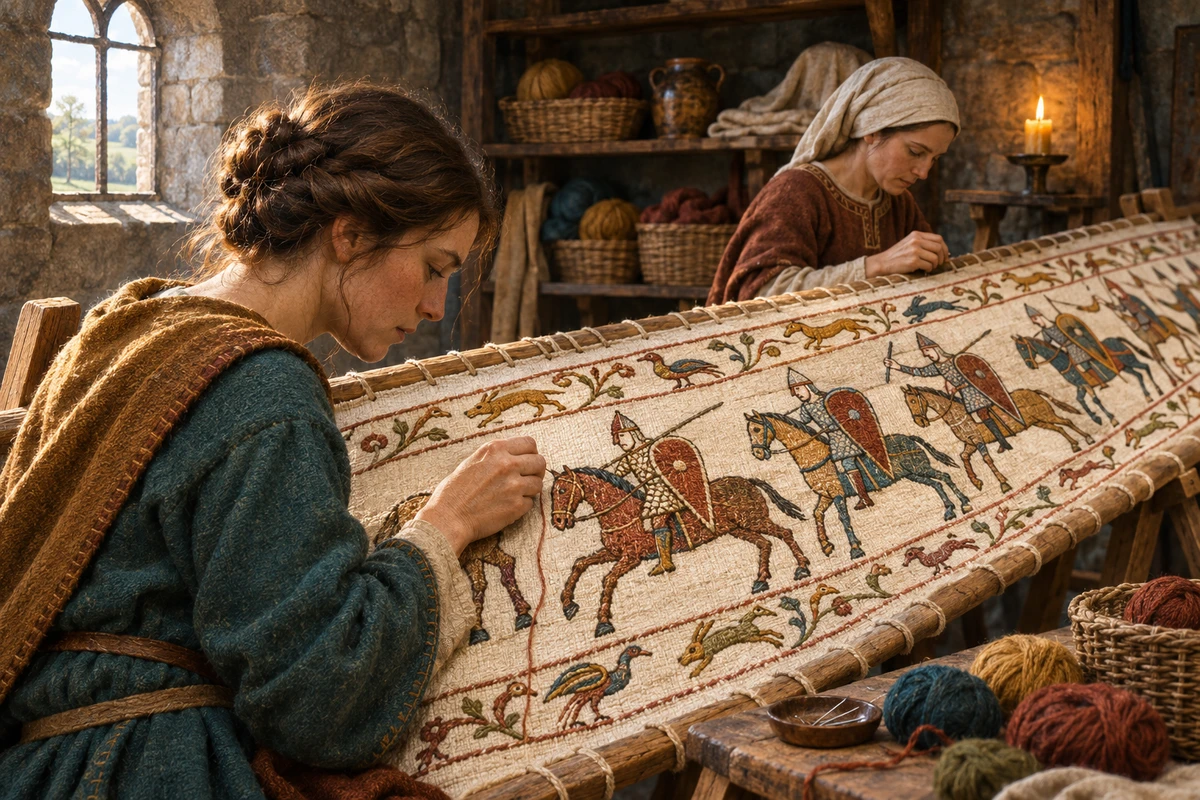
The Bayeux Tapestry tells the story of William’s conquest of England. Yet the hands that stitched it may have belonged to the people his army had defeated.
Behind its charging horses lies a quieter historical puzzle: who made the victors’ version of events, and how much of themselves could they put into it?
THE SHORT ANSWER
Probably, in the broad sense. The Bayeux Tapestry is generally thought to have been made in England after the Norman Conquest, with Canterbury a leading candidate. English embroiderers working for a Norman patron are the most widely accepted explanation.
But no surviving commission names its workshop or workers. We cannot identify their personal experiences of 1066, establish that every maker was English, or claim they were compelled to stitch their own defeat.
The hook is defensible. The imagined scene of grieving survivors secretly sewing their revenge is another matter.
WHAT WE KNOW
First, the famous tapestry is an embroidery. Its coloured wool was stitched onto a linen ground, rather than woven into the fabric as a tapestry’s design would be. It survives for nearly 70 metres: a remarkable amount of cloth on which to tell one political story.
Its narrative leads towards the Battle of Hastings on 14 October 1066, when William’s forces defeated Harold’s army. Scholars usually place its creation in the later eleventh century, often the 1070s. That makes it a work produced close to the events, but not an eyewitness report whose every detail can be taken literally.
There is an awkward documentary gap. Its first secure surviving written record is a 1476 inventory of Bayeux Cathedral’s possessions. The object is much older than that entry; the entry simply does not tell us who originally ordered or stitched it.
HOW A CONQUEST BECAME A PICTURE STORY
The embroidery makes a struggle over kingship visible. People travel, send messages, swear an oath, prepare ships and fight. Its sequence encourages viewers to connect actions with consequences.
That is an effective way to present a claim to power. A ruler can win a battle in a day and spend much longer establishing how people should remember it.
Yet “Norman story” and “Norman manufacture” are separate propositions. A patron could determine the purpose of a work while drawing on the skills and visual traditions available in the country he now helped to govern.
Conquest changes who commands resources. It does not instantly replace everyone capable of making something extraordinary.
THE STORY EVERYONE TELLS
A familiar tradition credits William’s wife, Queen Matilda, and her ladies with making the tapestry. It supplies everything an origin story likes: a famous woman, a royal household and a suitably patient occupation while the men make history.
Bayeux Museum explicitly cautions against that romantic account. Matilda’s association is not a surviving workshop record.
Replacing her with anonymous English workers brings us closer to the prevailing scholarly explanation. It should also make us more careful. Removing one picturesque certainty is little help if we immediately stitch another in its place.
WHAT THE EVIDENCE ACTUALLY SAYS
The evidence label here is PLAUSIBLE. The case has several parts, and they do not all carry the same weight.
The place: England, possibly Canterbury
Scholars have identified close relationships between the embroidery’s imagery and manuscripts associated with Canterbury. These comparisons are an important reason for locating its design there, particularly around St Augustine’s Abbey. Old English features in some inscriptions also support an English connection.
Neither clue is a signed address. A designer’s access to a manuscript tradition and the location where every stitch was made are related questions, rather than identical ones.
The patron: probably Bishop Odo
William’s half-brother Odo, Bishop of Bayeux and Earl of Kent, is the leading candidate. His conspicuous part in the narrative and the work’s later cathedral association help explain that attribution. A connection with the cathedral’s consecration in 1077 is a proposal, not a documented delivery date.
The workers: skilled, anonymous and difficult to recover
English craftsmanship is a strong working explanation. The sex, number and circumstances of the embroiderers are much less secure. English women’s needlework was admired in the period, but that does not establish the membership of this particular workshop.
Nor does patronage establish coercion. The surviving object cannot tell us whether an individual worker approached the task with pride, resentment, necessity, mixed feelings or none of the emotions we now imagine.
The message: room for sympathy, but no proven secret code
One striking scene shows Harold rescuing men from the sands of the River Couesnon during the Breton campaign. He carries one on his back while helping another. The future enemy of William is allowed an unmistakably capable, generous action.
Nikki Rollason and Michael Lewis have examined this scene’s possible relationship to the story of Aeneas. Their study is a useful reminder that medieval images could draw on literary models as well as political arguments.
Harold’s rescue complicates a reading in which he is merely a villain. It does not identify a rebellious embroiderer. A generous portrayal might serve several narrative purposes, and the people devising the images need not have been the same people stitching them.
English production and covert English resistance are different claims. Evidence for the first cannot, by itself, prove the second.
WHY IT STUCK
The tapestry gives history recognisable bodies: men hauling, riding, eating, rescuing and dying. Its makers turned a dispute over succession into something later viewers could follow with their eyes.
There is a revealing comparison at Reading Museum. Its full-sized Victorian replica was completed in 1886 by a group of women whose names are recorded; the embroiderers signed their individual sections. For that later work, we can recover people as well as pictures.
For the medieval original, we have kings’ names and a famous battle, but no equivalent roll call of makers.
That absence is the strongest reason to ask this question. William’s victory may owe its most enduring visual form to English hands. We should give those hands their place in the story without pretending we can read the minds behind them.
The conquered may indeed have embroidered the conquest. Their silence in the records is part of its history too.
RELATED CURIOSITIES
Why Was the Tower of London’s Entrance Called Traitors’ Gate?
Why Did Maud Wagner Cover Her Body in Tattoos?
Why Could Saying the Word for Chickpeas Get You Killed?
SOURCES & FURTHER READING
English Heritage — Jeremy Ashbee, The Bayeux Tapestry and St Augustine’s Abbey. Examines the English, Canterbury and Odo attributions and their limitations.
Bayeux Museum — The Bayeux Tapestry is an embroidery. Materials, manufacture and the Matilda tradition.
Reading Museum — The History of Britain’s Bayeux Tapestry. The 1476 record and the documented Victorian replica.
Nikki K. Rollason and Michael J. Lewis — Harold-as-Aeneas? The Influence of the Aeneid on a Rescue Scene in the Bayeux Tapestry, Greece & Rome 67(2), 2020, pp. 203–229. The published extract and references are accessible; the complete article may require access.
https://doi.org/10.1017/S0017383520000066
Getty Research Institute — Cultural Objects Names Authority: Bayeux Tapestry. Records the unknown makers and prevailing English-production attribution.
https://www.getty.edu/cona/CONAFullSubject.aspx?subid=700009467
Bayeux Museum — Explore the Bayeux Tapestry online. The object itself, available for scene-by-scene examination.
https://www.bayeuxmuseum.com/en/the-bayeux-tapestry/discover-the-bayeux-tapestry/explore-online/