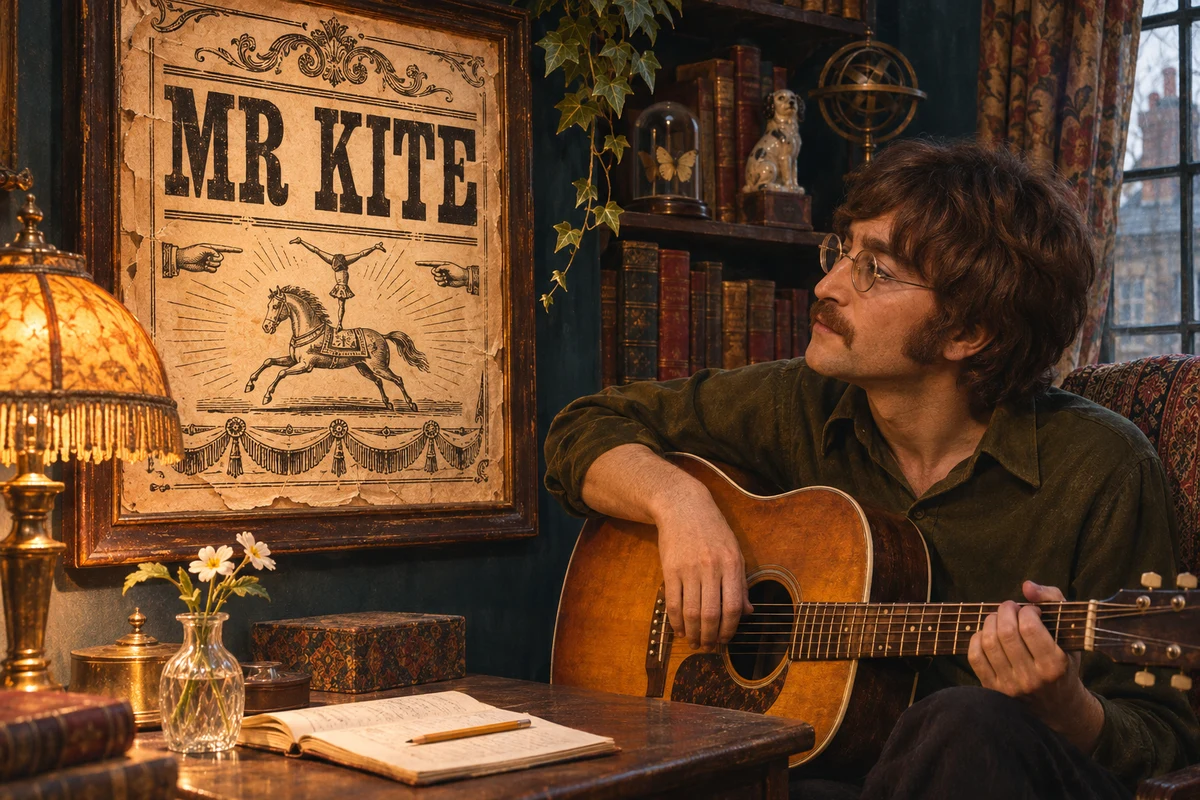
A horse named Zanthus, an acrobat promising twenty-one somersaults and a show in Rochdale do not sound like the ingredients of a psychedelic Beatles recording.
Yet an advertisement for a performance in 1843 helped furnish one of the strangest songs on Sgt. Pepper. The story begins with an old sheet of print, and becomes more interesting when we notice what the musicians changed.
THE SHORT ANSWER
John Lennon bought a Victorian circus poster while the Beatles were working in Kent in early 1967. Its performers, attractions and exuberant advertising language supplied much of the material for “Being for the Benefit of Mr. Kite!”.
The poster advertised a real show by Pablo Fanque’s Circus Royal. The song, credited to Lennon–McCartney, did not simply reproduce it: names, numbers, place and timing were adapted. A nineteenth-century announcement became the raw material for a twentieth-century musical scene.
WHAT WE KNOW
The poster announces a performance at the Town-Meadows in Rochdale on Tuesday 14 February 1843. It promotes an evening benefiting Mr Kite and Mr J. Henderson and carries the imprint of Jones & Crosskill, printers and booksellers in the town.
Its promised attractions include tightrope work, trampoline leaps, acrobatics and a trained horse. The language is practical show-business promotion, designed to persuade people that a particular evening deserved their money.
The Beatles Story museum records Lennon’s purchase of the poster from a Kent antiques shop during the period when the band were filming promotional material. The band’s official website dates the beginning of the song’s recording to 17 February 1967 and credits George Martin as producer.
There is therefore a firm connection between a specific printed object and a specific recording, not merely a resemblance between Victorian spectacle and 1960s eccentricity.
HOW AN ADVERTISEMENT BECAME A SONG
The poster already supplied things a songwriter could use: a cast, a sequence of attractions, striking vocabulary and an insistent promise that something extraordinary was about to happen.
Reading it today, we can hear a promotional voice trying to outdo the ordinary world. Everything is exceptional, difficult or unprecedented. The public must not miss this performance.
That voice could survive a change of medium. Instead of sending a reader to a circus, the song invites a listener into one. Names that once helped sell tickets now suggest a world we cannot quite picture.
This is a reading of how the material works, rather than proof of every thought Lennon had while writing. The physical comparison is firmer evidence than an imagined account of his private creative process.
THREE DETAILS THAT DID NOT STAY THE SAME
The differences are as revealing as the borrowing.
The poster’s performance is in Rochdale on a Tuesday. The song relocates a performance to Bishopsgate on a Saturday. The original announcement was attached to a particular local occasion; the recording moves within a more invented setting.
The advertised horse is Zanthus. The song calls its horse Henry. A memorable name in a lyric should not be used to rewrite the historical animal’s identity.
Henderson’s poster promises twenty-one somersaults on the ground. The song reduces the number to ten. Even a story based closely on an advertisement involves selection, reshaping and musical convenience.
These are small changes with a useful consequence. We can appreciate the recording’s relationship with the poster without treating it as an accurate report of the 1843 programme.
THE REAL PERSON BEHIND PABLO FANQUE
One name in the song opens a history beyond the Beatles.
Pablo Fanque was the professional name of William Darby, a Black British equestrian performer and circus proprietor. The University of Sheffield’s archive describes a company travelling particularly through Yorkshire and Lancashire, but also farther afield.
Historic England’s record of the Darby memorial in Leeds adds another important detail: Fanque held benefit performances for fellow circus workers and community causes. The advertisement belonged to an entertainment business with real people and obligations behind it.
The memorial also commemorates his wife Susannah, killed in a circus seating collapse in Leeds in 1848. Her death occurred five years after the Rochdale show; it should not be presented as the reason for that particular benefit.
A name that can sound like an invention from a dream was attached to someone who worked, toured, employed performers and experienced losses far outside a pop song.
THE STORY EVERYONE TELLS
The compact version is that Lennon copied the whole song from a poster.
The resemblance is undeniable, but “copied” leaves a great deal out. An advertisement does not supply a finished melody, recording or performance simply by existing. The alterations also show that the writers were not acting as neutral transcribers.
There is a second caution about credit. The official Beatles record credits Lennon–McCartney and identifies Lennon as the principal writer in its accompanying account. The Beatles Story describes the song as written by Lennon and McCartney. Those summaries do not let us measure their contributions line by line.
The secure point is Lennon’s poster-based starting material. A precise reconstruction of every contribution to the writing session would require evidence beyond the finished words and a general recollection.
WHAT THE EVIDENCE ACTUALLY SAYS
WELL SUPPORTED applies to the poster connection. The surviving text and the authorised song text allow readers to test it for themselves.
The objects encountered later need their own labels. The poster described in the Beatles Story’s 2017 display is a modern reproduction, not an 1843 sheet newly discovered in Liverpool.
Its makers, New North Press, explain that they studied a photograph, worked out scale and typography, and used newly commissioned wood engravings by Andy English. Their account describes a substantial reconstruction, printed as a limited edition of 1,967 copies.
That replica is useful evidence of a later act of craftsmanship. It should not be confused with the older object that inspired the song, or cited as though every visible printing detail escaped interpretation.
WHY IT STUCK
The song gave an ephemeral advertisement a remarkable second life. A sheet intended to publicise one evening became material repeatedly heard long after the original audience, performers and circus had gone.
It also offers a satisfying way to think about inspiration. Sometimes an idea begins with a grand personal revelation. Sometimes it begins with noticing that someone else’s practical language already contains rhythm, character and a world of possibilities.
The Victorian printer wanted to fill a circus. More than a century later, his handiwork helped fill a Beatles song.
RELATED CURIOSITIES
How Was the Doctor Who Theme Built from Tape and a Plucked String?
Why Did a Victorian Man Cover an Entire Room with 44,068 Postage Stamps?
Why Did Maud Wagner Cover Her Body in Tattoos?
SOURCES & FURTHER READING
1. The Beatles Story — “Memorabilia: Being for the Benefit of Mr. Kite Poster”, 31 January 2017. Purchase history, relation to the song and explicit identification of its displayed reproduction.
https://www.beatlesstory.com/blog/memorabilia-being-for-the-benefit-of-mr-kite-poster/
2. The Beatles — “Being for the Benefit of Mr. Kite!”. Official recording information, songwriting credit and authorised text for comparison. No extended lyric quotation is reproduced in this article.
https://www.thebeatles.com/being-benefit-mr-kite
3. Jones & Crosskill — Pablo Fanque’s Circus Royal playbill for 14 February 1843, facsimile and transcription preserved on Wikimedia Commons. Primary printed text for the date, place, performers, horse and advertised feats.
https://commons.wikimedia.org/wiki/File:Affiche_MrKite.jpg
4. University of Sheffield Archives — “Pablo Fanque Circus (c1841–1869)”. Company history and touring geography. Biographical birth-date disagreements are not resolved by assuming one catalogue entry is conclusive.
https://archives.shef.ac.uk/agents/corporate_entities/94
5. Historic England — “Grave memorial to Susannah Darby and William Darby (also known as Pablo Fanque)”, list entry 1483795. The surviving memorial, benefit performances and the 1848 accident.
https://historicengland.org.uk/listing/the-list/list-entry/1483795
6. New North Press — “Being for the Benefit of Mr Kite”. The printer’s first-hand account of reconstructing the poster, typography, engravings and edition.
https://new-north-press.co.uk/commission/being-for-the-benefit-of-mr-kite/